

A culture handbook should do more than list company values. It should show how those values shape everyday work. Knowing what to include in a culture handbook means bringing together the organization’s purpose, guiding principles, expected behaviors, and real stories that show what working there is like.
A handbook can become a polished snapshot that no longer reflects employees’ actual experience. A useful one gives people a clearer sense of how to make decisions, work together, and find support, while making room for the voices and experiences that shape the culture.
This article explains what a culture handbook is, which company details and stories can make it meaningful, and how to keep it current. You’ll also learn why regular employee input matters and how a full review every six months can help the handbook stay aligned with an evolving culture.
Key Takeaways
- Make the handbook a practical guide to purpose, values, expected behaviors, and how people work together, not just a collection of policies.
- Use company history, roles, and leadership context selectively to help employees understand the organization and their place in it.
- Bring values to life with employee stories, quotes, and images that reflect people’s real experiences at work.
- Review the handbook every six months and invite employee input so its guidance keeps pace with the culture.
- Explain work hours, remote-work norms, time off, and support pathways clearly, while keeping formal policies easy to distinguish from cultural guidance.
What is a culture handbook?
A culture handbook describes what working at an organization looks and feels like. It connects purpose, values, expected behaviors, and everyday decisions. Unlike a traditional employee handbook, which often focuses on policies and procedures, a culture handbook explains how people put principles into practice. It may be a printed document, a digital slide deck, or a living resource that changes as the organization does.
The distinction is practical. A policy might explain how to request time off; a culture guide can add how teammates communicate about coverage and support each other. To decide what to include in a culture handbook, start with the questions employees need answered: What matters here? How do we work through disagreement? Where can someone turn for help? Clear examples make those answers more useful than abstract value statements alone.
A handbook can support onboarding by helping new employees understand more than their job description. For example, it can describe how teams share information, make decisions, and recognize contributions. A real scenario, such as a team raising a concern before a project decision, can show new starters how a stated value guides action. That context helps them see how their work connects with colleagues and organizational purpose.
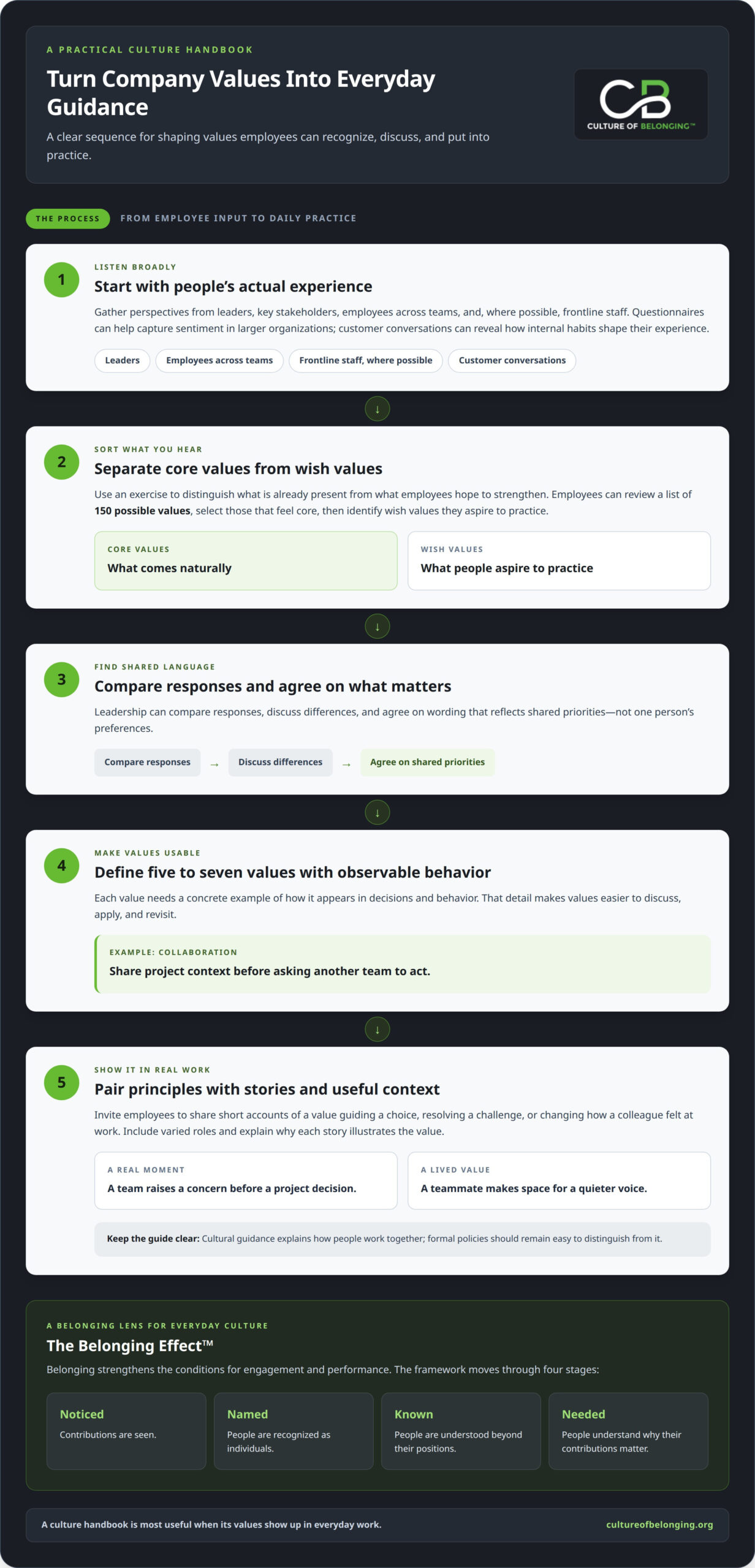
Build a useful picture of culture from more than leadership’s perspective. Gather input from leaders, key stakeholders, employees across teams, and, where possible, frontline staff. Questionnaires can help capture employee sentiment in larger organizations; conversations with customers can reveal how internal habits shape their experience. A workplace belonging perspective can also consider The Belonging Effect™: Noticed means contributions are seen; Named means people are recognized as individuals; Known means they’re understood beyond their positions; Needed means they understand why their contributions matter. Those conditions can strengthen the foundation for engagement and performance. The operational strategy for workplace belonging connects that idea to daily organizational practice.
Invite employees to submit culture stories, not just review polished copy. Ask for a short account of a moment when a value guided a choice, helped resolve a challenge, or changed how a colleague felt at work. A story about a teammate making space for a quieter voice can show what respect means in practice. Include a range of roles and experiences, and explain why each story illustrates the value. Employee participation can strengthen belonging and make the handbook feel lived rather than imposed.
In the United States, what legal and compliance risks should companies consider? A handbook can create confusion if cultural guidance conflicts with formal policies or promises don’t match workplace practice. Have HR and legal reviewers assess policy-related content, employment promises, and descriptions of employee rights before publication.
What are examples of effective culture handbooks from U.S. companies? A field-guide-style culture book can combine teammate quotes, photos, explanations of inside jokes, and honest accounts of working at the organization. Another useful format is a digital guide that pairs a value with a real decision, showing employees how to apply it rather than asking them to memorize slogans.
Optional company background and employee information
Company context helps employees connect daily work with the organization’s purpose. Choose details that clarify how the business developed, what it values, and how people contribute.
Company Story and History
A company story links the organization’s origins, milestones, and present-day culture. A welcome letter can introduce new employees to the people and purpose behind the work, while a short history explains how key decisions shaped current practices. For example, a timeline might connect a founding challenge, a major product change, and a current commitment to customers.
Keep the story specific and useful. Explain why the organization began, what it learned through growth, and which principles still guide its choices. A CEO introduction can describe the company’s direction, while employee stories show how that direction feels in practice. Include milestones that explain change, not every date in the company archive. This helps new starters understand the culture without mistaking history for a list of accomplishments.
Values and Employee Information
Company values name the principles employees should see in decisions and behavior. Agree on five to seven core values that represent the team and the culture it wants to develop. Define each value with an observable example: “collaboration” might mean sharing project context before asking another team to act. That detail makes values easier to discuss, apply, and revisit.
An exercise can help separate values already present from values people hope to strengthen. Employees can review a list of 150 possible values, select those that feel core, then identify wish values they aspire to practice. The distinction matters: core values describe what comes naturally, while wish values describe growth. Leadership can compare responses, discuss differences, and agree on language that reflects shared priorities rather than one person’s preferences.
Optional employee information can include profiles, role descriptions, an organizational structure, and reporting relationships. Describe responsibilities by role rather than attaching every detail to a named individual, since people and teams change. A simple structure can clarify who owns a decision, who provides input, and where employees can find support. Include profiles from varied roles and contributions so the handbook reflects more than senior leadership. This helps employees see how their work fits into the wider organization.
Brand pillars can add another layer of focus. A company may choose three to five pillars describing what it is known for and intends to maintain. Keep these distinct from values: a pillar can describe a customer promise, while a value guides how employees deliver it. Leaders shaping these choices can explore Curtis Ray Hill’s perspective on workplace belonging as they connect company principles with employees’ lived experience.
Sharing values through stories, photos, and customer notes
Mission, vision, and values give employees three different anchors. The mission explains why the organization exists; the vision describes where it aims to go. Values guide how people move toward that future. A handbook is more useful when it connects all three through examples instead of presenting them as separate slogans.
Show the connection with a decision story. For example, a team facing a tight deadline might flag a quality concern rather than ship unfinished work. Explain how that choice reflects a stated value and supports the mission. This gives employees a reference point for similar decisions, including situations without a manager present.
Core values and wish values can tell different parts of the culture story. A value already visible in daily behavior may be a core value; a wish value signals a principle employees want to practice more consistently. Give a specific example of each. If collaboration is an aspiration, describe a behavior that would make it tangible, such as inviting another team into planning earlier.
Build a set of short stories around real moments. Invite employees from different roles to share when a colleague put a value into action, challenged an assumption, or helped a teammate contribute. A useful story names the situation, the choice, and its impact on the people involved. Edit for clarity without smoothing away the details that make the account credible.
Photos and illustrations can show the everyday texture of work. Choose images of team activities, informal gatherings, or shared work moments that reflect employees’ actual experience. Add captions that explain the connection to a value; a photo of colleagues reviewing a project, for instance, can illustrate shared responsibility. Avoid staged images that tell a different story from daily work.
Customer notes can make the organization’s purpose visible from outside. Include a brief customer comment about a helpful interaction or product experience, with context explaining the employee actions behind it. Gather customer perspectives through conversations, and obtain permission before including identifiable names or comments. A note without context may praise an outcome, but it won’t show employees which choices helped create it.
Keep each item focused. A pull quote, short caption, or story summary can make the handbook easier to scan without stripping away meaning. Before including an example, connect it to a named value and a behavior employees can recognize. This simple editorial test helps the handbook represent company culture through evidence, not just intent.
Culture handbook review and updates
A culture handbook should change as the workplace does. Schedule a full review every six months, then invite employees to suggest updates between reviews. This keeps the guidance close to lived experience. A handbook that describes an old team structure or retired communication tool can confuse employees instead of helping them act with confidence.
Give the review a clear owner and scope. HR or a small cross-functional group can coordinate edits, while employees in different roles identify gaps between the handbook and daily practice. For example, if the guide says teams share decisions openly but employees say decisions arrive without context, examine both the wording and the practice behind it.
Check each section against current work. A practical review can ask:
- Does the mission, vision, or values language still reflect organizational priorities?
- Do examples show how employees make decisions and work together now?
- Are team roles, reporting relationships, and support pathways still accurate?
- Do communication tools and onboarding guidance match actual use?
Use employee input to identify what needs revision, not just proofreading. Invite people to flag a page that feels outdated, unclear, or disconnected from their experience. A frontline employee may notice that a support pathway no longer works in practice. A new starter may point out that an onboarding explanation assumes knowledge they didn’t have. Both are valuable signals.
Make updates traceable. Record the section changed, the reason, and the revision date in a simple change log. If a policy or process changes, distinguish that formal update from cultural guidance. For instance, clarify whether a paragraph describes an official procedure or a shared norm for team communication. This reduces confusion when employees use the handbook to make decisions.
Regular updates also need employee participation. Encourage employees to submit new examples, clarify language, and identify practices worth preserving. A story about a team changing how it shares project decisions can show how the culture has evolved. Invite different roles and locations to contribute, so the next edition doesn’t rely only on leadership’s view.
After each six-month review, communicate what changed and why. If employees raised concerns about unclear responsibilities, explain how updated role descriptions address them. If the wording stays the same, say which sections were reviewed and remain useful. This closes the loop: employees can see their input was considered, and the culture handbook stays connected to the organization they experience.
Should a culture handbook include work hours, remote work, and time-off expectations?
Yes, include practical guidance on how people coordinate work, while distinguishing cultural norms from formal policies. For example, describe how a team shares availability, arranges coverage, and communicates during remote work. Keep detailed rules in the appropriate policy documents, and make clear which source employees should follow if guidance differs.
Work hours affect collaboration, so explain the team’s expectations without implying everyone works identically. A handbook might say that employees should share their availability and flag schedule changes that affect a handoff. If a customer-facing team needs coverage during particular periods, explain how employees coordinate it. Avoid vague phrases such as “be flexible” without an example of what flexibility looks like.
Remote-work guidance can clarify how employees stay connected across locations. Describe which channel a team uses for project updates, how people signal they’re unavailable, and how decisions are recorded for colleagues who aren’t in a meeting. For instance, a team could document a decision in its shared workspace after a video call. The aim is clarity and connection, not constant visibility.
Time-off expectations should explain how employees communicate absences and arrange essential handoffs. Keep the cultural message humane: employees can take a sick day without apologizing. For example, someone who is ill should use the established absence process, while teammates coordinate urgent work without expecting them to remain online. Formal leave rules belong in the relevant policy, not an informal culture statement.
Use direct language to distinguish a shared norm from a requirement. “Tell your team when you’ll be unavailable” describes coordination; “submit requests through the designated process” points to a procedure. That distinction helps employees understand whether a sentence describes a cultural expectation, a manager’s practice, or a formal policy. HR can review policy references to avoid conflicting instructions.
Make the guidance work for different roles. A remote employee, a shift-based team member, and a colleague serving customers may have different coordination needs. Describe the common principle, such as giving teammates enough context to plan, then direct readers to relevant team or policy guidance for role-specific details. This supports psychological safety by clarifying expectations and reducing the pressure to guess what others consider acceptable.
Review these sections when team practices change. If a team adopts a new communication channel or changes how it records coverage, update the handbook example. Leaders can also discuss how daily expectations affect employees’ sense of connection and ability to contribute.
Culture of Belonging Global®
Culture Of Belonging Global INC. helps leaders connect workplace culture with the everyday conditions that support belonging, engagement, and performance. When a handbook describes values but employees experience something different, leaders can use that gap as a starting point for examining daily practice. Curtis Ray Hill, founder of Culture Of Belonging Global INC. and a leading authority and keynote speaker on Workplace Belonging, brings a human-centered perspective to that work. His philosophy is clear: belonging is the prerequisite for performance.
Organizations shaping a culture handbook can draw on keynotes, workshops, professional development, or consulting to explore how employees experience expectations, recognition, and support. The right format depends on whether leaders need a shared starting point, deeper discussion, or strategic guidance. To discuss workplace culture and belonging, contact Culture Of Belonging Global INC.
Make the Handbook a Living Commitment
A culture handbook matters most when employees can recognize their real workplace in its pages. Use it to prompt honest conversations: where do people experience the organization’s stated commitments, and where does daily practice tell a different story? That question makes the document a leadership tool, not just a communications project.
As you decide what to include in a culture handbook, keep its purpose in view: help people understand how they belong, contribute, and work together. Words alone can’t create that experience. Leaders shape it through their choices, the voices they hear, and how they respond when employees speak up. Belonging is the prerequisite for performance, and a handbook can make that principle visible in everyday work.
If you’re ready to connect workplace culture with belonging, contact Culture of Belonging Global® to start a conversation. Keep listening, keep aligning words with action, and give employees a culture they can experience, not just read about.
Frequently Asked Questions
Firstly, what is a culture book?
A culture book is an editorially designed way to make an organization’s character easy to explore. Think of it as a field guide: readers can move through short sections, quotes, illustrations, and callouts instead of following a policy manual from beginning to end. For instance, a page might pair a team photo with a brief explanation of a shared phrase and why employees use it.
What is culture in the workplace?
Workplace culture is the pattern people can observe in how an organization operates. Look at what gets recognized, how leaders respond to difficult news, and whose input shapes decisions. An organization might value curiosity, for example, but employees experience that value through whether questions receive thoughtful responses. These repeated interactions, not just written statements, reveal how the culture works in practice.
What is a culture handbook and what purpose does it serve?
A culture handbook gives employees a reference point when expectations feel unclear. A team member deciding whether to raise a concern, for example, can use its guidance to understand how the organization approaches candor and responsibility. Managers can also use the same language in team discussions, helping people explain the reasoning behind choices. The handbook is a shared reference, not a substitute for judgment or formal procedures.
What sections should an employee culture handbook include?
Organize sections around moments when employees need guidance, rather than arranging content only by department. A reader-friendly structure might include a welcome, organizational context, principles for working together, support resources, and links to formal policies. Add a contents page and clear labels so someone can find the right topic quickly. For example, “Getting help” is easier to scan than a broad heading like “Additional information.”
How should a company explain its mission, vision, and core values in a culture handbook?
Give each statement a distinct purpose and keep the language specific. A simple editorial test is whether an employee could explain the mission as the organization’s reason for existing, the vision as its intended direction, and a value as a guide for choices. Replace abstract wording with plain language, then test the draft with employees who weren’t involved in creating it. Their questions can expose unclear phrases.
What workplace behaviors, communication norms, and collaboration expectations should be documented?
Document expectations employees can recognize and use, especially during moments of tension. For example, explain how colleagues should challenge an idea without attacking its author, or how a meeting facilitator makes room for differing views. Define what respectful disagreement sounds like and where it crosses the line. Specific examples help employees interpret the norm consistently while leaving room for teams to adapt it to their work.
What policies on inclusion, accessibility, and respectful conduct should a culture handbook cover?
Summarize relevant organizational standards and point employees to current formal policies and reporting channels. Practical examples might explain how to request accessible meeting materials or raise a concern about disrespectful conduct. Keep the cultural guidance consistent with official policy wording, and identify who can answer process questions. This gives employees a clear next step without reproducing every procedure in the culture handbook.
What should a culture handbook say about feedback, performance, and career development?
Explain what constructive feedback looks like, how employees can discuss performance expectations, and where development conversations fit. For example, encourage managers to connect feedback to observable work and agree on a useful next step. Career guidance can describe how employees raise interests in new responsibilities or learning opportunities. Avoid promising a promotion or a particular outcome; focus on transparent conversations, relevant criteria, and available support.

Article by
Curtis Ray Hill
Curtis Ray Hill, MAT, M.Ed., is a workplace belonging keynote speaker, culture strategist, author, and founder of Culture of Belonging Global®. For more than two decades, his work has centered on one core belief: belonging is the prerequisite for performance.
Curtis has worked with leaders and organizations including Pfizer, State Farm, BP, Southwest Airlines, Hallmark, and Avis Budget Group, bringing a practical, human-centered approach to workplace belonging, employee engagement, employee experience, psychological safety, and organizational culture. His background spans education, leadership, and process improvement, and he holds a Black Belt in Lean Six Sigma.
He is the author of Creating a Culture of Belonging: From Feeling Like to Knowing You Belong, a book focused on moving belonging beyond intention and creating environments where people know they belong.
Curtis is also the creator of The Belonging Effect™, his proprietary framework built around four human experiences: Noticed → Named → Known → Needed. His work equips leaders to translate belonging into everyday leadership behaviors and workplace experiences that create stronger conditions for engagement and performance.
Through his keynotes, consulting, writing, and thought leadership, Curtis is advancing workplace belonging as a business and leadership priority—not simply a culture initiative. His work connects belonging to human-centered leadership, psychological safety, employee experience, retention, engagement, and performance. His goal is to move organizations beyond talking about belonging to creating workplaces where people experience it every day—and where belonging becomes the foundation for how people connect, contribute, and perform.
Disclaimer
The content published on this website by Curtis Ray Hill and Culture of Belonging Global® is provided for general informational and educational purposes only. It is intended to share perspectives, frameworks, strategies, research, and ideas related to workplace belonging, organizational culture, leadership, employee experience, engagement, retention, psychological safety, and related topics.
No Professional Advice. Nothing on this website constitutes or should be relied upon as legal, financial, accounting, employment, human resources, medical, psychological, compliance, or other professional advice. The information provided is not a substitute for advice from qualified professionals familiar with your organization, circumstances, jurisdiction, employees, policies, and applicable laws or regulations.
No Guarantee of Results. Curtis Ray Hill and Culture of Belonging Global® make no representation, warranty, promise, or guarantee that any framework, strategy, recommendation, keynote, training, consulting engagement, or other information discussed on this website will produce any particular result. Organizational outcomes vary based on numerous factors, including leadership, implementation, organizational culture, industry, workforce, resources, timing, and circumstances.
Research, Statistics, and Results. Statistics, research findings, survey data, industry findings, quotations, and third-party information referenced in an article should be considered within the context, methodology, limitations, and publication date of the original source. Any specific client result or organizational outcome referenced is illustrative of that particular experience and should not be interpreted as typical, expected, or guaranteed for another organization.
Independent Decision-Making. Readers and organizations are responsible for evaluating the suitability of any ideas, strategies, frameworks, or recommendations for their own circumstances. Before implementing decisions that may affect employees, employment practices, workplace policies, compliance obligations, finances, or business operations, consult the appropriate qualified legal, HR, financial, compliance, or other professional advisers.
Third-Party References. References to companies, organizations, publications, research institutions, products, services, or other third parties are provided for informational or contextual purposes. Unless expressly stated, such references do not imply endorsement, sponsorship, partnership, validation, or approval by or of Curtis Ray Hill or Culture of Belonging Global®.
Intellectual Property. Culture of Belonging®, The Belonging Effect™, The Invisible Floor Plan™, and other identified proprietary concepts, frameworks, names, and materials associated with Curtis Ray Hill and Culture of Belonging Global® are protected intellectual property where applicable. Nothing published on this website grants permission to reproduce, distribute, modify, teach, sell, license, or commercially exploit proprietary materials without authorization.
Limitation of Responsibility. To the fullest extent permitted by applicable law, Curtis Ray Hill and Culture of Belonging Global® disclaim responsibility for losses, damages, liabilities, or consequences arising from reliance upon or application of information contained on this website. Use of this content and any decisions based upon it are undertaken at the reader's or organization's own discretion and risk.
Information may be updated, revised, or become outdated over time. Readers should verify information that is material to an organizational, employment, legal, financial, or compliance decision and consult qualified professionals when appropriate.


