

Authority without trust isn’t empowerment. Learning how to empower employees to make decisions starts with clear goals, room to act, and coaching and feedback that help people use their judgment. Delegating a task is only the beginning; employees also need to know their voice matters and their contribution is needed.
Leaders already know that decisions can’t stay at the top if teams are expected to take ownership. But autonomy without support can leave employees unsure, while close control can make initiative feel risky. Belonging is the prerequisite for performance: open conversations help people feel seen, understood, and confident enough to contribute.
This article explores practical ways to build that confidence through coaching, constructive feedback, and meaningful decision-making authority. You’ll also see how empowerment works at the individual, team, and organizational levels, and how leaders can set clear expectations without taking every decision back. The aim is a workplace where people can speak openly, learn from mistakes, and make informed choices within their responsibilities.
Key Takeaways
- Empowerment goes beyond handing off tasks: match responsibilities to employees’ strengths, interests, and capacity, then give them room to shape the work.
- Build decision-making confidence through coaching, stretch opportunities, and time to develop relevant skills.
- Make feedback a two-way conversation that recognizes strengths and turns mistakes into useful learning.
- Set clear goals and boundaries, then let employees closest to the work use their judgment to solve problems.
- Strengthen empowerment at the individual, team, and organizational levels by connecting people’s contributions to why their work matters.
1. What is employee empowerment?
Employee empowerment gives people the authority, information, and skills to make decisions within their responsibilities. Delegation assigns work; empowerment also clarifies which choices employees can make and trusts them to act. For example, assigning a team member to prepare a client presentation is delegation. Letting that person choose its structure, coordinate input, and resolve routine questions gives them more ownership.
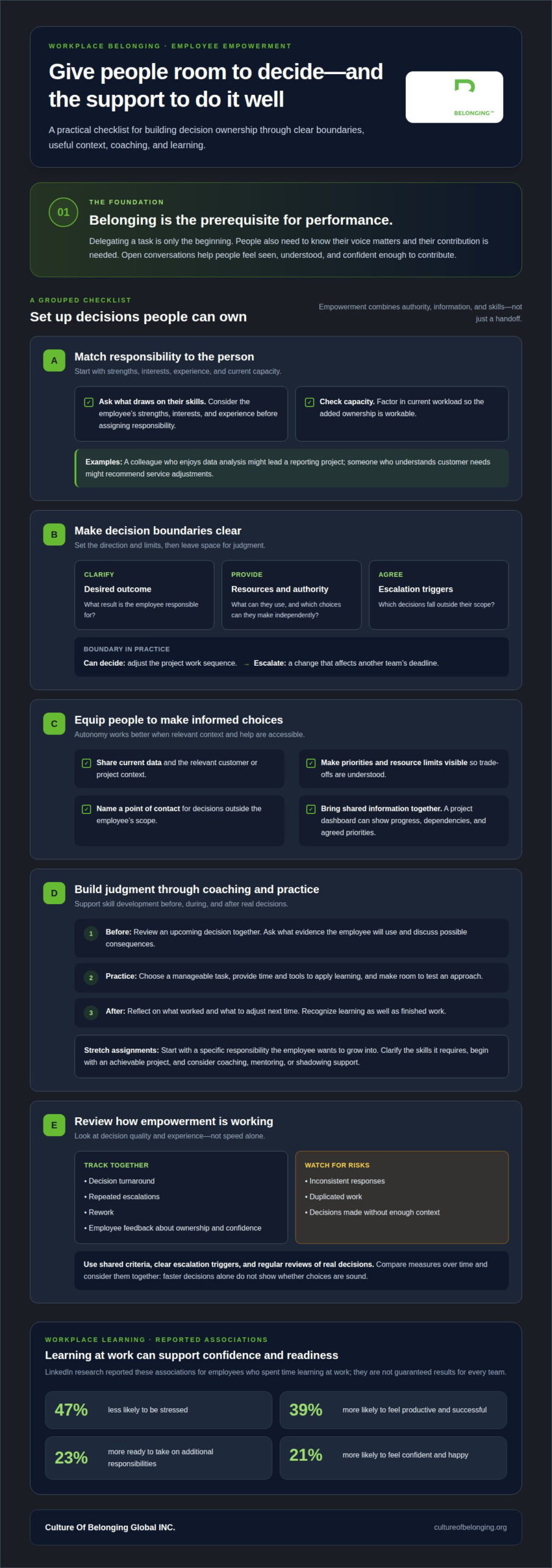
Start with strengths, not assumptions. Ask employees which tasks draw on their skills, interests, and experience, then consider their current workload before assigning responsibility. A colleague who enjoys analyzing data might lead a reporting project, while someone who understands customer needs might recommend service adjustments. Matching responsibilities to people’s strengths helps build an empowered team without treating employees as interchangeable.
Clear decision boundaries make autonomy practical. State the desired outcome, available resources, and decisions an employee can make independently. For example, a project owner might adjust the work sequence but escalate a change that affects another team’s deadline. Clear boundaries support accountability while leaving room for judgment. They also help create a culture where initiative is expected, not mistaken for overstepping.
Employees need practical tools and information to make informed decisions: current data, the goal, relevant customer or project context, resource limits, and clear authority. Give them a named point of contact for decisions outside their scope. A shared project dashboard, for example, can bring progress, dependencies, and agreed priorities together in one place.
Track decision turnaround, repeated escalations, rework, and employee feedback about ownership and confidence to understand how empowerment is working. Compare these measures over time and consider them together; faster decisions alone don’t show whether choices are sound. Decentralized decisions can lead to inconsistent responses, duplicated work, or choices made without enough context. Address these risks with shared criteria, clear escalation triggers, and regular reviews of real decisions.
Esquel Group, a global textile manufacturer with 35,000 employees, accelerated its transition to continuous feedback in only three months. That provides an example of an organizational practice supporting open communication, but it doesn’t establish that the company’s decisions were decentralized or prove a particular outcome. The distinction matters: leaders should describe what a company demonstrably does, rather than treat feedback as proof of decision-making authority.
2. Coaching, development, and growth opportunities
Decision authority works best when employees have the skills and confidence to use it. Coaching builds capability in the flow of work. A manager can review an upcoming decision with an employee, ask what evidence they’ll use, and discuss possible consequences before they act. Afterward, they can reflect together on what worked and what to adjust next time.
Begin development with a specific responsibility the employee wants to grow into. If a coordinator hopes to lead a project, for example, offer a smaller project first, clarify the skills it requires, and schedule coaching around key milestones. A stretch assignment should challenge without setting someone up to fail. Pairing it with a mentor or an opportunity to shadow an experienced colleague can make unfamiliar decisions easier to navigate.
Learning also needs room in the workday. A course alone won’t build judgment if employees have no chance to apply what they learned. Give people time to practice, access to relevant tools, and permission to test a new approach on a manageable task. A team learning a new software process, for instance, can pilot it on one workflow, share lessons, and refine its guidance before wider use.
Development should account for strengths without limiting people to what they already know. Gallup reports that employees who use their strengths daily are 8 percent more productive and 15 percent less likely to quit. Managers can ask which parts of the work feel energizing, then create chances to deepen those skills while exploring new ones. This supports engaged employees and gives innovation room to emerge.
Workplace learning can also support confidence and readiness for greater responsibility. LinkedIn research found that employees who spent time learning at work were 47 percent less likely to be stressed, 39 percent more likely to feel productive and successful, 23 percent more ready to take on additional responsibilities, and 21 percent more likely to feel confident and happy. These findings describe reported associations, not guaranteed results for every team.
Make coaching practical: agree on a skill, choose an upcoming task where it can be practiced, and set a time to review the experience. Recognize learning as well as finished work. For leaders shaping a development approach around belonging and human-centered leadership, Curtis Ray Hill’s keynote on Workplace Belonging can help frame why employees need to feel seen and valued as they grow.
3. Constructive feedback and open conversations
Useful feedback clarifies a decision without diminishing the employee’s role. Describe the specific action, explain its effect, then agree on a next step. For example, after a project lead changes a delivery sequence, a manager can identify what helped, point out a missed dependency, and discuss how to spot it next time. This keeps the conversation focused on progress and judgment, not personal criticism.
Strengths-focused feedback gives employees a fuller picture of their contribution. In a Gallup survey, 67 percent of employees whose managers focused on strengths were fully engaged at work. The survey also found 31 percent of workers receiving feedback centered on weaknesses were fully engaged. Use these findings as a prompt to balance candid guidance with specific recognition, not as a prediction for an individual employee.
Leaders build trust and psychological safety by responding to questions, concerns, and mistakes without humiliation or retaliation. During a decision review, thank the employee for raising a risk, ask what information shaped the choice, and work through the next step together. Employees are more able to speak openly when honest input receives a thoughtful response.
Feedback must move in both directions. During a one-on-one, ask an employee what is slowing a decision, what guidance would help, and which process creates unnecessary friction. Then name an action, an owner, and a point to revisit it. If an employee flags a missing approval that delays customer responses, leadership can clarify who owns that approval and share the change with affected teams.
Open communication also means acting visibly on employee input. If a team recommends changing a handoff between departments, test the suggestion in a relevant workflow, gather examples, and explain what happens next. When leadership can’t adopt an idea, explain the constraint and invite another option. Silence after feedback suggests that employee input has no purpose.
Make mistakes teachable without erasing accountability. Ask what the employee expected, what happened, and what signal could guide a different decision next time. A manager might use a missed project dependency to improve a checklist, then invite the employee to help revise it. Mentorship can extend the learning by pairing someone with a colleague who has handled similar trade-offs.
Recognition strengthens the conversation when it’s personal, specific, and timely. Connect an employee’s choice to the people it helped, such as how a careful handoff gave a teammate the context needed to serve a customer. Linking individual contributions to shared purpose supports belonging, while clear feedback helps employees keep learning and making informed decisions.
4. Employee autonomy and decision-making authority
Autonomy means employees can choose how to reach an agreed goal within their decision authority. It isn’t unlimited freedom or a vague instruction to “take initiative.” A customer support team, for example, might be authorized to resolve routine delivery problems using shared service principles, while escalating exceptions that affect another department. Clear authority helps employees act without waiting for approval at every step.
Start collaboratively. A leader names the outcome, then asks the people closest to the work what approach makes sense. For a product launch, the team might agree on the goal, identify dependencies, and decide how to divide testing and customer communication. The leader remains accountable for organizational priorities, while employees bring practical knowledge about execution. Employees feel trusted when their input shapes the plan, rather than simply filling a meeting.
Define autonomy by decision category, not with a blanket instruction. Teams can clarify which choices employees make independently, which require consultation, and which need leadership approval. For instance, a staff member might adjust a customer response within approved guidance, consult a colleague before changing a shared process, and escalate a commitment that affects another team’s resources. These boundaries make initiative safer and reduce conflicting decisions.
Decision-making authority should sit near the work when employees have the context and capability to act. A frontline employee often sees a recurring customer problem before it reaches senior leadership. Give that person a way to suggest a fix, test a low-risk change, and share what the team discovers. Leaders still set direction, but they don’t need to control every operational choice. This can give senior leaders more room for strategy.
Autonomy also requires alignment across teams. If the sales team changes a client handoff, the service team needs a voice because the change affects its work. Use a brief decision conversation to name the goal, identify affected groups, agree on who decides, and communicate the choice to everyone involved. This keeps collaboration from becoming either a leadership bottleneck or a process without clear ownership.
When an employee makes a poor call, examine the conditions before removing authority. Ask whether expectations, information, or cross-team dependencies were unclear. A project manager who misses an important dependency may need a better coordination process, not an immediate loss of decision rights. Leaders can review the impact, correct the issue, and retain appropriate autonomy. This supports motivation and psychological safety while keeping accountability real.
Make autonomy visible in daily work: identify the decision owner, state the intended outcome, and clarify when others must be involved. When leaders consistently match authority to responsibility, employees can act with purpose and teams can move without waiting for permission at every turn.
5. Individual, team, and organizational empowerment
Empowerment works at three connected levels. Individuals need authority to make decisions within their roles. Teams need shared responsibility for decisions affecting their work. Organizations need systems that let those decisions inform broader priorities. For example, a support employee can resolve a customer issue, the team can identify recurring causes, and leaders can address a process that spans departments.
At the individual level, connect decision authority to skills, context, and career growth. A new team member might first recommend options for a routine decision, then own that choice as they gain experience. Managers can review the reasoning and outcomes without reclaiming every decision. This gives people a practical path from contributing ideas to taking responsibility.
Team empowerment depends on clear shared ownership. For a cross-functional project, name the outcome, identify who makes each decision, and agree how team members will resolve competing priorities. A sales representative may understand a client’s needs, while an operations colleague sees delivery constraints. Bringing those perspectives together helps the team make a more informed choice and understand how its work affects others.
At the organizational level, belonging strengthens the conditions for engagement and performance. The Belonging Effect™ offers a framework for considering those conditions: Noticed, where contributions are seen; Named, where people are recognized as individuals; Known, where they’re understood beyond their position; and Needed, where they understand why their contribution matters. Leaders can apply this sequence in project reviews by recognizing work, learning about contributors, understanding their context, and connecting effort to purpose.
Systems must support the behaviors leaders ask for. If a company invites initiative but routes every small decision through senior approval, employees experience a gap between stated culture and daily work. Review one recurring workflow: identify where decisions stall, who has useful knowledge, and which approval provides necessary accountability. Then adjust authority and communicate the change to affected teams.
To assess progress, look at examples from each level: whether individuals can explain their authority, whether teams coordinate decisions, and whether organizational processes respond to frontline insight. Pair these observations with employee conversations about recognition, voice, and contribution. For a broader approach to putting belonging into workplace systems, explore workplace belonging initiatives.
Culture Of Belonging Global INC.
Culture Of Belonging Global INC. helps leaders connect employee decision-making with the conditions people need to contribute, including trust, recognition, and a clear sense of purpose. When employees have responsibility but lack confidence or shared understanding, the company’s professional development, workshops, consulting, and keynotes help leaders explore how workplace culture shapes everyday decisions.
Founded by Curtis Ray Hill, a leading authority and keynote speaker on Workplace Belonging, the organization centers a practical principle: belonging is the prerequisite for performance. Leaders can use this perspective to consider whether employees are noticed, understood, and able to see why their work matters. That reflection can inform conversations about decision boundaries, team ownership, and leadership behavior.
If your organization is ready to explore how belonging can support employee decision-making, book a conversation with Curtis at Culture Of Belonging Global INC.
Make the Next Decision Easier to Own
The next step in learning how to empower employees to make decisions is to make decision rights visible in everyday work. Choose one recurring decision that stalls, name its owner, and clarify the authority they hold. Then observe whether employees use that authority and what barriers remain.
Use what you learn to improve the conditions around the decision. Missing information may call for better access; unclear ownership may call for a direct conversation. Treat each adjustment as a chance to build a workplace where employees can contribute with confidence and understand why their judgment matters.
For leaders ready to strengthen belonging as part of that work, contact Culture Of Belonging Global INC. to start a conversation about your organization’s needs.
One clearer decision can open the door to stronger conversations and shared ownership. Keep moving forward, one intentional choice at a time.
Frequently Asked Questions
How can you do this?
To learn how to empower employees to make decisions, start with one recurring, low-risk choice that currently waits for approval. Map who handles it, what information they use, and where delays occur. Assign a decision owner and record the reasoning behind their choices. Review a few real examples with the team, then refine the process before extending authority to other decisions.
What is employee empowerment?
Employee empowerment is a work environment where people can contribute their judgment, not just complete instructions. It includes having a meaningful voice in choices that affect their work and being accountable for the decisions they own. For example, an employee may propose a change to a team handoff and help assess its effects, rather than simply follow a process they had no chance to shape.
What does employee decision-making empowerment mean?
Employee decision-making empowerment means employees have a recognized role in deciding what happens, rather than only being asked for opinions. A manager might gather suggestions about a meeting format, then retain the final choice; that is input, not shared authority. If the team agrees on the format and can adjust it to meet its needs, employees have a clearer decision-making role.
What are practical steps to empower employees to make decisions?
Choose a decision that affects a team’s daily work, such as how it organizes shift handoffs. Invite the people doing the work to identify what gets lost, suggest a change, and agree on how to assess it. Give the team room to try its approach, then discuss what it learned. Make the next decision based on those observations, not habit alone.
How can managers define decision-making authority and boundaries?
Managers can use a short decision charter to name the decision owner, intended outcome, people to consult, and conditions that require escalation. For a scheduling change, the charter might let a team lead rearrange coverage but require discussion when another team’s commitments are affected. Revisit the boundaries when responsibilities or risks change, so authority stays clear as the work evolves.
How can companies train employees to make better decisions?
Use realistic practice, not just presentations. A manager can bring a fictional customer complaint or project delay to a team meeting and ask employees to identify relevant facts, compare options, and explain their reasoning. Peers can discuss trade-offs before the manager shares additional context. A decision log can help employees revisit the choice and learn from its consequences.
Which decisions should employees make versus managers?
Employees are well placed to decide matters within their role and based on their direct knowledge, such as the order of routine tasks. Managers should handle choices with broader organizational consequences, competing priorities, or commitments across teams. For a shared deadline, the team can recommend a workable schedule, while the manager resolves conflicts involving other departments’ priorities and resources.

Article by
Curtis Ray Hill
Curtis Ray Hill, MAT, M.Ed., is a workplace belonging keynote speaker, culture strategist, author, and founder of Culture of Belonging Global®. For more than two decades, his work has centered on one core belief: belonging is the prerequisite for performance.
Curtis has worked with leaders and organizations including Pfizer, State Farm, BP, Southwest Airlines, Hallmark, and Avis Budget Group, bringing a practical, human-centered approach to workplace belonging, employee engagement, employee experience, psychological safety, and organizational culture. His background spans education, leadership, and process improvement, and he holds a Black Belt in Lean Six Sigma.
He is the author of Creating a Culture of Belonging: From Feeling Like to Knowing You Belong, a book focused on moving belonging beyond intention and creating environments where people know they belong.
Curtis is also the creator of The Belonging Effect™, his proprietary framework built around four human experiences: Noticed → Named → Known → Needed. His work equips leaders to translate belonging into everyday leadership behaviors and workplace experiences that create stronger conditions for engagement and performance.
Through his keynotes, consulting, writing, and thought leadership, Curtis is advancing workplace belonging as a business and leadership priority—not simply a culture initiative. His work connects belonging to human-centered leadership, psychological safety, employee experience, retention, engagement, and performance. His goal is to move organizations beyond talking about belonging to creating workplaces where people experience it every day—and where belonging becomes the foundation for how people connect, contribute, and perform.
Disclaimer
The content published on this website by Curtis Ray Hill and Culture of Belonging Global® is provided for general informational and educational purposes only. It is intended to share perspectives, frameworks, strategies, research, and ideas related to workplace belonging, organizational culture, leadership, employee experience, engagement, retention, psychological safety, and related topics.
No Professional Advice. Nothing on this website constitutes or should be relied upon as legal, financial, accounting, employment, human resources, medical, psychological, compliance, or other professional advice. The information provided is not a substitute for advice from qualified professionals familiar with your organization, circumstances, jurisdiction, employees, policies, and applicable laws or regulations.
No Guarantee of Results. Curtis Ray Hill and Culture of Belonging Global® make no representation, warranty, promise, or guarantee that any framework, strategy, recommendation, keynote, training, consulting engagement, or other information discussed on this website will produce any particular result. Organizational outcomes vary based on numerous factors, including leadership, implementation, organizational culture, industry, workforce, resources, timing, and circumstances.
Research, Statistics, and Results. Statistics, research findings, survey data, industry findings, quotations, and third-party information referenced in an article should be considered within the context, methodology, limitations, and publication date of the original source. Any specific client result or organizational outcome referenced is illustrative of that particular experience and should not be interpreted as typical, expected, or guaranteed for another organization.
Independent Decision-Making. Readers and organizations are responsible for evaluating the suitability of any ideas, strategies, frameworks, or recommendations for their own circumstances. Before implementing decisions that may affect employees, employment practices, workplace policies, compliance obligations, finances, or business operations, consult the appropriate qualified legal, HR, financial, compliance, or other professional advisers.
Third-Party References. References to companies, organizations, publications, research institutions, products, services, or other third parties are provided for informational or contextual purposes. Unless expressly stated, such references do not imply endorsement, sponsorship, partnership, validation, or approval by or of Curtis Ray Hill or Culture of Belonging Global®.
Intellectual Property. Culture of Belonging®, The Belonging Effect™, The Invisible Floor Plan™, and other identified proprietary concepts, frameworks, names, and materials associated with Curtis Ray Hill and Culture of Belonging Global® are protected intellectual property where applicable. Nothing published on this website grants permission to reproduce, distribute, modify, teach, sell, license, or commercially exploit proprietary materials without authorization.
Limitation of Responsibility. To the fullest extent permitted by applicable law, Curtis Ray Hill and Culture of Belonging Global® disclaim responsibility for losses, damages, liabilities, or consequences arising from reliance upon or application of information contained on this website. Use of this content and any decisions based upon it are undertaken at the reader's or organization's own discretion and risk.
Information may be updated, revised, or become outdated over time. Readers should verify information that is material to an organizational, employment, legal, financial, or compliance decision and consult qualified professionals when appropriate.


