A leadership workshop for senior executives can run from a focused half-day to a multi-day retreat: a half-day intensive typically lasts 3-4 hours, a full-day workshop 6-8 hours, and an offsite retreat 2-3 days. The right duration depends on the challenge leaders need to address and how much time they need to practise, reflect, and turn ideas into action. More hours alone won’t make a workshop more effective.
Senior leaders need more than a packed agenda. They need space to examine how they make decisions, build trust, and shape the conditions their teams work in. Belonging helps create the conditions for performance, so a useful workshop connects leadership behavior with the everyday experience of being noticed, respected, and able to contribute.
This article explains what executive workshops can achieve, how to choose a format, and which interactive activities make the time count. Simulations, case studies, and guided discussion can bring real leadership challenges into the room and help participants carry their learning back to work.
Key Takeaways
- Match the workshop length to its purpose: focused sessions, full-day learning, and retreats allow different levels of practice and reflection.
- Set clear leadership development objectives that connect to organizational priorities, then choose activities that let executives practise relevant skills.
- Build in self-assessment, peer feedback, and follow-up so learning can move from the room into everyday leadership.
- Use simulations, case studies, and guided exercises to make collaboration, trust, and decision-making tangible.
- Connect leadership behavior to employees’ lived experience: belonging helps create conditions for engagement and performance.
What are the benefits of leadership development?
Leadership development helps senior managers connect everyday decisions with organizational priorities and the experience of their teams. For example, an executive who practices listening can surface concerns that routine performance reviews may miss. That matters because people may be more willing to contribute when they feel their contributions are seen and valued. Development should strengthen practical skills, not simply add concepts to an already full calendar.
Start by setting a specific, measurable, achievable, relevant, and time-bound objective. Instead of “become a better communicator,” define an observable behavior, such as “use structured questions in project reviews and assess progress through feedback within three months.” Connect that objective to a business goal, such as clearer handoffs between departments. Measure behavior or experience rather than promising a business result the workshop cannot guarantee.
Personal goals give executives a reason to engage with that organizational objective. A leader might want to handle disagreement without shutting down discussion, while the organization needs faster, clearer decisions across teams. Coaching can connect the two through reflection, practice, and follow-up. Transformational leadership training begins by identifying core values and developing a vision, according to the National Institute of Standards and Technology (NIST). Those steps help leaders consider how their values shape the culture employees actually experience.
In-person, virtual, and customized workshops support participation in different ways. In-person sessions make live discussion and group dynamics easier to read. Virtual sessions can bring leaders together across locations, but require deliberate turn-taking. Customized workshops draw on participants’ actual leadership challenges, making practice more relevant to their work.
Topics often include communication, decision-making, emotional intelligence, strategic thinking, conflict resolution, and team trust. Choose based on the objective: a group struggling with cross-functional decisions might practise clarifying assumptions, while executives managing change could work through a scenario with competing priorities. These examples turn broad themes into skills participants can rehearse and discuss.
Leadership workshop costs in the United States depend on factors such as session length, format, customization, facilitator preparation, and participant needs. These factors shape the workshop’s scope and design, so there is no single standard fee.
A facilitator should be able to guide senior-level discussion, connect activities to organizational challenges, and offer specific, respectful feedback. Relevant experience includes helping leaders work through complex decisions and making room for disagreement without losing focus. Consider how an exercise will translate into workplace practice: a discussion about trust, for example, should lead to observable leadership behaviors participants can apply with their teams.
For a leadership workshop for senior executives, the strongest development plan links three things: a measurable organizational objective, a personal leadership goal, and a way to practise the skill. Coaching can reinforce that link through reflection and feedback after the session. When leaders examine how their choices affect whether colleagues’ contributions are seen (Noticed), they are recognized as individuals (Named), understood beyond their positions (Known), and understand why their contributions matter (Needed), development moves beyond individual technique and toward a more human-centered workplace.
How long should a leadership workshop be?
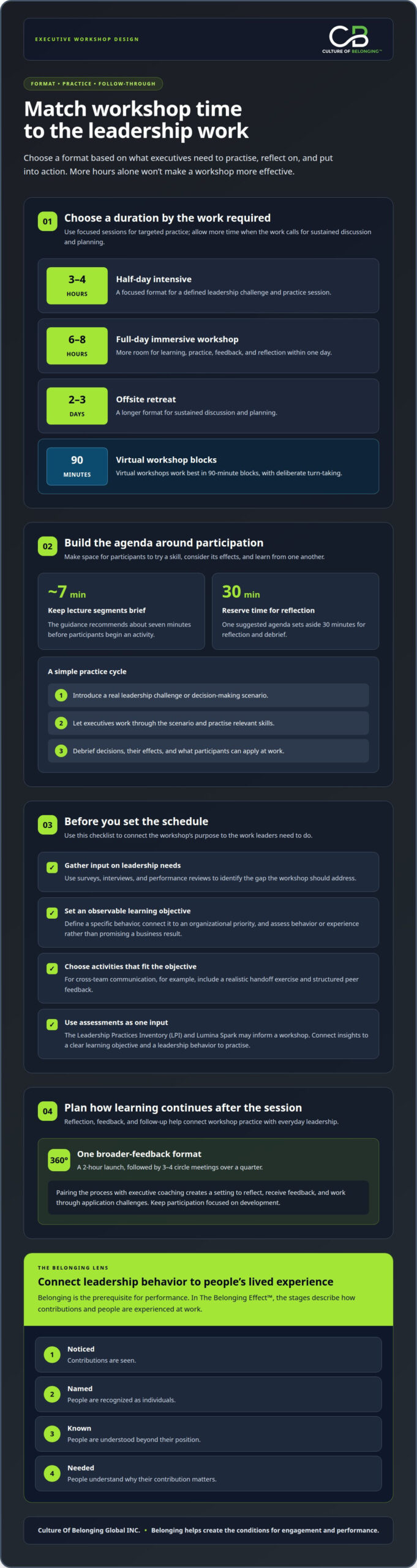
A half-day intensive typically lasts 3-4 hours, a full-day immersive workshop 6-8 hours, and an offsite retreat 2-3 days. Virtual leadership workshops work best in 90-minute blocks. Choose the format by the work participants need to do: a focused practice session needs less time than a retreat designed for sustained discussion and planning.
Use the time for practice, feedback, and reflection, not uninterrupted presentations. One suggested agenda reserves 30 minutes for reflection and debrief. Keep lecture segments brief: the guidance recommends about seven minutes before participants begin an activity. For example, introduce a decision-making scenario, let executives work through it, then debrief the choices and their effects.
Before setting the schedule, assess leadership training needs. Gather input through surveys, interviews, and performance reviews, then identify the gap those sources reveal. If executives need stronger cross-team communication, include a realistic handoff exercise and structured peer feedback. A self-assessment can help participants compare their intentions with how they describe their behavior, providing a starting point for discussion.
The Leadership Practices Inventory (LPI) and Lumina Spark assessments may also be included in workshop designs. Treat either as one input, not a substitute for a clear learning objective. First determine what the assessment should inform. Then plan how participants will discuss relevant insights and connect them to a leadership behavior they can practise. Without that connection, assessment results can remain separate from the workshop’s work.
For broader feedback, a 360-degree process can extend beyond a single session. One format begins with a 2-hour launch and continues with 3-4 circle meetings over a quarter. Pairing that process with executive coaching gives participants a setting to reflect, receive feedback, and work through application challenges. Keep participation focused on development, with clear expectations about how feedback will be used.
Choose a workshop by matching its objective, format, and assessment approach to the leadership challenge. Make sure the schedule leaves time to practise and receive feedback instead of trying to cover too many topics. An assessment or short session alone cannot resolve broader organizational barriers; a communication exercise, for example, will not clarify decision-making authority.
When the design needs to connect leadership behavior with employees’ experience of belonging, a keynote on belonging and human-centered leadership can help frame that conversation for executives.
What about leadership training programs?
A leadership training program extends learning beyond a single workshop. A multi-session series can run for 4-8 sessions over 8-12 weeks, giving executives time to practise between meetings. For example, a session on delegation can lead into a real assignment, followed by discussion of what worked. The sequence turns leadership skills into repeated behaviors, not isolated concepts. It also gives participants and facilitators room to adjust the program as workplace needs become clearer.
Practice needs a specific feedback loop. After a role-play about a difficult conversation, participants can identify what they said, how they listened, and what response followed. A peer can offer feedback on one observable behavior, such as asking a clarifying question before proposing a solution. The participant then chooses a related task at work. Applying a practiced skill within 72 hours after the session gives learning an immediate point of connection to daily leadership.
Program check-ins help keep that application active. A supervisor and participant can discuss progress during a one-to-one, using a concrete example from a recent team meeting. Facilitators can gather program feedback, invite reflection, and revise later sessions when exercises miss the mark. If leaders find that a scenario doesn’t reflect their actual decision process, the next session can use a more relevant case. Iteration should respond to participant experience and the program’s stated objectives.
Leadership storytelling makes these conversations specific. A leader can describe a moment when a decision left out a team member’s perspective, then discuss what they would change now. Peers can respond to the behavior and its impact rather than judging the person. This approach can reveal gaps between stated values and employees’ daily experience. For example, a team may value openness but routinely interrupt dissenting views.
360-degree feedback adds perspectives beyond a participant’s self-assessment. Feedback from colleagues, direct reports, and supervisors can help an executive notice patterns across different working relationships. Use it to guide reflection and coaching, not as a score without context. A coach can help the participant select one behavior to practise, then revisit examples in later check-ins. Clear confidentiality and discussion expectations help keep feedback focused on development.
Belonging can also provide a practical lens for program discussions: do people feel their contributions are seen, their perspectives understood, and their work meaningful? Curtis Ray Hill’s workplace belonging initiatives connect leaders’ everyday choices with the culture employees experience. This lens makes leadership development more than individual skill-building. It gives executives a way to discuss how their decisions shape the conditions for engagement, psychological safety, and contribution.
Collaboration, engagement, and inclusive environments
Executive collaboration takes more than shared goals. Leaders need to surface different views, clarify assumptions, and make decisions amid competing priorities. In a workshop, a team can practise by solving a case with limited information, then reviewing whose perspective shaped the outcome. The learning comes from examining group dynamics, not simply reaching an answer. Reflection helps executives notice how their behavior affects participation and trust.
Structure each exercise so everyone has a way to contribute. For example, ask each person to share one concern before the group chooses a course of action. Active listening means attending to team members’ feedback, concerns, and ideas, then reflecting back what was heard. This gives quieter voices a route into the discussion and helps leaders distinguish genuine agreement from a decision made too quickly.
A team charter workshop can take 2-3 hours for one intact team. Participants can define shared expectations, decision roles, communication norms, and ways to address disagreement. These agreements give collaboration a practical reference point after the session. When assumptions differ, leaders can return to the charter rather than treating friction as a personal failure. Clear expectations also help teams interrupt the blame and shame spiral when plans go wrong.
Problem-solving games can make those patterns visible. The Marshmallow Challenge is an 18-minute team exercise that gives participants a shared task and a short deadline. Afterward, discuss who proposed ideas, who tested them, and how the group responded when its first approach faltered. The exercise is a prompt for reflection, not proof of how a leader will perform in every workplace situation. A debrief connects the game’s dynamics to real decisions.
Influencing across teams means understanding what matters to colleagues, not simply pressing harder for agreement. A useful simulation gives each group a different stake in a shared decision. Participants practise asking questions, naming trade-offs, and explaining how a proposal addresses another team’s concerns. The facilitator can invite feedback on clarity and listening. Influence becomes a two-way process: communicate a position, understand the response, and adjust when the evidence supports it.
Belonging helps create conditions for engagement by showing people that their contributions matter. Leaders can examine whether meeting routines, informal networks, or decision processes make it easier for some voices to participate than others. The article recommends Team Canvas alignment sessions every two to three months as an opportunity to revisit expectations and collaboration. The key is to carry workshop learning into observable habits: invite input, clarify decisions, and recognize contributions across the team.
Interactive executive workshop activities
Interactive activities turn strategic leadership ideas into choices participants can examine and practise. Choose an exercise based on the behavior it should reveal, then debrief what happened and connect it to work. A decision simulation, for example, can show whether executives clarify assumptions, invite dissent, and explain trade-offs before acting. The activity matters less than the learning drawn from it.
The 1-2-4-All activity offers a simple structure for balanced participation. Participants first reflect alone, then discuss in pairs, small groups, and together. This progression gives each person time to form an idea before the largest discussion begins. Use it to explore a question such as, “What makes it difficult to raise a concern in our meetings?” Compare themes, then identify a leadership behavior to test.
For a fast look at decision-making under pressure, a crisis simulation can involve 8-24 participants in teams of 4-6 and take 90 minutes. Give teams a realistic scenario with incomplete information and competing priorities. During the debrief, ask what information they sought, who influenced the decision, and whose concerns went unheard. That review turns a high-pressure exercise into insight about actual leadership dynamics.
Pair work can make difficult conversations more concrete. A radical candor and difficult conversations workshop takes 2 hours and is designed for 6-20 participants working in pairs. One person practises delivering a clear message; the other responds as a colleague might. Switch roles, then discuss how candor and respect shaped the exchange. The purpose is not to script every conversation, but to practise choices before a consequential moment.
Activities can also focus directly on belonging. The Heard, Seen, Respected activity takes 35 minutes, while What I Need From You takes 55-70 minutes. Use these exercises to help leaders discuss what recognition, listening, and clear requests look like in their teams. The Belonging Effect™ offers a related framework: Noticed, contributions are seen; Named, individuals are recognized; Known, people are understood beyond their positions; Needed, they understand why their contribution matters.
Choose activities that fit the issue, the group, and the time available. A psychological safety assessment and action-planning workshop takes 90 minutes; it can help participants surface concerns and decide on practical next steps. Close any exercise with three questions: What happened? What did it reveal about our habits? What behavior will we try at work? Curtis Ray Hill’s keynote on belonging and human-centered leadership can help executives frame this work. Explore a keynote that connects leadership activity design with workplace belonging.
Culture of Belonging Global®: Workshops
Culture Of Belonging Global INC. offers workshops that help executives connect leadership practices with employees’ lived experiences. This work can help leadership teams examine how trust, communication, and belonging show up in daily decisions, not just in stated values.
Led by Curtis Ray Hill, founder of Culture Of Belonging Global INC. and a leading authority and keynote speaker on Workplace Belonging, the approach centers on a clear principle: belonging is the prerequisite for performance. A workshop can help leaders consider how colleagues are noticed, named, known, and needed, then discuss behaviors that bring those experiences into the workplace. This brings strategy back to human interactions: who is heard, whose contribution is recognized, and how people understand their impact.
If your executive team is ready to explore that work, contact Culture Of Belonging Global INC.
Make the Next Leadership Conversation Count
Start by deciding what executives should do differently after the session. Choose one workplace challenge, identify the leadership behavior that could address it, and make room to practise that behavior with colleagues. Then continue the conversation in regular meetings, where leaders can notice whether their choices make it easier for people to contribute and feel they belong.
A leadership workshop for senior executives is most relevant when its design reflects the culture leaders shape every day. Curtis Ray Hill connects Workplace Belonging with human-centered leadership through keynotes, workshops, and professional development. The work starts with a practical question: what should people experience differently because of how leaders act?
Bring that question to your next leadership conversation. Contact Culture of Belonging Global®. to discuss a possible next step. Stronger leadership begins with choices people can see, feel, and build on together.
Frequently Asked Questions
How Does It Work?
An executive workshop turns a defined leadership challenge into guided practice and a workplace commitment. Before the session, organizers frame a decision or relationship issue, such as unclear ownership between two functions. During the session, executives examine the scenario, test responses, and compare assumptions. The facilitator then records commitments and assigns an owner to each next step, connecting discussion to leadership routines.
What are some key leadership skills to focus on in 2025?
Useful leadership skills include adaptability, emotional intelligence, strategic thinking, communication, and technological literacy. Executives can practise adaptability by revising a plan when new information changes priorities. Emotional intelligence is reflected in how leaders manage their reactions during disagreement. To assess practice, examine a recent decision: did leaders explain their reasoning, invite concerns, and adjust when colleagues raised relevant information?
What are the benefits and expected outcomes of an executive leadership workshop?
An executive workshop can strengthen self-awareness, improve how leaders communicate decisions, and give teams shared language for working through challenges. A useful outcome is a specific behavior leaders can apply, such as explaining how a decision affects another department. Workshops can also help leaders notice whether colleagues feel their contributions matter, supporting conditions for engagement and performance without promising a particular business result.
How long do senior executive leadership workshops typically last?
Formats range from a 3-4-hour half-day intensive to a 6-8-hour full-day workshop; an offsite retreat may last 2-3 days. Virtual sessions work best in 90-minute blocks. Choose based on the work involved: a focused discussion may fit a shorter session, while a complex planning challenge may need more time for deliberation, practice, and reflection.
What are the best leadership development programs for senior executives in the US?
The best fit is a program tied to a real leadership need, with learning executives can use in their roles. Culture of Belonging Global® offers workshops and professional development focused on organizational culture and belonging. A team facing inconsistent communication, for example, can use structured learning to examine how leadership decisions shape employees’ everyday experiences and identify practical behaviors that strengthen connection.
What preparation and follow-up steps improve executive workshop results?
Before the session, provide a concise brief describing the business challenge, the decisions executives need to make, and relevant team context. Ask participants to bring a real example rather than a hypothetical problem. Afterward, document commitments clearly, identify who owns each action, and schedule a review during an existing leadership meeting. Concrete examples at follow-up help distinguish changed behavior from good intentions.

Article by
Curtis Ray Hill
Curtis Ray Hill, MAT, M.Ed., is a workplace belonging keynote speaker, culture strategist, author, and founder of Culture of Belonging Global®. For more than two decades, his work has centered on one core belief: belonging is the prerequisite for performance.
Curtis has worked with leaders and organizations including Pfizer, State Farm, BP, Southwest Airlines, Hallmark, and Avis Budget Group, bringing a practical, human-centered approach to workplace belonging, employee engagement, employee experience, psychological safety, and organizational culture. His background spans education, leadership, and process improvement, and he holds a Black Belt in Lean Six Sigma.
He is the author of Creating a Culture of Belonging: From Feeling Like to Knowing You Belong, a book focused on moving belonging beyond intention and creating environments where people know they belong.
Curtis is also the creator of The Belonging Effect™, his proprietary framework built around four human experiences: Noticed → Named → Known → Needed. His work equips leaders to translate belonging into everyday leadership behaviors and workplace experiences that create stronger conditions for engagement and performance.
Through his keynotes, consulting, writing, and thought leadership, Curtis is advancing workplace belonging as a business and leadership priority—not simply a culture initiative. His work connects belonging to human-centered leadership, psychological safety, employee experience, retention, engagement, and performance. His goal is to move organizations beyond talking about belonging to creating workplaces where people experience it every day—and where belonging becomes the foundation for how people connect, contribute, and perform.
Disclaimer
The content published on this website by Curtis Ray Hill and Culture of Belonging Global® is provided for general informational and educational purposes only. It is intended to share perspectives, frameworks, strategies, research, and ideas related to workplace belonging, organizational culture, leadership, employee experience, engagement, retention, psychological safety, and related topics.
No Professional Advice. Nothing on this website constitutes or should be relied upon as legal, financial, accounting, employment, human resources, medical, psychological, compliance, or other professional advice. The information provided is not a substitute for advice from qualified professionals familiar with your organization, circumstances, jurisdiction, employees, policies, and applicable laws or regulations.
No Guarantee of Results. Curtis Ray Hill and Culture of Belonging Global® make no representation, warranty, promise, or guarantee that any framework, strategy, recommendation, keynote, training, consulting engagement, or other information discussed on this website will produce any particular result. Organizational outcomes vary based on numerous factors, including leadership, implementation, organizational culture, industry, workforce, resources, timing, and circumstances.
Research, Statistics, and Results. Statistics, research findings, survey data, industry findings, quotations, and third-party information referenced in an article should be considered within the context, methodology, limitations, and publication date of the original source. Any specific client result or organizational outcome referenced is illustrative of that particular experience and should not be interpreted as typical, expected, or guaranteed for another organization.
Independent Decision-Making. Readers and organizations are responsible for evaluating the suitability of any ideas, strategies, frameworks, or recommendations for their own circumstances. Before implementing decisions that may affect employees, employment practices, workplace policies, compliance obligations, finances, or business operations, consult the appropriate qualified legal, HR, financial, compliance, or other professional advisers.
Third-Party References. References to companies, organizations, publications, research institutions, products, services, or other third parties are provided for informational or contextual purposes. Unless expressly stated, such references do not imply endorsement, sponsorship, partnership, validation, or approval by or of Curtis Ray Hill or Culture of Belonging Global®.
Intellectual Property. Culture of Belonging®, The Belonging Effect™, The Invisible Floor Plan™, and other identified proprietary concepts, frameworks, names, and materials associated with Curtis Ray Hill and Culture of Belonging Global® are protected intellectual property where applicable. Nothing published on this website grants permission to reproduce, distribute, modify, teach, sell, license, or commercially exploit proprietary materials without authorization.
Limitation of Responsibility. To the fullest extent permitted by applicable law, Curtis Ray Hill and Culture of Belonging Global® disclaim responsibility for losses, damages, liabilities, or consequences arising from reliance upon or application of information contained on this website. Use of this content and any decisions based upon it are undertaken at the reader's or organization's own discretion and risk.
Information may be updated, revised, or become outdated over time. Readers should verify information that is material to an organizational, employment, legal, financial, or compliance decision and consult qualified professionals when appropriate.