

Inclusive meetings aren’t measured by who was invited, but by whose input shaped the conversation. To understand how to create an inclusive meeting culture, observe who participates and ask attendees whether they felt heard, had accessible ways to contribute, and understood how decisions were made.
A meeting can look open while a few voices dominate and others hold back. A shared agenda gives people time to add ideas before discussion; inclusive decision-making brings in perspectives from those affected; and habits such as crediting ideas and returning the floor after an interruption shape how participation feels. This article explains how to put those practices into action, gather useful feedback, and use what you learn to strengthen belonging, psychological safety, and engagement at work.
Key Takeaways
- Make participation accessible with captions, clear materials, and more than one way to contribute.
- Share an editable agenda in advance so attendees can prepare and add topics before the discussion.
- Assess inclusion through meeting observations and attendee feedback about whether people feel heard.
- Before decisions are made, consider who will be affected and whether their perspectives are represented.
- Address interruptions, invite quieter voices into the conversation, and credit people for their ideas.
1. What Does an Inclusive Meeting Look Like?
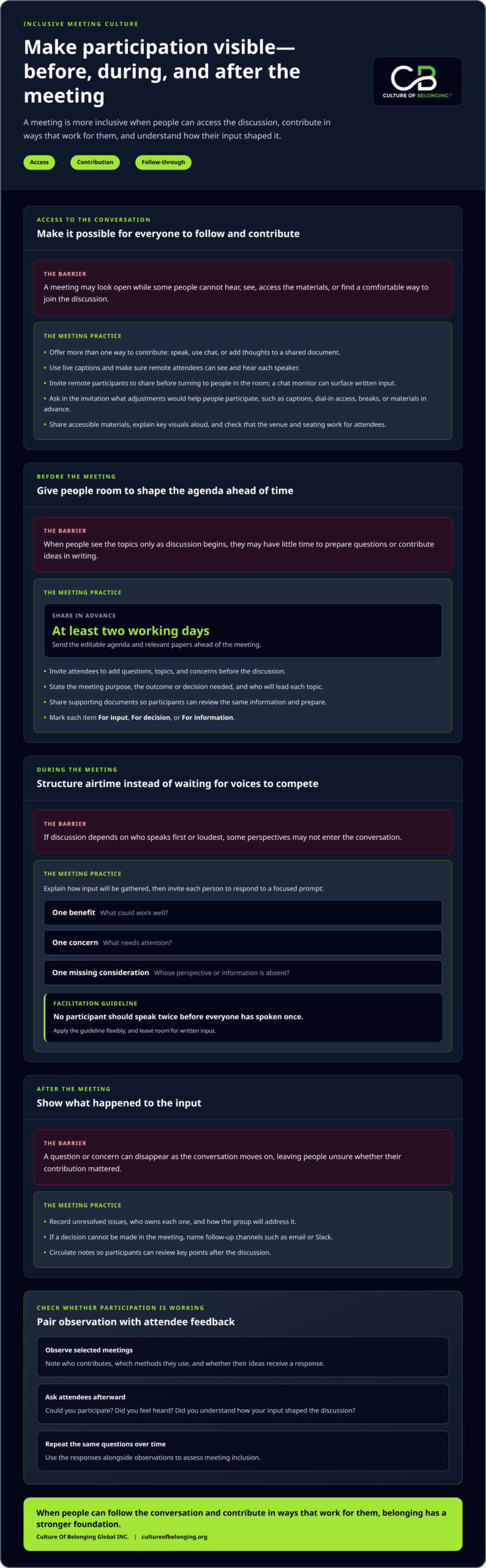
An inclusive meeting gives everyone a way to access the discussion and contribute. Leaders plan for different communication styles, access needs, and work locations before the meeting begins. Participants might speak, use chat, or add thoughts to a shared document. These options make participation practical and help build belonging through everyday interactions.
Remote and hybrid participants need equal access to what happens in the room. Use a virtual platform with live captions, and make sure remote attendees can see and hear each speaker. In hybrid meetings, invite remote participants to share their views before turning to people in the room. A designated chat monitor can surface written contributions, while individual devices help people sharing a room participate on equal terms.
Make access needs part of meeting preparation. Include a simple invitation prompt asking participants to share any adjustments that would help them take part. Someone may need captions, a dial-in option, breaks, or materials in advance. Treat each request as useful planning information, and don’t assume one format or adjustment works for everyone.
Accessible meeting materials support participation before, during, and after the discussion. Share agendas, presentations, and notes in formats that work with assistive technology. Use clear headings, readable text, and descriptive labels in documents. Keep slide wording brief, read key information aloud, and enable video captions. Present important ideas both verbally and visually, such as explaining a chart while showing it on screen.
Accessible venues matter for in-person meetings. Check that the route into the room, seating, and presentation setup work for attendees with different mobility and sensory needs. Offer virtual attendance when someone cannot attend in person. A hybrid option, for example, can let an employee join from another office without losing access to the group discussion.
Effective practices across cultures and time zones include rotating meeting times, using plain language, and avoiding unexplained acronyms. Rotating the time shares the inconvenience across locations instead of repeatedly burdening the same group. Invite input directly, since workplace hierarchy or cultural norms may affect whether someone speaks without an invitation. Circulating notes afterward also gives participants time to review or translate key points.
These details are part of how to create an inclusive meeting culture: leaders make access visible in the way meetings are planned and run. A workplace belonging strategy can connect those meeting practices to the wider conditions employees experience. When people can follow the conversation and contribute in ways that work for them, belonging has a stronger foundation.
2. Shared agendas that let attendees contribute in advance
A shared agenda gives participants a voice before the meeting starts. Make it editable, then invite attendees to add questions, topics, or concerns. Someone who needs time to shape their thoughts can contribute in writing instead of competing for airtime. A team member, for example, might add a risk to a project decision before discussion begins. The group can then consider it alongside the presenter’s planned topics.
Send the agenda and relevant papers in advance, ideally at least two working days before the meeting. Participants can review unfamiliar terms, gather information, and prepare questions instead of reacting on the spot. Include the meeting’s purpose, the decision or outcome needed, and the person leading each topic. If a proposal needs discussion, share its supporting document with the agenda so attendees can respond to the same information.
Keep the agenda focused enough to protect time for discussion. Estimate the time needed for each topic, identify which items require a decision, and separate updates from conversations that need input. A status update that could be sent by email may not need meeting time. A complex proposal, by contrast, may need space for questions and differing views. Start on time, follow the planned sequence, and finish on time or early.
Structure speaking opportunities instead of relying on whoever speaks first. A facilitator can explain how input will be gathered, then invite each participant to comment on a specific question. For a proposal, ask attendees to name one benefit, concern, or missing consideration. One facilitation guideline is that no participant should speak twice before everyone has spoken once. Apply it flexibly, and leave room for people who prefer written input.
An agenda should show where contributions can change the discussion. Mark items as “for input,” “for decision,” or “for information,” then explain what happens to comments. If a decision cannot be made during the meeting, offer email or Slack as follow-up channels. This reduces pressure to respond immediately and gives quieter voices another way to contribute.
Close the agenda with space for unresolved questions and proposed next steps. During the meeting, the facilitator can record each issue, its owner, and how the group will address it. This makes it easier to see whether input influenced the outcome. It also prevents a concern raised early from disappearing as the conversation moves to the next topic.
For leaders building these habits across teams, Curtis Ray Hill’s keynote on belonging and human-centered leadership can connect meeting practices with the wider conditions that support belonging.
3. Can you tell us about a tangible way a company or organization can measure inclusivity progress?
A practical way to assess meeting inclusion is to pair facilitator observations with participant surveys. During selected meetings, note who contributes, which methods they use, and whether their ideas receive a response. Afterward, ask attendees whether they could participate, felt heard, and understood how their input shaped the discussion. Repeating the same questions over time helps reveal patterns, not just impressions from one meeting.
Record participation without treating airtime as the only measure. Someone who speaks briefly may still shape a decision through chat, a poll, or written feedback. Track whether contributions come through different channels, whose points receive follow-up, and whether the same voices routinely dominate. A facilitator, for example, can compare spoken comments with chat contributions and note which perspectives informed the final choice.
Vary the format to make participation possible in different ways. Use spoken discussion to explore an issue, a poll to gather quick reactions, and a shared workspace for written ideas. Breakout activities can help smaller groups develop proposals before reporting back. Offer a way to pass or contribute later, so no one is pressured to respond before they’re ready.
A facilitator should actively invite input while keeping participation voluntary. They might ask, “What perspective haven’t we considered?” and allow quiet time before anyone responds. They can invite people who haven’t spoken to contribute without putting them on the spot. In a hybrid discussion, monitor chat and acknowledge remote participants’ points aloud so those contributions become part of the group’s record.
Surveys can make progress more visible when they use clear, consistent questions. Ask whether participants had a meaningful opportunity to contribute, whether differing views were welcomed, and whether the meeting format worked for them. Include an open response for examples. Review responses across teams or roles when appropriate, and protect privacy when reporting feedback about diversity or smaller groups.
When someone uses exclusionary language, the facilitator should address it promptly and calmly. Name the impact, redirect the discussion toward respectful language, and give affected participants room to respond without requiring them to educate the group. For example: “That wording may exclude people; let’s describe the behavior or concern without making assumptions about a group.”
Turn the findings into a focused next step. If surveys show that written input is easier than speaking, add a post-meeting response channel and observe whether people use it. If interruptions recur in one team’s meetings, practice returning the floor to interrupted speakers. Separate access barriers from facilitation patterns, since each calls for a different response. Then review observation notes and survey responses again. This cycle helps leaders connect meeting behavior with the conditions for belonging and psychological safety.
4. Considering affected people before decisions
Before a group settles a decision, identify who will experience its effects. Ask whose workload, access, schedule, or responsibilities could change. For example, a team changing its customer handoff process should include employees who handle each step, not only the managers approving the proposal. Review the attendee list for missing expertise or dissenting perspectives. If an affected group isn’t represented, gather its input before the decision becomes final.
Make the decision process clear before discussion starts. State what the group can decide, who holds final authority, and who will implement the outcome. Distinguish a request for ideas from a request for approval. If leaders are choosing between two project timelines, explain the constraints and invite affected teams to describe the practical consequences of each option. Clarifying people’s influence prevents consultation from being mistaken for shared authority.
Invite perspectives that could challenge the first proposal. Ask, “Who will carry this out?” and “Who might experience a different impact?” A quieter employee may identify a handoff problem decision-makers haven’t seen. A colleague responsible for accessibility, scheduling, or frontline operations may surface another constraint. These questions help the group test an idea against real working conditions before committing resources or assigning action owners.
When a decision affects people who aren’t in the room, pause before approval. Name the absent role or group, identify what information is missing, and assign someone to bring that input back. A policy affecting shift coverage, for example, may need feedback from employees across different shifts. The chair can record the unresolved concern and defer the decision until the relevant perspective is heard.
After discussion, circulate a concise written recap with the decision, its rationale, open questions, and next steps. Name each action owner and describe the expected deliverable, such as “Operations will draft the handoff steps.” Organizers are advised to circulate a summary of decisions, actions, and owners within 48 hours after the meeting. Clear records give attendees a shared reference and help absent stakeholders understand what was decided.
Minutes should capture meaningful disagreement without becoming a transcript. Note the main options considered, the reason for the selected path, and any concerns that remain unresolved. If a participant raised a risk, record how the group will address it. This preserves the substance of contributions, including views that didn’t prevail, and gives leaders a basis for revisiting the decision if its assumptions change.
Close the loop with people whose input shaped or will be affected by the outcome. Share the recap with attendees, then communicate relevant decisions to impacted employees who weren’t present. If their feedback changed the plan, say what changed. If it didn’t, explain the decision rationale plainly. That follow-through shows whether participation had a real place in the process, strengthening the conditions for trust, belonging, and engagement.
5. Micro-inclusions such as marking interruptions and attributing ideas
Small facilitation choices shape who gets heard and whose thinking moves a discussion forward. Repeated interruptions can push some voices out, while uncredited ideas can make contributions seem invisible. Leaders can counter these patterns with clear meeting agreements, attentive facilitation, and accurate credit. These are practical ways to make respect visible in everyday work.
Facilitators can prevent interruptions by setting a turn-taking expectation and stepping in when someone is cut off. A simple response works: “I’d like to hear the rest of Jordan’s point, then we’ll come back to yours.” Return the floor promptly, and give the original speaker room to finish without rushing.
Notice who speaks, who gets interrupted, and whose comments receive follow-up. These observations can reveal patterns without assuming intent or singling out individuals. If one person repeatedly dominates, the facilitator can pause, summarize the discussion, and invite perspectives that haven’t surfaced. A specific prompt, such as “What concern have we not heard yet?” gives the group a clear opening.
Credit ideas by naming the person who first raised them, especially when someone else repeats or builds on the point. For example, say, “That develops Priya’s suggestion about simplifying the handoff.” If the idea later appears in meeting notes or a project plan, retain the attribution where appropriate. Recognition should be specific, accurate, and tied to the contribution.
Respond to each question or proposal, even when there’s no immediate answer. A facilitator might say, “That’s a useful question; we’ll add it to the follow-up list.” Then record who raised it and assign someone to respond. This keeps unresolved contributions from disappearing and signals clearly that the person’s input was heard.
When exclusionary language arises, address the words and their effect without making it a personal attack. A facilitator can say, “Let’s avoid assumptions about a whole group. Can we describe the specific behavior or concern?” Then redirect the discussion and give affected participants space, without requiring them to explain the impact for everyone.
Build these practices into the meeting process. Rotate facilitation and note-taking roles so the same people don’t always control the discussion or record. Agree on norms such as listening without interruption, making room for others, and crediting contributions. Afterward, review meeting notes for missing attribution or unanswered questions. Consistent follow-through connects everyday respect with belonging and psychological safety.
Leaders can reinforce these habits in ordinary exchanges, not only in formal meetings. A manager, for example, can publicly credit the colleague who originated a proposal, then invite that person to explain its context. Repeated, visible recognition helps make respectful participation part of how the organization works.
Culture of Belonging Global®
Culture of Belonging Global® helps leaders connect inclusive meeting practices with the wider conditions employees experience at work. When teams need to move beyond isolated meeting adjustments, its keynotes, workshops, professional development, and consulting support a broader focus on belonging and human-centered leadership.
Curtis Ray Hill, founder of Culture of Belonging Global® and a leading authority and keynote speaker on Workplace Belonging, centers this work on a clear principle: belonging is the prerequisite for performance. Shared input matters because employees are better positioned to engage when their contributions are seen, understood, and connected to meaningful work.
If your organization is ready to strengthen belonging through everyday leadership and meeting practices, contact Culture of Belonging Global® to start a conversation.
Make Shared Input Part of How Work Gets Done
Inclusive meetings matter most when their principles shape the wider employee experience. A meeting can be a daily test of whether people’s perspectives are welcomed, whether leaders act on what they hear, and whether employees understand how their work matters. Make that standard part of leadership practice, not an occasional facilitation technique.
Learning how to create an inclusive meeting culture is an ongoing leadership commitment. Keep noticing whose contributions influence decisions, and adjust when participation patterns shift. Belonging is the prerequisite for performance: people need to feel valued and connected before they can fully engage. Consistent attention to that human foundation can help teams build trust and strengthen the conditions for meaningful work.
For support connecting workplace belonging with leadership practice, contact Culture of Belonging Global®. Keep making space for people to contribute, and let that commitment shape what your organization builds next.
Frequently Asked Questions
Can you tell us about a tangible way a company or organization can measure inclusivity progress?
Compare meeting records with participants’ accounts of their experience. A team, for example, can review whether concerns raised during planning appear in the final decision and whether follow-up actions reach the people affected. Pair that review with a short, confidential employee survey about voice and influence. Repeating the same measures helps leaders identify whether changes are becoming part of everyday meeting practice.
What Does an Inclusive Meeting Look Like?
An inclusive meeting lets people access information, follow the discussion, and influence its direction. That includes a remote employee who can’t hear a room speaker, a participant who needs time to process a proposal, and someone who contributes best in writing. The meeting format should support these differences. The practical test is whether participants can understand what’s happening and take part meaningfully.
What are the key principles of an inclusive meeting culture?
Build meetings around access, respect, shared influence, and follow-through. Access means participants can use the materials and join the discussion. Respect means interruptions and dismissive remarks are addressed. Shared influence means decisions account for people affected by them. Follow-through means contributions receive a response, even when the group doesn’t adopt them. These principles make belonging a lived experience rather than a statement on a values page.
How can meeting organizers make meetings accessible to people with disabilities?
Ask about access needs in the invitation, then plan the room and materials accordingly. A participant may need a step-free route, captioning, a screen-reader-friendly document, or a remote attendance option. Share key information in advance and explain visual content aloud during the meeting. Avoid asking attendees to disclose a diagnosis. Focus on the adjustment that enables participation, and handle personal information with care.
How can you encourage quieter participants to contribute in meetings?
Offer choices without equating quietness with disengagement. Before a discussion, invite participants to jot down thoughts; during it, allow a pause before responses and accept written contributions afterward. A facilitator can also invite someone by name while making it clear they may pass. For example: “Sam, is there a perspective you’d like to add, now or in the follow-up?” That invitation creates room without demanding disclosure.
How should meeting agendas and materials be shared in advance?
Send one clearly labeled agenda with the meeting purpose, key documents, and any preparation needed. Use a stable shared location and identify the current version, so participants don’t prepare from conflicting drafts. Explain unfamiliar terms and mark which materials are background and which are for discussion. If a proposal changes, highlight what changed and why. This helps attendees prepare for the actual decision instead of searching through files.
How can organizations measure inclusion and participation in meetings?
Use a small set of consistent indicators and examine them alongside employee feedback. A meeting review might record whose suggestions appear in the outcome, whether people can raise disagreement, and whether assigned actions are completed. Compare patterns across teams without turning participation into a contest for airtime. The aim is to understand whose input carries influence and where meeting design may be limiting it.
What tools support accessible, inclusive meetings?
Useful tools include captioning, screen-sharing, accessible document formats, chat, shared notes, polls, and breakout rooms. Choose them based on the meeting’s purpose and participants’ access needs. A poll, for instance, can collect individual reactions before open discussion, while shared notes can preserve questions for later review. Agree on how each channel will be monitored, so contributions in chat or documents receive attention instead of disappearing unnoticed.

Article by
Curtis Ray Hill
Curtis Ray Hill, MAT, M.Ed., is a workplace belonging keynote speaker, culture strategist, author, and founder of Culture of Belonging Global®. For more than two decades, his work has centered on one core belief: belonging is the prerequisite for performance.
Curtis has worked with leaders and organizations including Pfizer, State Farm, BP, Southwest Airlines, Hallmark, and Avis Budget Group, bringing a practical, human-centered approach to workplace belonging, employee engagement, employee experience, psychological safety, and organizational culture. His background spans education, leadership, and process improvement, and he holds a Black Belt in Lean Six Sigma.
He is the author of Creating a Culture of Belonging: From Feeling Like to Knowing You Belong, a book focused on moving belonging beyond intention and creating environments where people know they belong.
Curtis is also the creator of The Belonging Effect™, his proprietary framework built around four human experiences: Noticed → Named → Known → Needed. His work equips leaders to translate belonging into everyday leadership behaviors and workplace experiences that create stronger conditions for engagement and performance.
Through his keynotes, consulting, writing, and thought leadership, Curtis is advancing workplace belonging as a business and leadership priority—not simply a culture initiative. His work connects belonging to human-centered leadership, psychological safety, employee experience, retention, engagement, and performance. His goal is to move organizations beyond talking about belonging to creating workplaces where people experience it every day—and where belonging becomes the foundation for how people connect, contribute, and perform.
Disclaimer
The content published on this website by Curtis Ray Hill and Culture of Belonging Global® is provided for general informational and educational purposes only. It is intended to share perspectives, frameworks, strategies, research, and ideas related to workplace belonging, organizational culture, leadership, employee experience, engagement, retention, psychological safety, and related topics.
No Professional Advice. Nothing on this website constitutes or should be relied upon as legal, financial, accounting, employment, human resources, medical, psychological, compliance, or other professional advice. The information provided is not a substitute for advice from qualified professionals familiar with your organization, circumstances, jurisdiction, employees, policies, and applicable laws or regulations.
No Guarantee of Results. Curtis Ray Hill and Culture of Belonging Global® make no representation, warranty, promise, or guarantee that any framework, strategy, recommendation, keynote, training, consulting engagement, or other information discussed on this website will produce any particular result. Organizational outcomes vary based on numerous factors, including leadership, implementation, organizational culture, industry, workforce, resources, timing, and circumstances.
Research, Statistics, and Results. Statistics, research findings, survey data, industry findings, quotations, and third-party information referenced in an article should be considered within the context, methodology, limitations, and publication date of the original source. Any specific client result or organizational outcome referenced is illustrative of that particular experience and should not be interpreted as typical, expected, or guaranteed for another organization.
Independent Decision-Making. Readers and organizations are responsible for evaluating the suitability of any ideas, strategies, frameworks, or recommendations for their own circumstances. Before implementing decisions that may affect employees, employment practices, workplace policies, compliance obligations, finances, or business operations, consult the appropriate qualified legal, HR, financial, compliance, or other professional advisers.
Third-Party References. References to companies, organizations, publications, research institutions, products, services, or other third parties are provided for informational or contextual purposes. Unless expressly stated, such references do not imply endorsement, sponsorship, partnership, validation, or approval by or of Curtis Ray Hill or Culture of Belonging Global®.
Intellectual Property. Culture of Belonging®, The Belonging Effect™, The Invisible Floor Plan™, and other identified proprietary concepts, frameworks, names, and materials associated with Curtis Ray Hill and Culture of Belonging Global® are protected intellectual property where applicable. Nothing published on this website grants permission to reproduce, distribute, modify, teach, sell, license, or commercially exploit proprietary materials without authorization.
Limitation of Responsibility. To the fullest extent permitted by applicable law, Curtis Ray Hill and Culture of Belonging Global® disclaim responsibility for losses, damages, liabilities, or consequences arising from reliance upon or application of information contained on this website. Use of this content and any decisions based upon it are undertaken at the reader's or organization's own discretion and risk.
Information may be updated, revised, or become outdated over time. Readers should verify information that is material to an organizational, employment, legal, financial, or compliance decision and consult qualified professionals when appropriate.


