

A team can share a mission and still work at cross-purposes. Defining your team’s working agreements means agreeing on the practical norms that guide how people communicate, make decisions, share work, and support one another. These agreements turn unspoken expectations into a common reference point.
That clarity matters most when someone is new. Instead of guessing which channel to use, when to ask for help, or how decisions are made, they can see how the team works and where their contribution fits. Shared expectations can also make it easier for people to speak up, feel included, and do meaningful work.
This article explains what working agreements are, why they matter, and how a team can shape expectations around its real needs. You’ll explore communication norms, collaborative ways to create agreements, and practical steps for documenting and revisiting them, giving new members a clearer path into the team.
Key Takeaways
- Make team norms explicit so people can align on collaboration, decisions, responsibilities, and how work moves forward.
- Set clear communication expectations for channels, response times, meetings, availability, and asking for help.
- Create agreements together so team members have a voice in the expectations they’re asked to follow.
- Document the agreements where everyone can find them, and use them to help new members understand how the team works.
- Revisit the agreement when team membership, work arrangements, or the team’s actual practices change.
Why create a team working agreement?
A working agreement makes expectations visible and gives teammates a shared basis for collaboration. Defining your team’s working agreements early can establish how people coordinate and support the team’s purpose.
Agreements That Support Collaboration
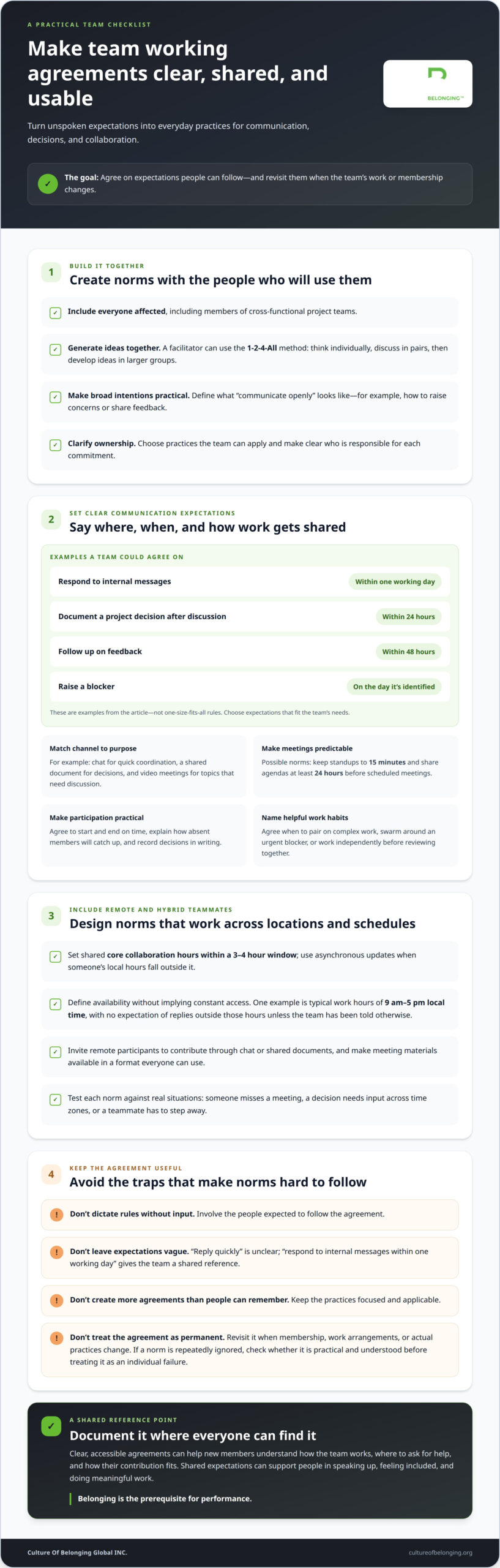
Team working agreements describe how members coordinate tasks, decisions, and day-to-day work. They matter because teammates can collaborate effectively when they understand how work moves between people, rather than relying on assumptions. An agreement might ask members to document project decisions within 24 hours of discussion or follow up on feedback within 48 hours.
These examples turn broad intentions into observable practices. A team might agree to respond to internal messages within one working day or escalate blockers on the day they identify them. The aim isn’t to impose identical habits on every team. It’s to discuss which expectations reduce friction and help people deliver work together.
Agreements can also clarify how people approach shared tasks. Members might pair on complex work, swarm around an urgent blocker, or take ownership of separate tasks before reviewing them together. Naming these approaches helps teammates know when to collaborate closely and when to work independently. It also gives the team a concrete way to assess whether its workflow supports its purpose.
Collaborative Agreement Design
Collaborative agreement design means team members generate, discuss, and choose expectations together, rather than receiving a finished list from a manager. Include everyone who will follow the agreement, including members of cross-functional project teams. A facilitator can invite silent brainstorming, then use the 1-2-4-All method to develop ideas individually, in pairs, and in larger groups. This shared process gives people a voice in shaping team norms.
Next, group related suggestions and discuss what each would look like in practice. For example, “communicate openly” becomes more useful when teammates define how they’ll raise concerns or share feedback. Choose practices the team can apply, then clarify who is responsible for each commitment. Defining your team’s working agreements collaboratively helps make them relevant to the people expected to use them.
Mistakes and Risks
Common mistakes include dictating rules without team input, writing vague expectations, and creating more agreements than members can remember. These choices can weaken adoption and leave practical questions unanswered. For instance, “reply quickly” sets no shared expectation, while “respond to internal messages within one working day” is clearer.
Another risk is treating an agreement as permanent even as the team’s work changes. If members repeatedly ignore a norm, discuss whether it is practical before treating noncompliance as an individual failure. Check whether the agreement fits the team’s purpose, whether everyone understands it, and whether another approach would better support collaboration. A useful agreement is clear enough to guide work and flexible enough to improve.
Communication expectations
Communication agreements define how people share information, raise concerns, and coordinate work. To include remote and hybrid members, agree on accessible channels, clear meeting practices, and expectations that don’t depend on being in the office.
Communication and Work-Practice Norms
Communication and work-practice norms describe the behaviors everyone is expected to follow while coordinating tasks. Clear guidelines help an agile team share information without relying on hallway conversations or assumptions. For example, members can agree to ask for help when blocked, share relevant updates, and keep work calendars current.
Make expectations specific enough to guide behavior. A norm such as “be respectful” can be supported by clear practices: listen without interrupting, invite different perspectives, and explain concerns with examples. The team can also agree to share schedule changes and mark absences on its work calendar, helping colleagues plan handoffs across locations.
Channels and Meeting Norms
Channel and meeting norms clarify which communication tools serve which purposes and how gatherings should work. They help everyone find the right information and participate, whether they join from a conference room or remotely. A team might reserve chat for quick coordination, a shared document for decisions, and a video meeting for topics that need discussion.
Set practical meeting guidelines, too. A team can keep standups to 15 minutes and share agendas at least 24 hours before scheduled meetings. Agree to start and end on time, and decide how absent members will learn what happened. A five-minute opening for casual conversation can help people connect, while a written decision record gives those who could not attend useful context.
Including Remote and Hybrid Members
Inclusive communication agreements make participation possible across work locations and schedules. This matters because office-only conversations can leave remote colleagues out of decisions. Establish core collaboration hours within a shared window of 3-4 hours, and use asynchronous updates when someone’s local working hours fall outside it.
Define availability without implying constant access. For example, an agreement can state that typical work hours are 9 am to 5 pm local time, with no expectation of replies outside those hours unless the team has been told otherwise. Invite remote participants to contribute through chat or shared documents, and make meeting materials available in a format everyone can use.
Test each norm against a real scenario: a teammate misses a meeting, a decision needs input across time zones, or someone has to step away. If the agreement still explains what happens next, it gives everyone a clearer way to contribute. If it depends on physical presence, revise the practice so location doesn’t determine whose voice counts.
Documenting agreements and onboarding new members
A written agreement gives team members a shared reference for how work moves, where information lives, and how new colleagues can participate. Use it to explain real practices, not just ideal intentions.
Reasons to Document Agreements
Documenting a team’s way of working preserves practical knowledge that might otherwise remain with long-standing members. A new colleague can learn which tools the team uses, where project artifacts are stored, and who updates them. That context makes onboarding more concrete: instead of guessing how work gets done, members can consult the same guide and ask focused questions.
A useful document can also support governance, collaboration between teams, and organizational requirements. For example, a project agreement might clarify which milestones stakeholders can see, where decisions are recorded, and how delivery plans are communicated. An internal guide might explain role responsibilities or the team’s process for updating relevant documentation. These details help teams coordinate without confusing internal practices with commitments to stakeholders.
Choose a format that fits the information. A single page can work when the team needs only a concise set of norms. A more detailed document may suit a team with several workflows, tools, or stakeholder expectations. Either way, make the content easy to scan. Group related items under labels such as communication, decisions, tools, and work practices.
Sharing and Reviewing Agreements
Sharing an agreement means making it easy for every member to find and use during real work. Store it alongside the team’s other working documents, such as in its shared project space, and identify that location during onboarding. If the team uses Jira, it might also agree to link each pull request to its related issue, making the work and its context easier to follow.
Give new members a guided introduction rather than sending a document without context. A teammate can walk through the agreement, explain where artifacts live, and show how the team updates them. Invite questions about unfamiliar terms or processes. For example, demonstrate how the team records a decision and where a newcomer can find the current project plan.
Review the agreement when the documented process no longer matches how the team works. Changes in membership, tools, responsibilities, or collaboration patterns can make an old instruction confusing. Ask members to identify the mismatch, discuss what should change, and update the shared version. A template can also specify how and when the team will review its agreement, making revisions part of normal practice.
Keep version changes clear. When a norm changes, make the current expectation easy to distinguish from outdated guidance, then tell affected members where to find the update. This matters when teams coordinate across functions or with stakeholders, because everyone needs to act from the same version of the plan.
Reasons to create a team working agreement
A working agreement gives team members a reference for coordinating toward shared goals. Create one when a team forms, then revisit it as its purpose, membership, or work changes.
Clear agreements make day-to-day expectations easier to apply. They can define how responsibilities connect, how work is adjusted, and how the team delivers what stakeholders need. They also help surface differences between a team’s preferred process and organizational expectations. Compliance and governance may shape some practices, especially when stakeholders need visibility into milestones, funding arrangements, or delivery strategy.
Start by establishing the team’s purpose and shared objectives for the next six months to a year. Then gather input from everyone who will follow the agreement. The following sequence keeps the conversation grounded in work rather than abstract ideals:
- Set the purpose. Agree on the outcomes the team needs to deliver and the stakeholders its work serves.
- Collect friction points. Ask members where handoffs, decisions, or changing plans create confusion. Invite each person to describe a real example.
- Choose practical norms. Discuss how the team will address those examples, including how proposed project-plan adjustments are evaluated, communicated, and carried out.
- Make the agreement usable. Record the shared commitments, clarify who they affect, and decide how the team will reference and review them.
This process works for a core team or a cross-functional project group. Include all members so the people responsible for following the agreement can shape it. Managers can clarify constraints, but dictating every norm risks overlooking the team’s actual needs. For agreements affecting external stakeholders, align expectations such as milestones and delivery visibility with them. Discuss proposed changes with stakeholders or give them sufficient warning before changing the agreement.
Revisit the agreement when membership, company size, strategy, or work arrangements change. A new delivery cadence can also alter handoffs and decision timing, making an old norm less useful. Teams can review agreements quarterly; some formally revisit internal agreements once or twice a year. The right trigger is a real mismatch between documented expectations and current work, not simply a calendar reminder.
When a norm isn’t being followed, first discuss why. The cause may be unclear wording, a changed workflow, or an expectation that no longer fits the team’s purpose. Revise the agreement when needed, then make the updated version the team’s shared reference.
Definition and characteristics of working agreements
A team working agreement describes how members work together to accomplish their shared purpose. Its value comes from making practical expectations clear enough to guide real work.
What Working Agreements Define
A working agreement is a set of shared principles or promises about how a team collaborates. Teammates can use it to align daily choices with the team’s purpose instead of relying on assumptions. For example, members might agree to make the Product Backlog and Sprint Backlog transparent, or define how they’ll focus and manage distractions.
Agreements can cover roles, work practices, and the team environment, whether physical or virtual. A Scrum team might specify the time and location of its events, describe its Definition of Done, or agree that continuous integration checks must pass before merging a change. These details describe how the team intends to work, not just what it hopes to achieve.
A useful template organizes commitments by topic, such as decision-making, feedback, tools, and responsibilities. It should help members answer practical questions: Who owns a task? Where is a decision recorded? How does the team raise a concern? Clear answers make an agreement a working reference, not a statement of values detached from everyday behavior.
Distinguishing Agreements from Other Team Guides
Working agreements differ from team norms, policies, and a team charter because they focus on shared commitments for how members work together. Team norms may describe familiar behaviors, including unwritten habits; agreements make selected expectations explicit. Policies set organization-level requirements, while a charter usually frames the team’s purpose, scope, and responsibilities.
These documents can support one another. A charter might explain that a team exists to deliver a product, while its working agreement explains how members make decisions and coordinate the work. An organization’s policy may set a required process, and the team can agree on practical ways to follow it. This distinction helps readers find the right reference without treating every guide as interchangeable.
Working agreements can be informal promises or more formal arrangements, depending on the relationship. An internal team might agree on peer review and role accountability. In an outsourcing arrangement, an agreement may function more like a formal contract. Scope matters: internal commitments are shaped by the team, while external commitments may also need to reflect stakeholder expectations.
Use the agreement to turn broad norms into observable practices. “Give constructive feedback” becomes clearer when the team defines how members offer it and make room for responses. Review the template against actual work, then revise any commitment that no longer reflects the team’s environment or responsibilities. That practical test keeps the agreement distinct from a policy manual or a charter focused only on purpose.
Culture of Belonging Global®
Culture of Belonging Global® was founded by Curtis Ray Hill, a leading authority and keynote speaker on Workplace Belonging. He helps leaders connect team practices with the conditions people need to contribute, engage, and perform, guided by the belief that belonging is the prerequisite for performance. Working agreements can put this into practice by making expectations visible and participation clearer.
For organizations strengthening human-centered leadership, Culture of Belonging Global® offers Workshops, Professional Development, and Consulting focused on workplace culture and belonging. These services help leaders examine whether everyday norms reflect the culture they intend to create and identify practical opportunities for change.
If you’re ready to explore how Culture of Belonging Global® can support your organization, contact the team to start a conversation.
Make Belonging Part of How the Team Works
The next phase of defining your team’s working agreements is noticing what those agreements make possible. Do team members feel able to ask questions, offer a different perspective, and understand why their contribution matters? Those everyday experiences shape whether belonging is present in practice, not just in stated values.
Use that reflection to keep the conversation open. Invite a new team member to share where expectations were clear and where they had to guess. Listen for patterns, then consider whether your agreements support the conditions for engagement, psychological safety, and performance. Belonging is the prerequisite for performance, and leaders influence it through the culture people experience every day.
For leaders ready to connect workplace belonging with human-centered leadership, Curtis Ray Hill, founder of Culture Of Belonging Global INC., brings this perspective to organizations. Contact Culture Of Belonging Global INC. to start a conversation about your team’s next step.
Small, honest conversations can help teams build working relationships where people feel seen, included, and ready to contribute.
Frequently Asked Questions
Who should use working agreements, and when?
Any team that depends on coordination can use working agreements, including an established department, a newly formed group, or a cross-functional project team. Create them early when members need to coordinate responsibilities, handoffs, or decisions. They’re also useful when a team’s work changes, such as when a project adds new stakeholders or shifts how it delivers work. Shared expectations give members a starting point for navigating those changes together.
Why Document Your Way of Working (WoW)?
Documenting a team’s way of working preserves context about its process, collaboration, and work artifacts. It helps a new member understand not only what the team produces, but how its work creates value for stakeholders. A written reference can also clarify how teams coordinate across organizational boundaries. For example, a partner team can see which project milestones affect its own work and where shared information is maintained.
Why do teams need agreements?
Teams need agreements to make expectations usable in everyday situations, especially when people interpret the same goal differently. A team might agree that members can challenge a proposal by explaining its risks and offering an alternative. That creates a practical route for disagreement, rather than leaving individuals to guess whether speaking up is welcome. Clear expectations can support psychological safety and belonging, conditions that help people engage and contribute.
What are team working agreements?
Team working agreements are shared principles or promises that describe how members will work together. They can be informal commitments or, in some settings, more formal arrangements. Their defining feature is a focus on the team’s working relationship and practices. For example, a group might agree to make room for different viewpoints before settling a decision. Commitments should reflect the team’s purpose and fit its actual work.
What topics should team working agreements cover?
Choose topics that shape how work gets done, rather than trying to document every preference. Teams can address role responsibilities, decision-making, constructive feedback, focus time, and how work is organized in a physical or virtual environment. A product team might clarify how it makes its backlog visible, while another group may specify how it approaches shared tasks. Let the team’s purpose and work determine which topics deserve attention.
How do you create working agreements with a team step by step?
Start by naming the team’s purpose and the situations where expectations feel unclear. Invite every member to generate ideas, then group similar suggestions and discuss what each would look like in practice. The 1-2-4-All method can help members develop ideas individually, in pairs, and in larger groups. Agree on commitments the team can apply, record the decisions, and decide how members will revisit them when work changes.
What are examples of effective team working agreements?
Useful examples describe observable practices tied to the team’s workflow. A software team might limit work in progress to four stories, require at least one approval for each pull request, and prevent direct commits to the main branch. It might also require changes to pass automated checks or be tested in staging. These are options, not universal rules: each team should choose agreements that fit its work and responsibilities.
How do you facilitate a working agreements workshop?
Bring the full team into the conversation and frame the workshop around actual collaboration challenges. Reserve 60-90 minutes for an initial session, with 5-10 minutes for silent brainstorming so everyone can prepare ideas. Invite participants to share, group related themes, and discuss which commitments would address real examples. Close by reading the proposed agreements aloud, resolving unclear wording, and identifying how the team will document and review them.

Article by
Curtis Ray Hill
Curtis Ray Hill, MAT, M.Ed., is a workplace belonging keynote speaker, culture strategist, author, and founder of Culture of Belonging Global®. For more than two decades, his work has centered on one core belief: belonging is the prerequisite for performance.
Curtis has worked with leaders and organizations including Pfizer, State Farm, BP, Southwest Airlines, Hallmark, and Avis Budget Group, bringing a practical, human-centered approach to workplace belonging, employee engagement, employee experience, psychological safety, and organizational culture. His background spans education, leadership, and process improvement, and he holds a Black Belt in Lean Six Sigma.
He is the author of Creating a Culture of Belonging: From Feeling Like to Knowing You Belong, a book focused on moving belonging beyond intention and creating environments where people know they belong.
Curtis is also the creator of The Belonging Effect™, his proprietary framework built around four human experiences: Noticed → Named → Known → Needed. His work equips leaders to translate belonging into everyday leadership behaviors and workplace experiences that create stronger conditions for engagement and performance.
Through his keynotes, consulting, writing, and thought leadership, Curtis is advancing workplace belonging as a business and leadership priority—not simply a culture initiative. His work connects belonging to human-centered leadership, psychological safety, employee experience, retention, engagement, and performance. His goal is to move organizations beyond talking about belonging to creating workplaces where people experience it every day—and where belonging becomes the foundation for how people connect, contribute, and perform.
Disclaimer
The content published on this website by Curtis Ray Hill and Culture of Belonging Global® is provided for general informational and educational purposes only. It is intended to share perspectives, frameworks, strategies, research, and ideas related to workplace belonging, organizational culture, leadership, employee experience, engagement, retention, psychological safety, and related topics.
No Professional Advice. Nothing on this website constitutes or should be relied upon as legal, financial, accounting, employment, human resources, medical, psychological, compliance, or other professional advice. The information provided is not a substitute for advice from qualified professionals familiar with your organization, circumstances, jurisdiction, employees, policies, and applicable laws or regulations.
No Guarantee of Results. Curtis Ray Hill and Culture of Belonging Global® make no representation, warranty, promise, or guarantee that any framework, strategy, recommendation, keynote, training, consulting engagement, or other information discussed on this website will produce any particular result. Organizational outcomes vary based on numerous factors, including leadership, implementation, organizational culture, industry, workforce, resources, timing, and circumstances.
Research, Statistics, and Results. Statistics, research findings, survey data, industry findings, quotations, and third-party information referenced in an article should be considered within the context, methodology, limitations, and publication date of the original source. Any specific client result or organizational outcome referenced is illustrative of that particular experience and should not be interpreted as typical, expected, or guaranteed for another organization.
Independent Decision-Making. Readers and organizations are responsible for evaluating the suitability of any ideas, strategies, frameworks, or recommendations for their own circumstances. Before implementing decisions that may affect employees, employment practices, workplace policies, compliance obligations, finances, or business operations, consult the appropriate qualified legal, HR, financial, compliance, or other professional advisers.
Third-Party References. References to companies, organizations, publications, research institutions, products, services, or other third parties are provided for informational or contextual purposes. Unless expressly stated, such references do not imply endorsement, sponsorship, partnership, validation, or approval by or of Curtis Ray Hill or Culture of Belonging Global®.
Intellectual Property. Culture of Belonging®, The Belonging Effect™, The Invisible Floor Plan™, and other identified proprietary concepts, frameworks, names, and materials associated with Curtis Ray Hill and Culture of Belonging Global® are protected intellectual property where applicable. Nothing published on this website grants permission to reproduce, distribute, modify, teach, sell, license, or commercially exploit proprietary materials without authorization.
Limitation of Responsibility. To the fullest extent permitted by applicable law, Curtis Ray Hill and Culture of Belonging Global® disclaim responsibility for losses, damages, liabilities, or consequences arising from reliance upon or application of information contained on this website. Use of this content and any decisions based upon it are undertaken at the reader's or organization's own discretion and risk.
Information may be updated, revised, or become outdated over time. Readers should verify information that is material to an organizational, employment, legal, financial, or compliance decision and consult qualified professionals when appropriate.


