

Honest feedback isn’t collected by asking once. It’s earned when employees can speak candidly, trust that their views will be taken seriously, and see leaders respond. Learning how to get honest feedback from employees means building that trust into everyday conversations, surveys, and follow-through. Employee feedback includes the experiences, concerns, and ideas people share about their work. It can reveal what helps them contribute and what gets in the way.
You likely know that asking for input matters. The harder part is creating conditions where employees can answer honestly, then showing that their candor made a difference. Belonging supports performance: when employees feel seen and valued, honest conversations have room to grow. This article explains what employee feedback is, shares questions that invite useful answers, and shows how to communicate results, take action, and build a lasting feedback culture.
Key Takeaways
- Ask specific, open-ended questions about workload, leadership, and team dynamics to make candid answers easier.
- Use anonymous surveys and regular pulse checks to gather feedback in ways that fit different situations.
- Share key themes with employees, then explain what action will follow and what may take longer.
- Build trust by responding constructively to criticism and making it safe to speak up without fear of retaliation.
- Connect honest feedback to workplace belonging: people are more able to contribute when they feel seen, understood, and valued.
1. What questions get honest feedback from your team?
A practical approach to how to get honest feedback from employees starts with specific, open-ended questions. Ask separately about workload, leadership, and team dynamics. For example, “Which part of your workload is hardest to manage?” invites a clearer answer than “Are you busy?” Follow with “What would make that task easier?” to uncover a practical change. Keep each question focused on a real part of the employee’s work.
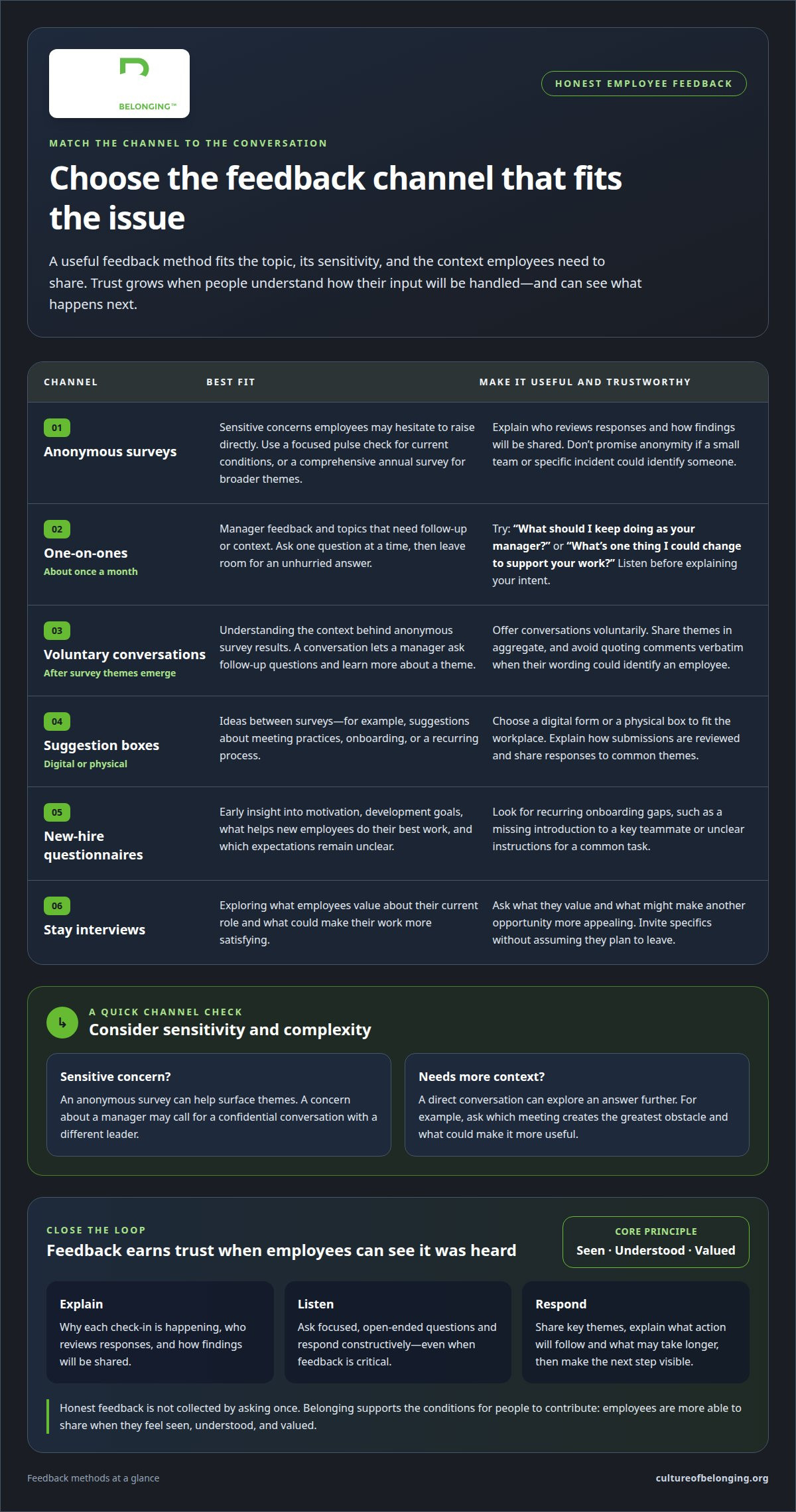
In one-on-ones, ask direct reports for feedback about once a month. Choose a quiet moment, ask one question at a time, and leave room for an unhurried answer. Useful prompts include, “What should I keep doing as your manager?” and “What’s one thing I could change to support your work?” If an answer is critical or negative, listen before explaining your intent. A calm response helps keep the conversation focused on the employee’s experience.
Questions about team dynamics can reveal issues that broad engagement questions miss. Try asking:
- “When does collaboration feel easiest, and what makes it work?”
- “Where do handoffs between teams slow down your work?”
- “Do you feel comfortable disagreeing in team meetings? What affects that?”
- “Whose perspective should we hear more often when making decisions?”
New-hire questionnaires can surface motivation and development goals early. Ask new employees what helps them do their best work, what skills they want to build, and which expectations remain unclear. Look for recurring onboarding gaps, such as a missing introduction to a key teammate or unclear instructions for a common task. Use these patterns to improve future onboarding and make the next employee’s start more coherent.
Stay interviews explore what might keep current employees engaged before a departure becomes the conversation. Ask, “What do you value most about your role?” and “What might make another opportunity more appealing?” These questions invite specifics without assuming someone plans to leave. Ask what could make their current work more satisfying, then listen for themes across conversations. For leaders considering how to get honest feedback from employees, this approach can uncover concerns while there’s still time to understand them.
Follow-up questions turn an initial answer into useful detail. If someone says meetings take too much time, ask which meeting creates the greatest obstacle and what could make it more useful. Close by summarizing what you heard and asking whether you understood correctly. This shows employees their input has been noticed and supports belonging and meaningful participation. Their answer can also clarify what leaders should explore next.
2. What is employee feedback?
Employee feedback is information employees share about their work, workplace, and experience with the organization. It could be a casual comment after a team meeting, a response to an annual engagement survey, or an anonymous suggestion. Regular pulse surveys offer a shorter, recurring way to hear about current conditions, while comprehensive annual surveys can explore broader themes.
Anonymous surveys can help employees share sensitive concerns without attaching their names. Face-to-face feedback lets a manager ask follow-up questions and understand context, but employees may feel less comfortable discussing a negative experience directly. Use both approaches: an anonymous survey to identify themes, followed by voluntary conversations to learn more about them.
Privacy involves more than removing names. Before launching a survey, explain who will review responses, how findings will be shared, and whether comments may contain identifying details. Don’t promise anonymity if a small team or a specific incident could make a response recognizable. Report themes in aggregate, and avoid quoting a comment verbatim if its wording could identify the employee.
A pulse check works best when it focuses on a clear topic and leads to a visible next step. For example, a short survey could ask whether employees understand current priorities, have the resources to complete their work, and can raise concerns with their manager. Keep questions consistent when tracking change, but include space for a comment explaining an answer. A comprehensive annual engagement survey can then explore broader topics, such as communication across departments or confidence in leadership.
Organizations can also use anonymous employee suggestion boxes to collect ideas between surveys. A digital form can invite suggestions about meeting practices, onboarding, or a recurring process; a physical box may suit a workplace where employees don’t regularly use email. Explain how submissions will be reviewed and share responses to common themes. Without visible follow-through, an anonymous feedback box can become a place where concerns disappear.
Choose a feedback schedule based on the decision leaders need to make. A pulse can reveal whether a recent change is affecting employees, while an annual engagement survey can examine broader patterns. Asking too often without explaining what happened to earlier feedback can weaken participation. Set a clear rhythm, explain why each check-in is happening, and close the loop by sharing what the organization heard and what it will address.
Choose a channel based on the issue’s sensitivity and complexity. A suggestion about meeting format may fit an anonymous box; a concern about a manager may call for a confidential conversation with a different leader. In either channel, feedback becomes useful when employees can see their input was received, understood, and considered.
3. Sharing survey results and acting on employee feedback
Survey results matter when employees can see what leaders heard and what happens next. Start by grouping responses into themes, such as workload, decision-making, or communication between teams. Share the top three themes with employees within two weeks, along with what leaders will explore or change. Remove details that could identify individual respondents. This transparency helps employees understand how their input is being handled.
Employee feedback tools commonly include survey platforms, forms, HR systems, suggestion channels, and facilitated forums. Some organizations use 360 feedback surveys to gather perspectives from managers, peers, and direct reports. Costs vary with the platform, features, licensing, and organization’s needs; choose based on how responses will be collected, protected, analyzed, and shared. The right tool supports a clear process rather than replacing thoughtful leadership.
Sharing results is not the same as acting on them. Assign an owner to each issue, agree on a practical next step, and tell employees when to expect an update. If feedback points to confusing handoffs, for example, a manager might map the process with affected teams and clarify responsibilities. If employees say meetings crowd out focused work, the manager could test a shorter format and report what changed. This follow-through is central to how to get honest feedback from employees.
A company-wide conversation can help employees understand patterns beyond their own team. Use a forum to explain survey themes, invite questions, and distinguish immediate actions from issues needing further discussion. Managers can then hold smaller team conversations to understand local context. Keep the discussion constructive: feedback identifies conditions that need attention, not individuals to blame. A facilitator can also make space for concerns that may not appear in survey results.
360 feedback can make leadership practices part of the conversation. A leader might share their own review with the executive team, discuss what they heard, and name a behavior they intend to change. That visible response shows that feedback applies upward as well as downward. Keep the focus on specific actions, such as clarifying priorities or inviting dissent before a decision. Leaders learning how to get honest feedback from employees can model openness by receiving input themselves.
Follow-up makes action visible. Record each theme, its owner, the next step, and its status in a shared update. When a concern needs more investigation, explain what is being examined rather than leaving employees to guess. If a change can’t be made, explain the constraint and alternatives considered. Silence after a survey can teach employees that speaking up has little effect. A clear update shows their perspective remains part of the conversation.
Close the loop with a brief team update or a 20-minute meeting. Name what employees raised, what action followed, and what remains unresolved. Then invite feedback on the response itself. That final step helps leaders see whether the change addressed the problem, while showing employees their contributions are noticed and taken seriously.
4. Building a culture of honest feedback
A feedback culture grows through everyday choices, not a single survey. For example, a project team can set aside time in its retrospective to name one process that helped and one that created friction. Leaders should make room for both answers, including criticism of their decisions. This routine signals that useful input belongs in normal work, not only in formal review conversations.
Make room for disagreement before a decision becomes final. A leader presenting a new workflow can ask, “What could make this difficult to use?” Then pause, hear concerns, and explain which suggestions shaped the final decision. If the plan stays unchanged, explain why. Employees can see that candid input is considered, even when it doesn’t change the outcome.
Leaders can model the behavior they expect by naming a specific misstep. For instance, a manager might tell the team, “I changed the deadline without checking the dependencies. What should I understand before setting the next one?” This invites concrete input and shows that authority doesn’t require appearing infallible. Next, demonstrate how the conversation affected the manager’s approach to similar decisions.
Set practical ground rules for team discussions. A facilitator can prevent interruptions, ask people to critique a proposal rather than a colleague, and invite written input from employees who prefer time to think. If one person dominates a discussion about staffing, for example, the facilitator can invite each participant to share a concern before debate begins. This makes room for perspectives that might otherwise be missed.
Belonging shapes whether employees feel their contributions matter. Leaders can make that connection concrete by recognizing the person behind an idea, asking what support would help them contribute, and explaining how their work connects to team priorities. For example, after an employee flags a recurring handoff problem, recognize their observation and include the relevant roles in examining the process.
Compare the culture leaders describe with what employees experience. The Carpet vs. Concrete metaphor captures this distinction: carpet represents stated culture, while concrete represents experienced culture. If leaders say questions are welcome but dismiss concerns during a project review, employees experience the response, not the slogan. Use that gap to identify a specific behavior leaders can change and observe in future conversations.
These practices become stronger when leaders treat belonging as part of how work gets done. Workplace belonging initiatives can connect everyday leadership behavior with the conditions employees need to contribute. The aim is to make candor a lived practice, supported by consistent choices across teams.
5. How can companies prevent retaliation after employees share critical feedback?
Preventing retaliation starts before an employee raises a concern. In an employee-silence study, 22.5% of employees cited fear of retaliation or punishment as a reason for withholding feedback. Leaders can reduce that fear by explaining how concerns are reviewed, who can receive them, and how employees can report what happens afterward. Make those steps clear before a survey, meeting, or one-on-one begins.
Offer a reporting route outside the employee’s direct management chain. For example, an employee criticizing their manager could speak with another designated leader or use an established reporting channel. Explain who will receive the concern and what information may be shared to address it. Don’t promise complete confidentiality if details could identify the person or require a response from others.
Keep feedback separate from decisions affecting the employee. If someone raises concerns about a supervisor, record the concern and response process separately from performance reviews, scheduling, and assignments. When a manager later changes an employee’s responsibilities, document the business reason and the decision-makers involved. Clear records help distinguish routine management decisions from actions that may appear retaliatory.
Check for changes after critical feedback, not just immediately afterward. A designated leader can review later decisions involving work assignments, meeting access, performance assessments, and opportunities. For example, if an employee who questioned a team decision is suddenly excluded from project meetings, review the reason and whether the change affects their ability to contribute. Apply the same criteria to comparable employees.
Address the substance of feedback without targeting the person. A manager who disagrees with criticism can ask for examples, examine the process, and explain the next step. They shouldn’t label the employee disloyal or use the criticism as a reason to isolate them. If the concern involves a manager, route follow-up through someone outside that reporting relationship.
Close the process with a private check-in. Ask whether the employee has experienced negative treatment since speaking up, and explain how to report new concerns. Focus on observable events, such as changed duties or exclusion from a meeting, rather than asking the employee to prove intent. Record the follow-up and route unresolved concerns to an appropriate leader.
Leaders also set the standard through their response to criticism. A senior leader can acknowledge a difficult comment, explain what will be examined, and avoid demanding that the employee disclose details publicly. When leaders treat candid input as information to consider rather than a challenge to authority, they strengthen trust and the conditions for belonging.
Culture of Belonging Global®
Culture of Belonging Global® helps leaders connect honest feedback with the conditions that support belonging, engagement, and performance. Curtis Ray Hill, its founder, is a leading authority and keynote speaker on Workplace Belonging. His philosophy is clear: belonging is the prerequisite for performance.
When feedback efforts reveal deeper challenges with trust, psychological safety, or employees feeling unseen, Culture of Belonging Global® helps leaders build understanding and practical next steps through keynotes, workshops, professional development, and consulting. The goal is to strengthen the everyday conditions that make candid contributions possible, not to promise a particular outcome.
Contact Culture of Belonging Global® to discuss how your organization can build a culture where employees speak honestly and leaders respond with purpose.
Make listening part of how your organization leads
Treat employee feedback as a leadership practice, not a one-time initiative. Decide how leaders will respond to an uncomfortable truth, and make that commitment visible in daily decisions. The real test is whether employees can see a difference between what the organization says and what it consistently does. That takes attention, accountability, and a willingness to learn from perspectives that challenge familiar assumptions.
Understanding how to get honest feedback from employees is a starting point. Building the conditions for candor asks leaders to keep listening, respond with care, and make room for people to contribute as themselves. Curtis Ray Hill, founder of Culture of Belonging Global® and a Workplace Belonging keynote speaker, brings a human-centered perspective to this work. If your organization is ready to strengthen its approach to belonging and leadership, connect with Curtis Ray Hill and Culture of Belonging Global®. Keep listening. Keep learning. The next honest conversation can begin with you.
Frequently Asked Questions
What is employee feedback?
Employee feedback is information employees share about how work is organized, experienced, and supported. It may be a process suggestion, a concern about communication, or a reflection in a performance conversation. For example, an employee might explain that a handoff depends on information they receive too late. That observation gives leaders a concrete issue to examine, rather than a general impression that “communication needs work.”
How do you respond to honest feedback so people keep giving it?
Listen without interruption, thank the person, and check that you understood their point. If an employee says a project decision excluded their expertise, ask what information or involvement would have helped. Avoid debating their feelings or promising an immediate fix. Explain what you’ll do next, then return with an update. A thoughtful response shows that candor receives attention, even when leaders can’t adopt every suggestion.
What does a 30-day plan for honest feedback look like?
A practical 30-day plan starts by choosing one workplace issue and explaining why input is needed. During the first part, gather employee perspectives through a survey or conversations. Next, group responses into themes and discuss them with relevant teams. Before the month ends, share one action, its owner, and how progress will be reviewed. Keep the scope focused, such as improving project handoffs, rather than attempting to solve every culture concern at once.
What gets lost between the team and the founder?
As information moves through managers, teams, and reporting layers, context can disappear. A founder may hear that a deadline was missed without learning that two departments used different approval steps. Employees may also soften criticism before it reaches senior leaders. Create a direct path for themes to reach the founder, such as a facilitated listening session, and preserve examples without identifying employees. Then compare frontline accounts with the decisions and processes leaders control.
What questions get honest feedback from your team?
Ask questions that invite a specific example and leave room for disagreement. Try, “What is one decision we made recently that created extra work?” or “What part of our team’s process should we reconsider?” In a project retrospective, ask what helped the work move forward and what slowed it down. A neutral prompt makes it easier to discuss a difficult experience without implying that employees should offer only positive feedback.
How can managers create psychological safety so employees feel comfortable giving honest feedback?
Managers build psychological safety through observable responses, especially when an employee challenges an idea. In a planning meeting, a manager can invite a different view, ask what evidence would change the decision, and acknowledge a useful point. They should also prevent interruptions and avoid turning disagreement into a judgment about someone’s attitude. Employees learn whether candor is welcome by watching what happens after someone speaks, not only by hearing a manager’s invitation.
What are the best ways to collect anonymous employee feedback?
Use a confidential digital survey, an anonymous suggestion form, or a physical feedback box, depending on how employees work. A distributed team may find an online form easier, while a workplace without regular computer access may benefit from a paper option. Explain who reviews submissions and how themes will be shared. Avoid requesting details that identify the writer, and don’t publish a distinctive comment if coworkers could recognize its author.
What questions should managers ask to get candid feedback from employees?
In a private check-in, managers can ask, “What’s something I may be missing about your workload?” or “Is there a concern you’ve held back because of how it might be received?” Give the employee time to think, and don’t rush to fill a pause. If they raise an issue, ask how it affects their work. These prompts surface specific experiences while keeping the conversation focused on listening, not defending.

Article by
Curtis Ray Hill
Curtis Ray Hill, MAT, M.Ed., is a workplace belonging keynote speaker, culture strategist, author, and founder of Culture of Belonging Global®. For more than two decades, his work has centered on one core belief: belonging is the prerequisite for performance.
Curtis has worked with leaders and organizations including Pfizer, State Farm, BP, Southwest Airlines, Hallmark, and Avis Budget Group, bringing a practical, human-centered approach to workplace belonging, employee engagement, employee experience, psychological safety, and organizational culture. His background spans education, leadership, and process improvement, and he holds a Black Belt in Lean Six Sigma.
He is the author of Creating a Culture of Belonging: From Feeling Like to Knowing You Belong, a book focused on moving belonging beyond intention and creating environments where people know they belong.
Curtis is also the creator of The Belonging Effect™, his proprietary framework built around four human experiences: Noticed → Named → Known → Needed. His work equips leaders to translate belonging into everyday leadership behaviors and workplace experiences that create stronger conditions for engagement and performance.
Through his keynotes, consulting, writing, and thought leadership, Curtis is advancing workplace belonging as a business and leadership priority—not simply a culture initiative. His work connects belonging to human-centered leadership, psychological safety, employee experience, retention, engagement, and performance. His goal is to move organizations beyond talking about belonging to creating workplaces where people experience it every day—and where belonging becomes the foundation for how people connect, contribute, and perform.
Disclaimer
The content published on this website by Curtis Ray Hill and Culture of Belonging Global® is provided for general informational and educational purposes only. It is intended to share perspectives, frameworks, strategies, research, and ideas related to workplace belonging, organizational culture, leadership, employee experience, engagement, retention, psychological safety, and related topics.
No Professional Advice. Nothing on this website constitutes or should be relied upon as legal, financial, accounting, employment, human resources, medical, psychological, compliance, or other professional advice. The information provided is not a substitute for advice from qualified professionals familiar with your organization, circumstances, jurisdiction, employees, policies, and applicable laws or regulations.
No Guarantee of Results. Curtis Ray Hill and Culture of Belonging Global® make no representation, warranty, promise, or guarantee that any framework, strategy, recommendation, keynote, training, consulting engagement, or other information discussed on this website will produce any particular result. Organizational outcomes vary based on numerous factors, including leadership, implementation, organizational culture, industry, workforce, resources, timing, and circumstances.
Research, Statistics, and Results. Statistics, research findings, survey data, industry findings, quotations, and third-party information referenced in an article should be considered within the context, methodology, limitations, and publication date of the original source. Any specific client result or organizational outcome referenced is illustrative of that particular experience and should not be interpreted as typical, expected, or guaranteed for another organization.
Independent Decision-Making. Readers and organizations are responsible for evaluating the suitability of any ideas, strategies, frameworks, or recommendations for their own circumstances. Before implementing decisions that may affect employees, employment practices, workplace policies, compliance obligations, finances, or business operations, consult the appropriate qualified legal, HR, financial, compliance, or other professional advisers.
Third-Party References. References to companies, organizations, publications, research institutions, products, services, or other third parties are provided for informational or contextual purposes. Unless expressly stated, such references do not imply endorsement, sponsorship, partnership, validation, or approval by or of Curtis Ray Hill or Culture of Belonging Global®.
Intellectual Property. Culture of Belonging®, The Belonging Effect™, The Invisible Floor Plan™, and other identified proprietary concepts, frameworks, names, and materials associated with Curtis Ray Hill and Culture of Belonging Global® are protected intellectual property where applicable. Nothing published on this website grants permission to reproduce, distribute, modify, teach, sell, license, or commercially exploit proprietary materials without authorization.
Limitation of Responsibility. To the fullest extent permitted by applicable law, Curtis Ray Hill and Culture of Belonging Global® disclaim responsibility for losses, damages, liabilities, or consequences arising from reliance upon or application of information contained on this website. Use of this content and any decisions based upon it are undertaken at the reader's or organization's own discretion and risk.
Information may be updated, revised, or become outdated over time. Readers should verify information that is material to an organizational, employment, legal, financial, or compliance decision and consult qualified professionals when appropriate.


