

A reorganization changes more than reporting lines. It can unsettle people’s roles, relationships, workload, and sense of what comes next. Improving employee morale after a reorg starts by addressing that uncertainty, not by asking people to move on before they feel heard.
It’s understandable that morale can dip when familiar teams change or responsibilities shift. People need clear information about what’s changing, space to raise concerns, and signs that their contributions still matter. Belonging is a foundation for performance: employees are better positioned to engage when they feel seen, valued, and connected to the work ahead.
This article covers practical ways to support morale through open communication, stronger team connections, meaningful recognition, and employee involvement in shaping what comes next. You’ll learn how leaders can acknowledge emotional responses, clarify roles and priorities, invite useful feedback, and help people understand why their work matters. The reorganization may be decided, but leaders’ choices still shape how people experience the transition.
Key Takeaways
- Explain what changed, why decisions were made, and what employees can expect next. Make space for questions through regular, accessible communication.
- Reconnect teams through purposeful collaboration that helps people rebuild working relationships and see how their efforts support shared goals.
- Acknowledge that employees may respond to change differently. Invite honest feedback, listen without rushing to fix every concern, and follow up on what you hear.
- Recognize specific contributions and progress. Meaningful acknowledgment helps employees see that their work still matters during a transition.
- Give employees a voice in shaping the future by involving them in decisions about work, processes, and workplace culture.
1. Communicating openly with remaining employees after layoffs
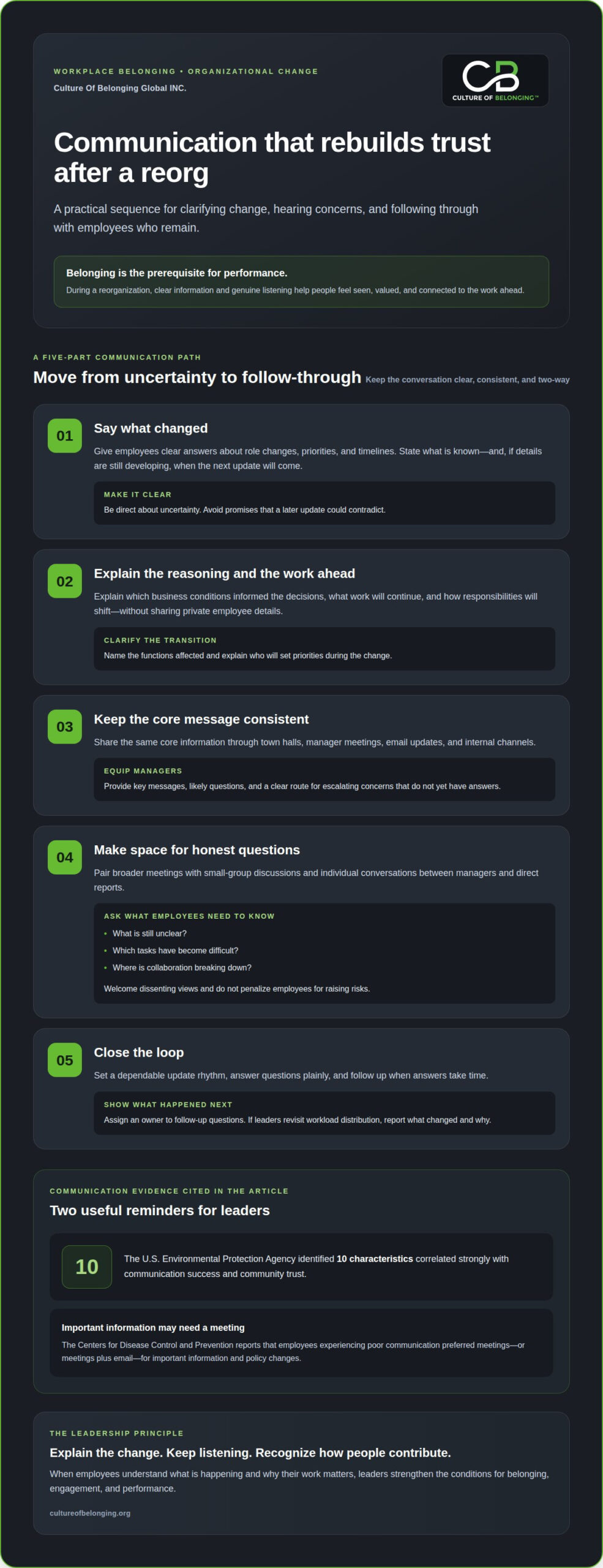
Leaders can communicate transparently after a reorg by stating what changed, why decisions were made, and what happens next. Share the same core message in town halls, manager meetings, email updates, and internal channels. Employees need clear answers about role changes, priorities, and timelines, not polished language that avoids hard questions. If information is still developing, explain what’s known and when you’ll update the team.
Explain the reasoning behind layoffs without sharing private employee details. Clarify which business conditions informed the decision, what work will continue, and how responsibilities will shift. For example, a leader might explain that a team is being consolidated, name the functions affected, and outline who will set priorities during the transition. Be direct about uncertainty. A promise made too quickly can damage trust if a later update contradicts it.
Consistency matters as much as candor. Give managers a shared briefing with key messages, likely questions, and a clear route for escalating unanswered concerns. The U.S. Environmental Protection Agency identified 10 characteristics that correlated strongly with communication success and community trust. The Centers for Disease Control and Prevention reports that employees experiencing poor communication preferred meetings, or meetings plus email, for important information and policy changes.
What are the best steps to rebuild trust after organizational change? Set a dependable update rhythm, invite questions, answer them plainly, and follow up when answers take time. Hold small-group discussions alongside broader meetings, then share responses to recurring questions. Managers should meet individually with direct reports to clarify responsibilities and hear concerns. Improving employee morale after a reorg takes follow-through: if leaders say they’ll revisit workload distribution, they should report what changed and why.
Make communication a two-way conversation. Ask employees what remains unclear, which tasks have become difficult, and where collaboration is breaking down. For example, a manager can end a team meeting by collecting questions and assigning an owner to each follow-up. Leaders should welcome dissenting views and avoid penalizing employees for raising risks. When people can speak honestly, the workplace has stronger conditions for belonging, engagement, and performance.
Layoffs can affect both employees who leave and those who remain. If a local site closure affects a town, explain the decision respectfully to community partners, protect departing employees’ privacy, and describe the transition support being offered. Listen to local concerns in a meeting with community representatives. Share accurate information about the organization’s next steps rather than making commitments beyond its control.
Communication also shapes how people experience workplace culture. Curtis Ray Hill’s perspective on Workplace Belonging and human-centered leadership connects belonging with the conditions for performance. After layoffs, leaders can make that principle tangible: explain how each role contributes, recognize the people carrying changed responsibilities, and keep listening as the team adjusts.
2. Team building to improve morale and reduce anxiety
A reorganization can redraw team boundaries faster than employees can rebuild working relationships. A project handoff that once took a quick conversation may now cross departments, managers, or locations. Team building works best when it helps people solve real coordination challenges, not when it adds a social event to an already full calendar. Start with the work, then create opportunities for employees to connect as they do it.
Managers can support employees whose roles or reporting lines changed by clarifying decision rights, introducing new partners, and arranging a focused working session. For example, a newly combined marketing and product group could map who owns research, approvals, and launch updates. Invite each person to describe their responsibilities and support needs. This makes new relationships practical while giving employees a clearer place on the team.
Rebuilding belonging also means helping employees understand how their work connects to a shared purpose. Ask the team to identify a customer or community need its combined work serves, then trace how each role contributes. A short project retrospective can show where handoffs work and where friction remains. These conversations make culture tangible: colleagues see one another’s contributions and understand why collaboration matters.
Choose team-building activities that are accessible, relevant, and connected to the organization’s mission. A cross-functional group might solve a current process problem, pair employees to share expertise, or volunteer with a local community organization. For a community activity, let employees help choose the organization and define the contribution. That respects local knowledge and avoids treating a serious transition as an excuse for a photo opportunity.
Recognition can strengthen team connection when leaders name a contribution and its impact. At a project review, recognize the analyst who surfaced a risk and the colleague who helped another team resolve it. Keep recognition specific and fair; praise should not repeatedly spotlight only the most visible roles. This supports a culture where employees feel noticed, named, known, and needed, rather than interchangeable on a new reporting chart.
Common mistakes that can worsen morale include forcing social events, ignoring workload concerns, and expecting employees to bond without clarifying responsibilities. A team lunch can’t repair a broken handoff or an unfair division of work. Before planning an activity, identify the challenge it should address, make participation inclusive, and follow up to see whether collaboration became easier.
For a team facing a particularly challenging transition, use a simple rhythm: connect around a shared task, reflect on what helped, then agree on one practical change. A manager might pair new colleagues on a customer issue, invite both to explain their approaches, and record a clearer handoff process. This creates trust through repeated actions, not forced closeness. Leaders shaping workplace belonging initiatives can use the same principle: make connection part of how work gets done.
3. Acknowledging employees’ emotional responses to change
A reorganization can bring relief, grief, frustration, and uncertainty to the same team. Leaders should acknowledge these responses without labeling employees difficult or disloyal. For example, after a reporting-line change, a manager can recognize that people may miss familiar colleagues while explaining what the new structure is meant to do. Acknowledgment shows respect; it doesn’t require leaders to agree with every reaction.
How should organizations address workload and burnout after a reorganization? Managers should identify essential work, clarify priorities, and involve employees in distributing new responsibilities. O.C. Tanner Institute research reports that employee burnout rises by 158% after layoffs, making workload conversations especially important during this transition.
Make employee voice part of the change process. Use anonymous surveys, small-group discussions, or one-on-one conversations to ask what feels unclear, stressful, or workable. Then report back on themes and actions. Resistance can point to practical problems, such as duplicated approvals or a role without clear decision authority. Treat those concerns as information to examine, not as an obstacle to success.
To measure morale and engagement, track consistent indicators over time. Ask employees whether they understand their responsibilities, feel heard, and see how their work contributes. Combine survey responses with team conversations and operational signals, such as missed handoffs or repeated priority changes. A quarterly well-being survey can help leaders spot patterns, but following up matters more than collecting answers and leaving them untouched.
How long does it take for employee morale to recover after a reorganization? There’s no single timeline. Recovery depends on whether roles become clear, workloads stay manageable, and leaders act on employee concerns. Instead of setting an arbitrary deadline, monitor how people describe their experience and whether agreed changes are happening.
Make mental health support and flexibility visible, not buried in a policy document. Managers can explain available resources, discuss schedule adjustments, and agree on a manageable workload with employees facing new demands. If someone says the transition is affecting their well-being, listen privately and focus on practical support. Don’t ask them to share personal details in a group meeting.
Belonging is a foundation for performance, and employee involvement helps create the conditions for it. Invite affected teams to test a new workflow, identify risks, and suggest improvements before decisions become routine. Explain which suggestions leaders adopted and why others weren’t feasible. Closing the loop shows that participation can shape the organization’s direction, even when change itself is inevitable.
Leaders who lack answers can say so instead of offering a shallow response. Mental health resources and flexibility can support adjustment, while anonymous surveys, an open-door policy, and small-group discussions help surface concerns. After employees have time to process layoffs, employers can work to rebuild morale through regular check-ins, recognition of contributions, and requests for feedback.
4. Recognition of employee contributions
After a reorganization, recognition helps employees see that their contributions still matter as roles shift. Make it specific: name the action, explain its impact, and connect it to a shared priority. A leader might recognize an employee who documented a handoff process, helping colleagues retain essential context during a team change. That detail carries more weight than general praise because it shows leadership noticed the work.
Timing matters. Recognize contributions soon after they happen, during a project review or one-on-one conversation. For example, a manager can thank an employee who helped a new colleague learn an unfamiliar system, then explain how that support helped the team meet its commitment. This recognition can encourage engagement by showing how everyday actions strengthen the team’s work.
The Belonging Effect™ offers a useful lens for recognition: Noticed, Named, Known, and Needed. Noticed means contributions are seen. Named means employees are recognized as individuals. Known means leaders understand them beyond their positions. Needed means employees understand why their contributions matter. After a reorg, managers can apply this sequence by noticing specific work, recognizing each person as an individual, learning their strengths, and explaining the value of their role.
Recognition should reflect the whole team’s contribution, not just visible wins. A successful launch may depend on the person who caught a data error, the colleague who coordinated a handoff, and the team member who answered customer questions. Naming these distinct efforts makes the path to success visible. It also addresses a common post-reorg risk: important work getting lost between newly divided roles.
Build fairness into recognition programs. Leaders can review who receives praise, which kinds of work are named, and whether credit is shared on joint projects. If the same high-profile roles dominate every update, recognize behind-the-scenes contributions too. Invite employees to suggest colleagues whose work deserves attention, while grounding recognition in observable actions rather than popularity or personal closeness.
Ask employees how they prefer to be recognized. One person may value public acknowledgment in a team meeting; another may prefer a private note explaining their impact. A manager can learn this preference in a check-in, then honor it consistently. The goal isn’t to create a reward for every task. It’s to make recognition meaningful, personal, and connected to the contribution.
Finally, connect recognition to learning and progress, not only completed outcomes. During a challenging transition, a team may be building a new process before results are clear. Leaders can acknowledge thoughtful testing, honest feedback, or a useful adjustment. This shows employees that their effort matters while the organization adapts. Recognition grounded in belonging helps people understand that they are valued and why their work is needed.
5. Employee involvement in the organization’s future
A reorganization changes the workforce, but employees still understand how work actually happens. Involve them in shaping what comes next, not just in receiving updates about decisions already made. This gives leaders a clearer view of process gaps, needed skills, and customer or community needs that may be missed at the executive level.
Effective ways to involve employees in post-reorg decisions include listening sessions, cross-functional working groups, process pilots, and structured feedback on proposed changes. Set the scope before asking for input: explain which decisions are open, who will decide, and when employees will hear the outcome. Clear boundaries prevent participation from feeling like a promise of control leaders can’t deliver.
Start with a real challenge. For example, a newly combined operations team could map a recurring approval delay, identify where knowledge gets lost, and recommend a simpler handoff. Include employees who do the work, managers who own the process, and partners who receive its output. Their different perspectives can reveal friction that an organization chart won’t show.
Make participation accessible to the whole team. Offer several ways to contribute, such as a small-group discussion, an anonymous form, or written feedback after a working session. Employees may hesitate to speak in front of a new manager, especially when concerns about job security or role changes remain. Leaders should explain how responses will be used and make room for candid concerns.
Close the loop visibly. After gathering input, summarize what employees raised, what leadership will change, and what it won’t change. Explain the reasoning without dismissing concerns. For instance, if a proposed workflow pilot can’t proceed, share the constraint and identify another way to test the team’s idea. Following through shows that employee voice can inform decisions, even when leaders retain final accountability.
Involvement can also shape future opportunities. Ask employees which skills the new structure requires, where they want to contribute, and what development would help them take on that work. A manager might pair an employee with deep customer knowledge with a colleague learning a new account process. That exchange recognizes existing expertise while supporting growth and engagement.
Keep participation connected to action. Assign an owner to each agreed change, set a review point, and report whether the adjustment helped. A team testing a new handoff can review missing information and employee feedback together, then revise the process. This turns involvement from a one-time meeting into a practical way to build trust and shape the organization’s future.
For leaders seeking to make belonging central to post-reorg decisions, explore a Workplace Belonging keynote on human-centered leadership.
Culture Of Belonging Global INC.
Culture Of Belonging Global INC. helps leaders turn workplace belonging into practical support during organizational change. When morale challenges extend beyond one team or require a more consistent leadership approach, its keynotes, workshops, professional development, and consulting can help organizations strengthen the conditions for connection, engagement, and performance. The work reflects founder Curtis Ray Hill’s central principle: belonging is the prerequisite for performance. It can help leaders examine whether employees feel noticed, valued, understood, and connected to meaningful work, then apply those insights to the culture people experience every day. To discuss support for your organization’s transition, contact Culture Of Belonging Global INC.
Make belonging part of what comes next
A reorganization changes the structure; leaders shape what that change means in daily work. The next step is to make belonging visible in decisions, relationships, and how people understand their contributions. That takes more than a one-time message. It requires attention to employees’ experience after the announcement, when new routines and expectations become real.
Improving employee morale after a reorg is an ongoing leadership practice, not a quick morale campaign. Keep listening as teams settle into new responsibilities. Notice where people feel connected and where the experience falls short of the culture leaders intend. Then make visible adjustments. Belonging is a foundation for performance: people need to feel valued and connected to contribute fully.
If your organization is ready to put Workplace Belonging into practice during change, Curtis Ray Hill, founder of Culture Of Belonging Global INC., is a leading authority and keynote speaker on Workplace Belonging. Start a conversation with Culture Of Belonging Global INC. about supporting your leaders and teams. A more connected next chapter begins with the choices leaders make today.
Frequently Asked Questions
What causes employee morale to decline after a reorganization?
Morale can decline when employees can’t tell how the new structure affects their security, status, or influence. A specialist who once made decisions may now need several approvals, while a colleague’s departure can take away trusted relationships and institutional knowledge. If leaders announce new titles but leave decision-making unclear, employees may interpret the gap as a loss of trust. Morale can also suffer when people believe teams were treated inconsistently.
How can companies recognize and reward employees after a reorg?
Recognize employees with specific, timely acknowledgment of their contributions, and make sure behind-the-scenes work gets credit. For example, after a new process launches, a leader can recognize the person who documented it and the colleagues who tested it. Ask employees whether they prefer public or private recognition. Where appropriate, pair acknowledgment with meaningful development opportunities, such as leading a project that draws on their skills and interests.

Article by
Curtis Ray Hill
Curtis Ray Hill, MAT, M.Ed., is a workplace belonging keynote speaker, culture strategist, author, and founder of Culture of Belonging Global®. For more than two decades, his work has centered on one core belief: belonging is the prerequisite for performance.
Curtis has worked with leaders and organizations including Pfizer, State Farm, BP, Southwest Airlines, Hallmark, and Avis Budget Group, bringing a practical, human-centered approach to workplace belonging, employee engagement, employee experience, psychological safety, and organizational culture. His background spans education, leadership, and process improvement, and he holds a Black Belt in Lean Six Sigma.
He is the author of Creating a Culture of Belonging: From Feeling Like to Knowing You Belong, a book focused on moving belonging beyond intention and creating environments where people know they belong.
Curtis is also the creator of The Belonging Effect™, his proprietary framework built around four human experiences: Noticed → Named → Known → Needed. His work equips leaders to translate belonging into everyday leadership behaviors and workplace experiences that create stronger conditions for engagement and performance.
Through his keynotes, consulting, writing, and thought leadership, Curtis is advancing workplace belonging as a business and leadership priority—not simply a culture initiative. His work connects belonging to human-centered leadership, psychological safety, employee experience, retention, engagement, and performance. His goal is to move organizations beyond talking about belonging to creating workplaces where people experience it every day—and where belonging becomes the foundation for how people connect, contribute, and perform.
Disclaimer
The content published on this website by Curtis Ray Hill and Culture of Belonging Global® is provided for general informational and educational purposes only. It is intended to share perspectives, frameworks, strategies, research, and ideas related to workplace belonging, organizational culture, leadership, employee experience, engagement, retention, psychological safety, and related topics.
No Professional Advice. Nothing on this website constitutes or should be relied upon as legal, financial, accounting, employment, human resources, medical, psychological, compliance, or other professional advice. The information provided is not a substitute for advice from qualified professionals familiar with your organization, circumstances, jurisdiction, employees, policies, and applicable laws or regulations.
No Guarantee of Results. Curtis Ray Hill and Culture of Belonging Global® make no representation, warranty, promise, or guarantee that any framework, strategy, recommendation, keynote, training, consulting engagement, or other information discussed on this website will produce any particular result. Organizational outcomes vary based on numerous factors, including leadership, implementation, organizational culture, industry, workforce, resources, timing, and circumstances.
Research, Statistics, and Results. Statistics, research findings, survey data, industry findings, quotations, and third-party information referenced in an article should be considered within the context, methodology, limitations, and publication date of the original source. Any specific client result or organizational outcome referenced is illustrative of that particular experience and should not be interpreted as typical, expected, or guaranteed for another organization.
Independent Decision-Making. Readers and organizations are responsible for evaluating the suitability of any ideas, strategies, frameworks, or recommendations for their own circumstances. Before implementing decisions that may affect employees, employment practices, workplace policies, compliance obligations, finances, or business operations, consult the appropriate qualified legal, HR, financial, compliance, or other professional advisers.
Third-Party References. References to companies, organizations, publications, research institutions, products, services, or other third parties are provided for informational or contextual purposes. Unless expressly stated, such references do not imply endorsement, sponsorship, partnership, validation, or approval by or of Curtis Ray Hill or Culture of Belonging Global®.
Intellectual Property. Culture of Belonging®, The Belonging Effect™, The Invisible Floor Plan™, and other identified proprietary concepts, frameworks, names, and materials associated with Curtis Ray Hill and Culture of Belonging Global® are protected intellectual property where applicable. Nothing published on this website grants permission to reproduce, distribute, modify, teach, sell, license, or commercially exploit proprietary materials without authorization.
Limitation of Responsibility. To the fullest extent permitted by applicable law, Curtis Ray Hill and Culture of Belonging Global® disclaim responsibility for losses, damages, liabilities, or consequences arising from reliance upon or application of information contained on this website. Use of this content and any decisions based upon it are undertaken at the reader's or organization's own discretion and risk.
Information may be updated, revised, or become outdated over time. Readers should verify information that is material to an organizational, employment, legal, financial, or compliance decision and consult qualified professionals when appropriate.


