Blame can look like accountability, but it often teaches people to protect themselves rather than solve problems. Understanding how to shift from a blame culture to accountability starts with interrupting that reflex: examine what happened, what conditions contributed, and what each person can take responsibility for next.
It’s reasonable to want clear responsibility when work goes wrong. But accountability isn’t about finding someone to fault. It means setting clear expectations, listening to the people closest to the work, and following through on meaningful action. When employees feel respected and included, a sense of belonging can support honest communication, engagement, and performance.
This article explains how leaders can reframe blame-filled conversations, look beyond individual mistakes to the systems around them, and co-create a culture-change plan with employees. You’ll also see how leaders’ responses shape whether people speak up, why shared responsibility depends on clear commitments, and how professional culture-change support can help turn good intentions into consistent practice.
Key Takeaways
- Model accountability under pressure by owning mistakes, sharing credit, and following through consistently.
- Separate accountability from blame: focus on clear expectations, contributing conditions, and constructive next steps.
- Use self-awareness and leadership development to recognize how your own responses shape team ownership.
- Interrupt blame habits by redirecting conversations from fault-finding toward facts, impact, and a specific action.
- Involve employees in shaping culture-change plans, then show their input matters through visible follow-through.
Want to Shift Team Culture from Blame to Responsibility?
Leaders looking for how to shift from a blame culture to accountability need to model ownership in visible, repeatable ways. Their conduct under pressure shows whether responsibility is shared or merely demanded.
Publicly Owning Leadership Mistakes
Publicly owning a leadership mistake means naming your part and its impact, then explaining how you’ll correct it without deflecting blame. Employees notice how leaders respond when plans fail. For example, a manager who missed a handoff can acknowledge the delay, explain what they’ll change, and recognize colleagues who raised the risk. Consistent follow-through makes that admission a standard practice, not a one-time performance.
Blame and Accountability Cultures
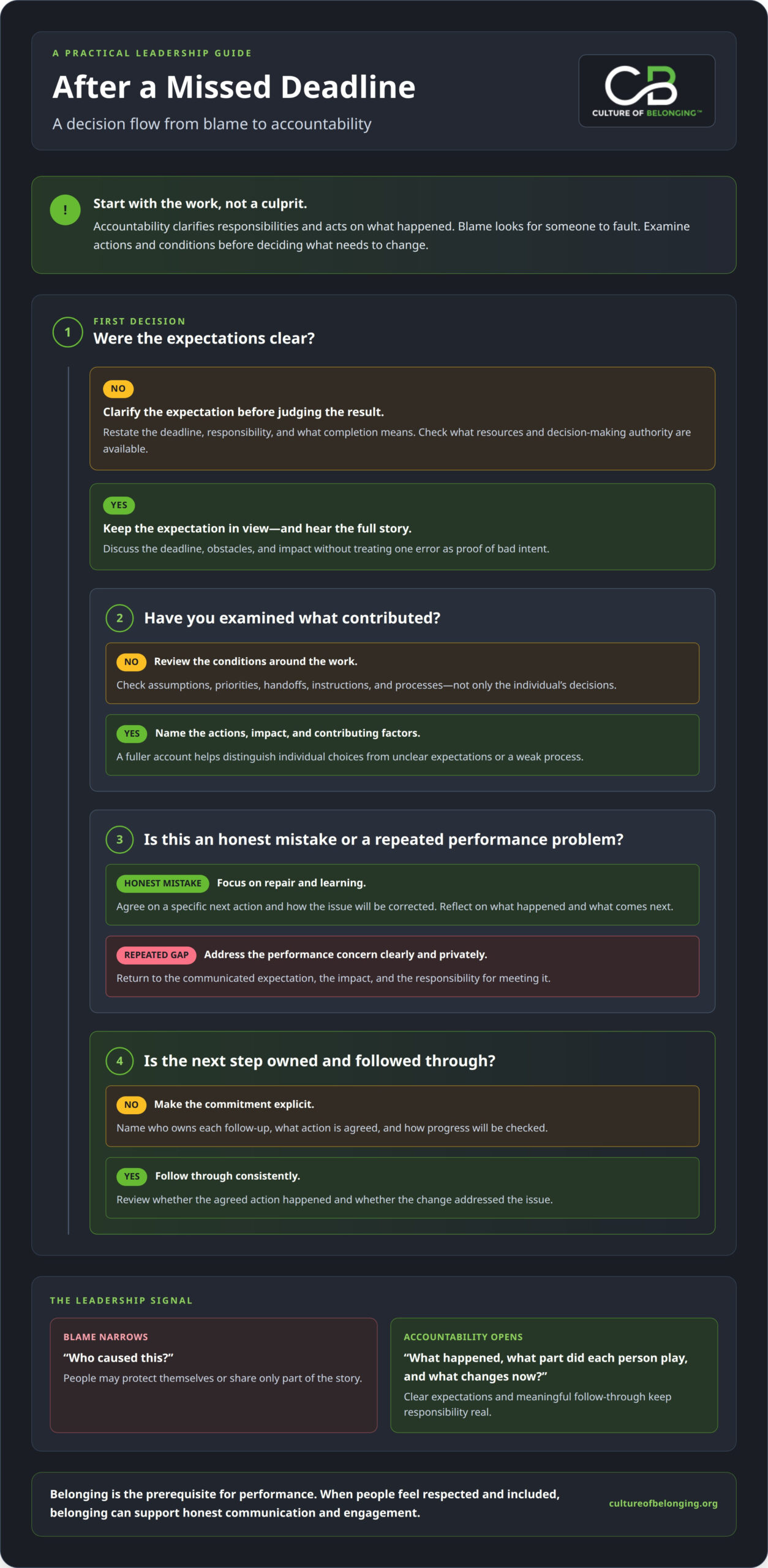
A blame culture looks for someone to fault; an accountability culture clarifies responsibilities and acts on what happened. For leaders asking how to shift from a blame culture to accountability, that distinction changes the first response to a problem. If a project misses a deadline, examine assumptions, priorities, and processes before judging an individual. Then address any clear performance gap directly, without treating one error as proof of bad intent.
Accountability Systems and Performance Metrics
An accountability system connects clear expectations with named owners, follow-up, and measures tied to shared goals. Useful indicators include whether people complete commitments, raise concerns early, and follow through on agreed changes. No single metric suits every organization. Choose measures that reflect the work and don’t reward speed at the expense of quality or collaboration.
Organizations can measure cultural progress by reviewing these indicators alongside employee feedback about speaking up and leadership responses. Look for patterns in meetings and follow-up, not only individual outcomes. A check-in during the first 10 minutes of a meeting can surface whether employees feel heard and whether promised actions happened. The operational approach to workplace belonging connects everyday practices with the culture employees experience.
Holding Employees Accountable Without Fear
Managers can hold employees accountable without creating fear by setting clear expectations, hearing the full story, and agreeing on a specific next action. If a task is late, discuss the deadline, obstacles, and impact, then clarify who owns each follow-up. Explain what resources and decision-making authority are available. Belonging can support honest communication, while consistent standards keep responsibility real. Address repeated performance problems clearly and privately.
Belonging can support honest communication, while leaders’ responses show whether responsibility is genuinely shared. Leaders move an organization beyond blame through consistent, observable behavior, especially under pressure. They should model taking responsibility rather than deflecting it, encouraging accountability across the organization.
When leaders make mistakes, they can take responsibility, acknowledge their role, and apologize when needed. They can turn mistakes into learning opportunities by reflecting on their choices, learning from what happened, and focusing on what comes next. Managers also help employees adopt a culture of responsibility by modeling accountability, providing guidance, and following up consistently. Their response to setbacks makes the example visible.
What Is the Difference Between a Blame Culture and a Culture of Accountability?
A blame culture treats a mistake as evidence against a person; a culture of accountability treats it as a reason to examine actions, conditions, and commitments. The difference shapes what happens after a missed deadline: people either protect themselves or share enough information to address the problem.
According to the Internet Encyclopedia of Philosophy, responsibility means an act can be attributed to someone reasonably expected to answer for it, but responsibility doesn’t necessarily imply fault. At work, a project owner can explain a missed handoff and help repair its impact without being treated as the sole cause. Separating responsibility from fault keeps ownership clear while leaving room to examine contributing factors.
Blame narrows the conversation to “Who caused this?” Accountability broadens it: “What happened, what part did each person play, and what changes now?” For example, if a team delivers an incomplete report, the manager can review the handoff, instructions, and review process alongside the employee’s decisions. That fuller account can reveal whether individual actions, unclear expectations, or a weak process shaped the outcome.
The consequences show up in what employees choose to share. Fear of blame can discourage risk-taking and innovation, while people who expect criticism may hide mistakes or offer only partial information. Teams then have less context for solving problems. Accountability still addresses performance concerns, but it starts with the facts and makes expectations, impact, and next steps explicit.
Consider the difference between a public reprimand and a focused review after an error in a client deliverable. The reprimand centers on the person and can signal that speaking up is risky. A focused review identifies the error, checks how it moved through the workflow, and clarifies who will correct it. Leaders can then distinguish an honest mistake from a repeated failure to meet a clearly communicated expectation.
Belonging shapes whether employees feel able to contribute what they know. In Culture of Belonging®, belonging is the prerequisite for performance: people need to feel their contributions matter before they can engage fully. A team’s stated values are its “carpet”; employees experience the “concrete” in everyday responses. If leaders claim to welcome openness but punish candid updates, the concrete tells the real story.
These patterns can reinforce one another. Fear of blame can discourage risk-taking and innovation, make problems harder to solve, and contribute to errors. When conversations feel accusatory, people may protect themselves by sharing only partial information. That leaves the team with less context to understand what went wrong and decide what to address.
Repeated blame can also shift attention away from improvement. People who are repeatedly blamed may lose motivation to improve and focus on hiding mistakes. That response limits opportunities to acknowledge errors and learn from them. By contrast, inviting a full account helps people discuss what happened and identify the actions or commitments that need follow-through. The goal isn’t to remove responsibility, but to make it possible to address problems with enough information. When employees can speak candidly about mistakes, teams are better positioned to correct them instead of letting incomplete accounts obscure what needs attention.
How Self-Awareness Helps Leaders Stop Blame
Self-awareness helps leaders catch the moment when pressure turns curiosity into accusation. Before assigning fault, separate what you observed from what you assumed. If a missed handoff triggers frustration, a manager might ask, “What did I expect, and did I make it clear?”
That pause makes leadership responsibility practical. A director reviewing a delayed launch, for example, can examine whether shifting priorities or unclear approvals contributed. They can acknowledge their own role, then clarify what they’ll do differently next time. Employees see responsibility modeled as a behavior, not just a value printed in a meeting room.
Leaders can build this awareness through a repeatable reflection after difficult conversations. They can note the trigger, their first interpretation, the response they chose, and its effect on the discussion. If a team member brings bad news and receives a sharp reply, the leader can revisit the exchange and identify a calmer, more useful response.
Leadership development gives managers a place to practise that response before pressure rises. A role-play can use a familiar workplace scenario: an employee challenges a deadline, and the manager feels dismissed. The manager practises asking what constraint they may be missing, then explains the impact and agrees on a next step. Professional development can strengthen these communication and reflection skills.
Ownership also grows when leaders invite specific feedback about their impact. After a tense planning meeting, a manager might ask a colleague, “Which part of my response helped the discussion, and which part shut it down?” The next step is to listen without rebuttal, name one adjustment, and demonstrate it in the following meeting. Repeated actions make the change observable.
Self-awareness supports success when it changes decisions, not just intentions. Leaders can review whether they clarified priorities, shared authority, or provided resources before holding someone responsible. That review doesn’t remove performance expectations. It helps distinguish an employee’s choices from conditions leaders can improve, giving teams a clearer path toward shared ownership.
Blame and Excuses Are Habits That Can Be Interrupted
Blame and excuses can become automatic responses to pressure, but leaders can interrupt the pattern. A practical answer to how to shift from a blame culture to accountability is to notice the reflex, examine what shaped the problem, and agree on a useful next action.
Start by identifying a repeated exchange. For example, one department blames another for a late report, and the other responds by listing competing priorities. The conflict resurfaces at the next deadline. A leader can name the cycle without accusing anyone: “We’re explaining the delay, but haven’t agreed how to prevent it.” That observation makes the pattern discussable.
Next, reframe the conversation around evidence and conditions. Ask what information was missing, which priorities competed, and how the process shaped each person’s choices. If two teams assumed the other owned client updates, map the handoff and assign a clear owner. This shifts the discussion from judging intent to correcting the structure that allowed confusion.
Questions help only when they lead to decisions. After hearing each perspective, summarize what needs to change, what will happen differently, and who owns the next action. A project lead might assign one person to send status updates and another to flag resource conflicts. Set a follow-up point so the agreement is visible in practice. Otherwise, even a better conversation can end in inaction.
Leaders also need to examine their role in recurring patterns. If a manager labels every new request “urgent,” employees may abandon planned work whenever priorities shift. The manager can clarify which work takes precedence, explain the trade-offs, and ask requesters to acknowledge what urgent work displaces. This makes competing priorities explicit and reduces the conditions that invite later excuses.
Interrupting blame doesn’t mean ignoring performance problems. Once the discussion centers on facts and contributing conditions, address missed commitments directly. Describe the agreed standard, the gap, its impact, and the required change. If someone repeatedly misses a clear commitment, address the pattern without turning a mistake into a judgment about character. That distinction keeps accountability focused on conduct and expectations.
Leaders working out how to shift from a blame culture to accountability should make new behaviors part of everyday routines. Meetings can check whether concerns are raised early and agreed actions completed. Respond with consideration, keep promises, and adjust processes when evidence points to a system issue. Repeated practice can help teams replace familiar blame cycles with candid, constructive problem-solving.
How a Professional Facilitator Can Help Co-Create a Culture-Change Plan
A professional facilitator gives employees and leaders a structured way to examine blame, hear different perspectives, and build shared commitments. The plan becomes meaningful when leaders act on what employees say.
Recognizing Blame Culture Signs
A blame culture shows up when employees expect criticism, withhold concerns, or focus on protecting themselves after problems. For example, team members may stay silent about a risky handoff because previous updates were met with public criticism.
Other signs include decisions made before employee input is considered, frequent deflection, and unresolved conflict between departments. In these situations, people may manage personal risk instead of contributing useful information. This can make it harder to build a workplace where employees feel engaged and understand how their contributions matter.
Following Through After Employees Speak Up
Following through means responding to employee concerns with consideration, clear next steps, and visible action. If employees describe a confusing approval process, leaders can summarize the issue, identify what needs to change, and assign someone responsibility for the follow-up.
Leaders should also report back, even when an idea can’t be adopted. Explain the decision and its constraints, then say what will happen instead. When employees see their input considered and receive updates on actions, speaking up feels purposeful rather than like a risk with no return.
Building Psychological Safety and Accountability
Professional guidance can help an organization build psychological safety and accountability through structured conversations, identifying recurring barriers, and turning employee input into commitments. A facilitator can invite perspectives across roles, redirect blaming language toward shared problems, and help people distinguish individual actions from system conditions.
The plan should specify what changes, who owns each action, and when leaders will review progress. For example, if employees report unclear cross-team priorities, leaders can clarify decision rights and establish a regular review of competing work. This combination supports candid communication without removing responsibility for agreed expectations.
Culture-Change Risks and Mistakes
A common mistake is asking employees to speak openly, then ignoring their feedback or making decisions before listening. The gap between stated values and experienced behavior can deepen distrust. Another risk is treating a workshop or new policy as the entire culture-change effort.
Facilitators can help leaders include relevant colleagues, surface wider organizational tensions, and build collaboration into meetings and measures of success. Leaders must then address actual performance problems clearly and apply expectations consistently. If employee input reveals a process issue, blaming someone for working within it leaves the cause intact and can make it harder to build a culture where people feel they belong.
Culture of Belonging Global
Culture Of Belonging Global INC. helps organizations consider how accountability and belonging show up in everyday work. If blame patterns persist across teams or employees hesitate to contribute, its organizational culture work can help leaders bring perspectives together and turn shared priorities into practical commitments. The organization remains responsible for its decisions and follow-through; professional support provides a structured way to work through the change.
Curtis Ray Hill is the founder of Culture Of Belonging Global INC. and a leading authority and keynote speaker on Workplace Belonging. His central philosophy is that belonging is the prerequisite for performance. Belonging strengthens the conditions for employee engagement, psychological safety, and contribution, without guaranteeing a particular business outcome. Leaders can use this perspective to examine whether workplace behaviors match the culture they intend to create.
Culture of Belonging® is the broader philosophy guiding this work. The Belonging Effect™ is a specific framework with four stages: Noticed (contributions are seen), Named (recognized as individuals), Known (understood beyond the position), and Needed (understanding why their contribution matters). Together, these concepts can help leaders examine whether people feel connected to the purpose of their work, and whether organizational practices support that experience. The focus stays on people’s lived experience, not slogans alone.
Culture Of Belonging Global INC. offers Keynotes, Workshops, Professional Development, and Consulting focused on organizational culture. Keynotes create a new shared language through real-time learning, conversations, and exploration. Workshops and Professional Development help leaders and employees explore how everyday interactions shape workplace experience. Consulting offers executive-level guidance and a strategic roadmap to support culture transformation.
This support can be relevant when leaders need to address blame across teams, make space for employee perspectives, or carry a culture-change plan into daily routines. The work can help clarify whose perspectives matter, what the organization intends to change, and how leaders will respond after employees speak up. This focus connects human-centered leadership with the conditions for engagement and performance, while keeping responsibility for implementation with the organization.
To discuss workplace culture support for your organization, contact Culture Of Belonging Global INC.
Frequently Asked Questions
What leadership behaviors help shift a workplace from blame to accountability?
Leaders build accountability by making decision rights and standards visible before work begins. For example, before a product launch, clarify who approves the final release and who communicates a delay. Invite disagreement while plans are still being shaped, then explain the decision. This helps employees understand how to contribute, where to raise concerns, and what they’re responsible for delivering.
How should leaders respond to mistakes and failures to encourage learning and ownership?
Leaders should first limit the impact, then review what happened without turning the discussion into a public judgment. If a customer receives incorrect information, correct the message promptly and agree on who will update affected colleagues. Afterward, hold a focused review: what was expected, where the work diverged, and what safeguard could prevent a repeat? Keep learning discussions distinct from performance management.
How can employees be coached to take ownership and address problems proactively?
Coach employees to bring a concern with its impact, a possible response, and a clear request for support. For example, an employee who sees a deadline at risk can explain what has changed, outline the consequence, and recommend a revised sequence of work. If they lack authority to act, help them identify the right decision-maker and agree on when to escalate the issue.

Article by
Curtis Ray Hill
Curtis Ray Hill, MAT, M.Ed., is a workplace belonging keynote speaker, culture strategist, author, and founder of Culture of Belonging Global®. For more than two decades, his work has centered on one core belief: belonging is the prerequisite for performance.
Curtis has worked with leaders and organizations including Pfizer, State Farm, BP, Southwest Airlines, Hallmark, and Avis Budget Group, bringing a practical, human-centered approach to workplace belonging, employee engagement, employee experience, psychological safety, and organizational culture. His background spans education, leadership, and process improvement, and he holds a Black Belt in Lean Six Sigma.
He is the author of Creating a Culture of Belonging: From Feeling Like to Knowing You Belong, a book focused on moving belonging beyond intention and creating environments where people know they belong.
Curtis is also the creator of The Belonging Effect™, his proprietary framework built around four human experiences: Noticed → Named → Known → Needed. His work equips leaders to translate belonging into everyday leadership behaviors and workplace experiences that create stronger conditions for engagement and performance.
Through his keynotes, consulting, writing, and thought leadership, Curtis is advancing workplace belonging as a business and leadership priority—not simply a culture initiative. His work connects belonging to human-centered leadership, psychological safety, employee experience, retention, engagement, and performance. His goal is to move organizations beyond talking about belonging to creating workplaces where people experience it every day—and where belonging becomes the foundation for how people connect, contribute, and perform.
Disclaimer
The content published on this website by Curtis Ray Hill and Culture of Belonging Global® is provided for general informational and educational purposes only. It is intended to share perspectives, frameworks, strategies, research, and ideas related to workplace belonging, organizational culture, leadership, employee experience, engagement, retention, psychological safety, and related topics.
No Professional Advice. Nothing on this website constitutes or should be relied upon as legal, financial, accounting, employment, human resources, medical, psychological, compliance, or other professional advice. The information provided is not a substitute for advice from qualified professionals familiar with your organization, circumstances, jurisdiction, employees, policies, and applicable laws or regulations.
No Guarantee of Results. Curtis Ray Hill and Culture of Belonging Global® make no representation, warranty, promise, or guarantee that any framework, strategy, recommendation, keynote, training, consulting engagement, or other information discussed on this website will produce any particular result. Organizational outcomes vary based on numerous factors, including leadership, implementation, organizational culture, industry, workforce, resources, timing, and circumstances.
Research, Statistics, and Results. Statistics, research findings, survey data, industry findings, quotations, and third-party information referenced in an article should be considered within the context, methodology, limitations, and publication date of the original source. Any specific client result or organizational outcome referenced is illustrative of that particular experience and should not be interpreted as typical, expected, or guaranteed for another organization.
Independent Decision-Making. Readers and organizations are responsible for evaluating the suitability of any ideas, strategies, frameworks, or recommendations for their own circumstances. Before implementing decisions that may affect employees, employment practices, workplace policies, compliance obligations, finances, or business operations, consult the appropriate qualified legal, HR, financial, compliance, or other professional advisers.
Third-Party References. References to companies, organizations, publications, research institutions, products, services, or other third parties are provided for informational or contextual purposes. Unless expressly stated, such references do not imply endorsement, sponsorship, partnership, validation, or approval by or of Curtis Ray Hill or Culture of Belonging Global®.
Intellectual Property. Culture of Belonging®, The Belonging Effect™, The Invisible Floor Plan™, and other identified proprietary concepts, frameworks, names, and materials associated with Curtis Ray Hill and Culture of Belonging Global® are protected intellectual property where applicable. Nothing published on this website grants permission to reproduce, distribute, modify, teach, sell, license, or commercially exploit proprietary materials without authorization.
Limitation of Responsibility. To the fullest extent permitted by applicable law, Curtis Ray Hill and Culture of Belonging Global® disclaim responsibility for losses, damages, liabilities, or consequences arising from reliance upon or application of information contained on this website. Use of this content and any decisions based upon it are undertaken at the reader's or organization's own discretion and risk.
Information may be updated, revised, or become outdated over time. Readers should verify information that is material to an organizational, employment, legal, financial, or compliance decision and consult qualified professionals when appropriate.