

Leaders don’t need to be mental health experts to shape how people experience work. The leader’s role in employee well-being is to help create conditions where employees can speak up, feel valued, and do meaningful work without treating their health as an afterthought. That influence shows up in everyday decisions, not just formal policies.
It’s easy to assume well-being belongs to HR or a workplace program. Those resources matter, but employees also notice what leaders model, how they respond to concerns, and whether flexibility and support are real in practice. Feeling seen, understood, and connected to meaningful work can support a sense of belonging and help people contribute at work.
This article explains how leaders influence employee well-being and mental health through role modeling, supportive conversations, participation in well-being initiatives, and flexible work. It also explores how psychological safety and belonging shape those experiences, and what human-centered leadership looks like in the ordinary rhythm of a working day.
Key Takeaways
- Leaders shape psychological safety through how they respond to questions, concerns, mistakes, and feedback.
- Model healthy boundaries and take part in well-being initiatives to make support visible in everyday work.
- Discuss work-related stress and workload with care while respecting employees’ privacy and autonomy.
- Use flexible work and practical well-being resources to give people more agency in how they manage their work.
- Connect everyday leadership behaviors to belonging: people are better positioned to contribute when they feel seen, understood, and valued.
Are Leaders Responsible for Employee Wellbeing?
Yes. Leaders shape daily working conditions through their decisions, responses, and example. Their role complements HR’s organization-wide policies and resources.
Psychological Safety at Work
Psychological safety means team members can raise concerns, offer ideas, and admit mistakes without fearing retaliation. At work, this makes it easier to explain workload pressure or ask for support before difficulties deepen. Professor Amy C. Edmondson’s research found that employees in psychologically safe workplaces show higher performance and stronger commitment to their organization’s vision. For example, a leader who thanks someone for flagging a project risk makes speaking up part of the culture. Inclusive responses also help people with different experiences feel heard and valued, strengthening belonging and engagement.
Leadership as a Psychosocial Hazard
Poor leadership can become a psychosocial hazard when aggressive behavior, disregard for team members, or harmful treatment exposes employees to avoidable stress. A manager who repeatedly humiliates someone for raising a concern can make silence feel safer than honest communication. Harassment and discrimination also undermine the conditions people need to feel respected at work. Leaders should notice patterns such as dismissive feedback or unreasonable pressure, address harmful conduct, and give employees room to discuss work-related concerns privately. Leaders’ well-being matters, too: an overwhelmed manager may have less capacity to listen patiently or respond consistently.
Leadership and HR Responsibilities
Managers shape employees’ everyday experience, while HR helps establish and coordinate organization-wide well-being policies, practices, and resources. A manager can discuss a team member’s workload, clarify priorities, and respond respectfully when stress affects a project. HR can support consistent processes and connect employees with available resources. Neither role replaces the other. When an employee reports unsustainable demands, for example, the manager can address immediate work allocation while HR helps examine whether broader practices need attention. A policy cannot replace a respectful conversation, and one manager cannot resolve every system-wide concern.
Measuring Leadership’s Well-Being Impact
Organizations can track leadership’s influence by gathering employee feedback about psychological safety, workload, support, and belonging over time. Anonymous pulse surveys can ask whether team members feel safe raising concerns and whether leaders respond constructively. Pair those responses with relevant workplace indicators, such as engagement feedback, absence patterns, or retention trends, and look for differences across teams. A change in one measure doesn’t establish its cause. Leaders and HR can compare survey themes with specific practices, such as how managers handle mistakes, then use follow-up feedback to see whether employees notice a difference.
Responsibility is shared, but it shows up in daily choices: who gets heard, how pressure is handled, and whether harmful behavior is addressed. When leaders make psychological safety part of the working culture, employees have firmer ground for expressing needs, contributing ideas, and building a sense of belonging.
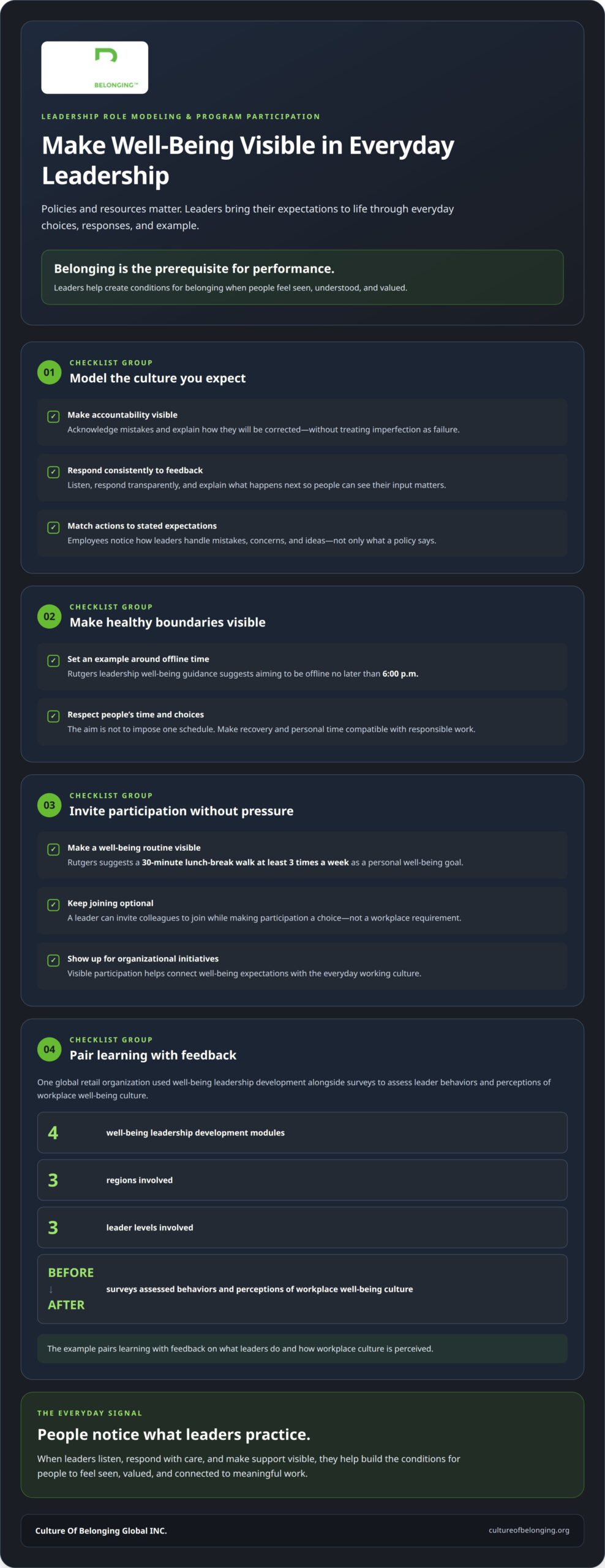
Leadership role modeling and program participation
Employees notice whether leaders practice the well-being behaviors an organization says it values. A policy gains credibility when leaders make those expectations visible in everyday work.
Leaders as Workplace Culture Role Models
Leaders model workplace culture through repeated choices: how they handle mistakes, respond to feedback, and set expectations. These choices show employees what the organization rewards in practice, not just what its policies say. For example, a manager who acknowledges an error and explains how it will be corrected makes accountability visible without treating imperfection as failure.
Consistency matters. If leaders invite feedback but become defensive when employees offer it, people may hesitate to speak up next time. When leaders listen, respond transparently, and explain what happens next, employees can see that their input matters. These behaviors can strengthen trust, connection, and job satisfaction, supporting a culture where people contribute with greater confidence.
Modeling Well-Being Behaviors
Leaders model well-being by setting boundaries for themselves and respecting employees’ time and choices. Rutgers’ leadership well-being guidance suggests that leaders set an example by aiming to be offline no later than 6:00 p.m. The point is not to impose one schedule on everyone. It is to make recovery and personal time compatible with responsible work.
Other examples can make the message tangible. Rutgers suggests a 30-minute lunch-break walk at least three times a week as a personal well-being goal. A leader might invite colleagues to join, while making participation optional. That approach signals that well-being matters without turning one person’s routine into a workplace requirement.
Participation also means showing up for organizational initiatives. One global retail organization used four well-being leadership development modules across three regions and three leader levels. Participants completed surveys before and after the programs to assess their behaviors and perceptions of workplace well-being culture. The example illustrates a useful principle: programs can combine learning with feedback on what leaders actually do.
In the organizational context described, formal policies alone did not strongly accelerate behavior change. Leaders bring policies to life when they make time for reflection, respond to feedback, and demonstrate expected behaviors. For instance, a manager who takes a real break instead of praising constant availability reinforces a different norm through action.
When leadership teams need a shared language for these practices, Curtis Ray Hill’s keynote on belonging and human-centered leadership can help frame the conversation around the culture employees experience each day.
Leadership’s effects on employee mental health
Leadership affects mental health through workload, daily interactions, and whether employees feel safe discussing work-related strain. A manager’s response can make support easier to seek or harder to approach.
Mental Health Training for Managers
Mental health training helps managers recognize workplace concerns and respond with care, without trying to diagnose employees. This matters because a manager’s first response can shape whether a team member shares a work-related challenge. Training can include practice in listening, discussing workload, and explaining available support. For example, if an employee says competing deadlines are affecting their focus, a manager can clarify priorities and agree on a manageable next step.
Openness About Mental Health
Openness means employees can discuss mental health at work without being pressured to share private details. A Mind Share Partners study found that 19% of workers felt comfortable discussing mental health with senior leaders. These figures make leader behavior worth examining: a calm response to a request for support can help make future conversations feel more possible. Ask about work needs, not personal medical details.
Work Conditions and Employee Health
Work conditions include demands, time pressure, relationships, and employees’ control over how they complete tasks. These conditions shape the emotional and mental experience of work, not just its output. If deadlines repeatedly conflict, for instance, a manager can surface the trade-off, reset priorities, and explain decisions to the team. Leaders should address harmful treatment rather than treat distress as an individual weakness. This shifts attention to workplace factors leaders can influence.
Managers face pressure, too. Conflicting demands from senior leaders and employees can leave them feeling unable to satisfy either group. Middle managers may carry emotional demands, while top managers can face loneliness and time pressure. When stress changes a manager’s behavior, employees may feel the effects in communication and work quality. Leaders can name capacity constraints, seek support from their management team, and avoid passing pressure downward as unexplained urgency.
Workplace well-being includes physical, mental, and emotional health, as well as feeling valued, purposeful, supported, and connected. Leaders can make check-ins more useful by asking whether workload, focus, or energy is affecting a work goal. They should respect boundaries, protect confidentiality, and avoid assumptions about motivation. If a team member says their schedule is affecting concentration, discuss work adjustments and available support, then agree on a follow-up conversation.
These practices connect care with belonging. Employees are better positioned to contribute when leaders take work-related concerns seriously and respond respectfully.
Wellbeing initiatives and flexible work
Well-being initiatives work best when leaders connect resources to employees’ actual needs. Flexible work, clear boundaries, and meaningful connection can make that support practical.
Work-Life Boundaries
Work-life boundaries are shared expectations that protect time for work and personal life. Leaders help make them workable by setting realistic priorities and respecting agreed schedules. For example, a manager can clarify which tasks need attention today and which can wait, rather than treating every request as urgent.
Employees can set boundaries by communicating their working hours, planning breaks, and discussing workload conflicts early. Leaders can support those choices without prescribing how employees should spend personal time. Rutgers’ leadership well-being guidance suggests scheduling self-care breaks of 10 to 15 minutes every two hours. Teams can use that idea to normalize breaks while adapting them to the work.
Supporting Well-Being While Respecting Privacy
Leaders can support well-being without invading privacy by focusing conversations on work needs, not personal details. Ask whether workload, stress, or energy is affecting a work goal, then listen. Don’t ask for unrelated personal information, assume someone’s motives, or pressure them to share under the banner of support.
If an employee says competing deadlines are causing stress, for example, a manager can review priorities and agree on a follow-up. The employee doesn’t need to explain private circumstances for the conversation to be useful. Leaders should respect confidentiality and personal autonomy while making available resources clear. This balance lets employees say what would help without giving up control of their personal story.
Flexibility can also address work-related strain. Leaders can give employees autonomy over how they complete tasks while maintaining clear performance standards. A team member might shift work hours to manage responsibilities or work remotely when the role allows. The key is to connect flexibility to the work, communicate expectations, and avoid treating one arrangement as right for everyone.
Connection deserves attention alongside scheduling. Teams can make room for conversation through regular check-ins, mentoring, or shared activities that respect employees’ lives outside work. For example, a manager might invite employees to suggest a format that works for the team, rather than making social participation mandatory. Reflecting on who participates, whose needs are missed, and what employees request can guide practical adjustments.
Organizations can assess existing well-being policies, practices, and spaces before choosing changes. They can then pilot manageable initiatives, gather feedback, and adapt as needs shift. A workplace belonging initiative from Culture Of Belonging Global INC. connects these decisions to the daily conditions that support employee connection, agency, and contribution.
How leaders influence employee well-being
Leaders influence well-being through the conditions their decisions create. Their behaviors shape whether employees have the ability, clarity, and support to contribute without sustained strain.
One pathway is the connection between leadership behavior and employees’ sense that the organization cares. Employees who feel supported may experience stronger engagement and less burnout, while those who feel overlooked may hesitate to invest effort. A manager who checks capacity before assigning urgent work makes care tangible. A manager who rewards constant availability sends a different signal, even if the organization promotes balance.
Leadership also influences how employees understand their contribution. Curtis Ray Hill’s The Belonging Effect™ moves through four stages: Noticed (contributions are seen), Named (individuals are recognized), Known (people are understood beyond their position), and Needed (they understand why their contribution matters). A team member who receives specific recognition, individualized support, and a clear connection between their work and team priorities can better see how they fit. Belonging is the prerequisite for performance, not a substitute for clear goals.
That connection becomes practical when leaders pair high standards with autonomy. A project lead can define the outcome, clarify decision boundaries, and let employees choose how to organize the work. This keeps accountability visible while giving people room to use their abilities. If deadlines or responsibilities collide, leaders can surface the trade-off and reset priorities instead of quietly adding pressure.
Influence must also extend across leadership levels. Senior leaders establish priorities and make resource decisions; middle managers translate them into daily expectations; team leads see how those expectations land. If leadership asks managers to encourage recovery but praises only after-hours responses, for example, the organization sends conflicting signals. Aligning what leaders say, reward, and model helps employees understand which behaviors truly count.
Leaders can make well-being part of performance conversations without reducing people to metrics. Discuss workload balance, recovery practices, and whether employees have the tools to meet their goals. Then use the answers to adjust responsibilities or clarify what success looks like. Personal well-being is more strongly associated with leadership style than workplace well-being, making leaders’ own habits relevant to the culture they shape.
For executives and people leaders ready to connect leadership behavior with workplace belonging, explore Curtis Ray Hill’s keynote on human-centered leadership.
Culture of Belonging Global
Culture of Belonging® helps organizations connect employee well-being with the leadership behaviors that shape workplace culture. Curtis Ray Hill, the founder, delivers keynotes and provides workshops and consulting focused on building a Culture of Belonging®. The work advances a clear principle: belonging is the prerequisite for performance.
Turn to Culture of Belonging® when your leadership team needs a shared language for belonging, practical ways to apply human-centered leadership, or support aligning stated values with employees’ daily experience. Keynotes, workshops, and consulting help leaders examine how people are recognized, supported, and connected to meaningful work.
To discuss your organization’s workplace culture goals, contact Culture of Belonging Global®.
Make Well-Being Part of How Work Gets Done
The next step is to make well-being a leadership practice, not a message reserved for special initiatives. At a regular point in your team’s planning cycle, ask what is helping people do their best work and what is getting in the way. Then act on what you hear, explain what can change, and be candid about what cannot.
The leader’s role in employee well-being isn’t to solve every personal struggle. It is to shape a workplace where people can contribute without hiding the conditions affecting their work. That takes attention, follow-through, and a willingness to revisit routines when they are not serving the team.
For leadership teams ready to deepen this work through a culture of belonging, contact Culture of Belonging Global®. Keep listening, keep adjusting, and give people a stronger foundation to do meaningful work.
Frequently Asked Questions
What is a leader’s role in employee well-being?
A leader’s role is to shape work conditions and relationships that help employees feel respected, supported, and able to contribute. This includes setting reasonable expectations, noticing when team dynamics create barriers, and following through on concerns. The leader’s role in employee well-being also means connecting individual contributions to shared purpose. For example, explain how the team’s work supports an organizational goal, then recognize the people behind it.
How does leadership behavior affect employee mental health and stress?
Leadership behavior influences how much uncertainty and pressure employees carry through the workday. Unclear priorities, unpredictable responses, or criticism that feels personal can make routine challenges harder to manage. By contrast, a manager who explains a decision and makes room for concerns gives employees more clarity about what to do next. That clarity doesn’t remove every source of stress, but it helps prevent avoidable confusion from becoming part of the job.
What leadership practices support employee well-being and engagement?
Useful practices include setting clear goals, inviting input before decisions affect a team, and recognizing contributions specifically. A leader can share a meeting agenda in advance, make room for quieter voices, and finish by clarifying who owns each next step. These behaviors give employees clearer expectations and a visible place in the work. Pair them with regular conversations about whether priorities remain realistic, so engagement isn’t mistaken for an unlimited ability to take on more.
How can managers recognize signs of burnout or poor well-being?
Managers can look for sustained changes in work patterns, such as missed handoffs, reduced participation, difficulty concentrating, or repeated concerns about capacity. These observations aren’t a diagnosis; they’re reasons to check in privately and respectfully. A manager might say, “I’ve noticed the last few deadlines have been difficult. Is anything about the workload getting in your way?” Focus on the employee’s experience at work and listen without demanding personal explanations.
What steps can leaders take to prevent workplace burnout?
Leaders can reduce preventable strain by reviewing workload before adding priorities, clarifying what can be delayed, and addressing recurring obstacles. If a team faces several urgent requests, identify which work matters most and communicate that choice to everyone affected. Managers can also review responsibilities regularly so one person doesn’t quietly absorb tasks when roles shift. Prevention depends on sustained attention to how work is organized, not a single wellness message.
What are the risks of neglecting employee well-being at work?
When employee well-being is neglected, people may stop raising concerns, even when problems affect the work. That silence makes it harder for leaders to spot emerging workload issues, strained relationships, or barriers to participation. Employees may also feel less connected to their teams and organizational purpose. Over time, leaders risk overlooking preventable friction that affects collaboration, engagement, and people’s willingness to remain involved in their work.
What research shows the link between leadership and employee well-being?
Research connects leadership behavior with employee mental health and workplace experience. Professor Amy C. Edmondson’s research on psychological safety found that employees in psychologically safe workplaces show higher performance and stronger commitment to their organization’s vision. This highlights a practical connection: how leaders respond to questions, mistakes, and new ideas helps shape whether people can contribute openly. Well-being research also emphasizes supportive work conditions, not just individual coping.

Article by
Curtis Ray Hill
Curtis Ray Hill, MAT, M.Ed., is a workplace belonging keynote speaker, culture strategist, author, and founder of Culture of Belonging Global®. For more than two decades, his work has centered on one core belief: belonging is the prerequisite for performance.
Curtis has worked with leaders and organizations including Pfizer, State Farm, BP, Southwest Airlines, Hallmark, and Avis Budget Group, bringing a practical, human-centered approach to workplace belonging, employee engagement, employee experience, psychological safety, and organizational culture. His background spans education, leadership, and process improvement, and he holds a Black Belt in Lean Six Sigma.
He is the author of Creating a Culture of Belonging: From Feeling Like to Knowing You Belong, a book focused on moving belonging beyond intention and creating environments where people know they belong.
Curtis is also the creator of The Belonging Effect™, his proprietary framework built around four human experiences: Noticed → Named → Known → Needed. His work equips leaders to translate belonging into everyday leadership behaviors and workplace experiences that create stronger conditions for engagement and performance.
Through his keynotes, consulting, writing, and thought leadership, Curtis is advancing workplace belonging as a business and leadership priority—not simply a culture initiative. His work connects belonging to human-centered leadership, psychological safety, employee experience, retention, engagement, and performance. His goal is to move organizations beyond talking about belonging to creating workplaces where people experience it every day—and where belonging becomes the foundation for how people connect, contribute, and perform.
Disclaimer
The content published on this website by Curtis Ray Hill and Culture of Belonging Global® is provided for general informational and educational purposes only. It is intended to share perspectives, frameworks, strategies, research, and ideas related to workplace belonging, organizational culture, leadership, employee experience, engagement, retention, psychological safety, and related topics.
No Professional Advice. Nothing on this website constitutes or should be relied upon as legal, financial, accounting, employment, human resources, medical, psychological, compliance, or other professional advice. The information provided is not a substitute for advice from qualified professionals familiar with your organization, circumstances, jurisdiction, employees, policies, and applicable laws or regulations.
No Guarantee of Results. Curtis Ray Hill and Culture of Belonging Global® make no representation, warranty, promise, or guarantee that any framework, strategy, recommendation, keynote, training, consulting engagement, or other information discussed on this website will produce any particular result. Organizational outcomes vary based on numerous factors, including leadership, implementation, organizational culture, industry, workforce, resources, timing, and circumstances.
Research, Statistics, and Results. Statistics, research findings, survey data, industry findings, quotations, and third-party information referenced in an article should be considered within the context, methodology, limitations, and publication date of the original source. Any specific client result or organizational outcome referenced is illustrative of that particular experience and should not be interpreted as typical, expected, or guaranteed for another organization.
Independent Decision-Making. Readers and organizations are responsible for evaluating the suitability of any ideas, strategies, frameworks, or recommendations for their own circumstances. Before implementing decisions that may affect employees, employment practices, workplace policies, compliance obligations, finances, or business operations, consult the appropriate qualified legal, HR, financial, compliance, or other professional advisers.
Third-Party References. References to companies, organizations, publications, research institutions, products, services, or other third parties are provided for informational or contextual purposes. Unless expressly stated, such references do not imply endorsement, sponsorship, partnership, validation, or approval by or of Curtis Ray Hill or Culture of Belonging Global®.
Intellectual Property. Culture of Belonging®, The Belonging Effect™, The Invisible Floor Plan™, and other identified proprietary concepts, frameworks, names, and materials associated with Curtis Ray Hill and Culture of Belonging Global® are protected intellectual property where applicable. Nothing published on this website grants permission to reproduce, distribute, modify, teach, sell, license, or commercially exploit proprietary materials without authorization.
Limitation of Responsibility. To the fullest extent permitted by applicable law, Curtis Ray Hill and Culture of Belonging Global® disclaim responsibility for losses, damages, liabilities, or consequences arising from reliance upon or application of information contained on this website. Use of this content and any decisions based upon it are undertaken at the reader's or organization's own discretion and risk.
Information may be updated, revised, or become outdated over time. Readers should verify information that is material to an organizational, employment, legal, financial, or compliance decision and consult qualified professionals when appropriate.


