

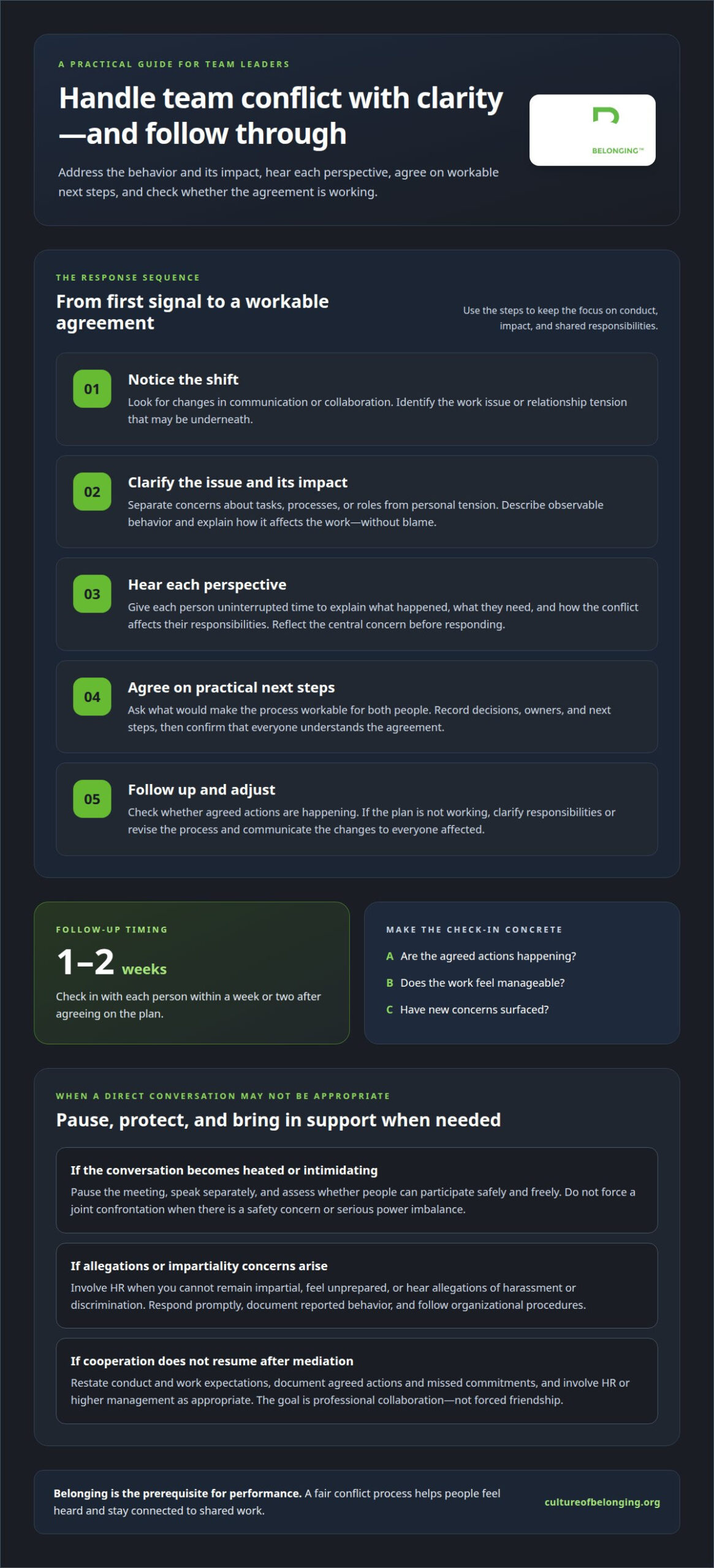
Conflict rarely begins with the argument everyone can see. Knowing how to handle conflict between team members starts with noticing changes in communication or collaboration and understanding what may be driving them. Address the behavior and its impact, make room for each person’s perspective, agree on a workable next step, and follow up.
Disagreement can be uncomfortable, especially when it begins to affect trust or the work itself. Avoiding it does not resolve the underlying issue. A thoughtful response can help people feel heard while keeping the team focused on shared responsibilities.
This guide explains how to recognize conflict, identify its causes, and encourage team members to resolve disagreements directly when appropriate. You’ll learn when a manager should step in, how to coach people toward constructive conversations, and how follow-up can show whether an agreement is working. The goal is more than ending one dispute. It’s creating conditions where people feel they belong and can contribute.
Key Takeaways
- Notice shifts in communication and collaboration early, then look for the work issue or relationship tension underneath them.
- Encourage direct, respectful conversations when appropriate, and step in when the conflict persists or team members can’t move forward.
- Separate disagreements about tasks, processes, and roles from personal tension before choosing a response.
- Turn agreements into clear next steps, then follow up to see whether they’re working.
- Coach team members to focus on behavior, listen to different perspectives, and reconnect their work to shared goals.
1. Encouraging employees to resolve disagreements directly
To resolve conflict between team members, clarify the issue, hear each perspective, and agree on specific next steps. Start separately if tension is high, then bring employees together when a respectful discussion is appropriate. A clear process helps people address the work problem while protecting their ability to contribute. Belonging supports the conditions for performance.
Direct resolution works best when people can speak without interruption or fear of retaliation. Set ground rules: describe observable behavior, explain its effect, and ask for the other person’s view. For example, “When the project update arrives late, I can’t prepare the client briefing. Can we agree on a handoff time?” Focus on impact and a practical request, not blame. Respectful dialogue helps employees stay engaged in shared work.
Listening is a leadership responsibility, not a courtesy. Give each employee uninterrupted time to explain what happened, what they need, and how the dispute affects their responsibilities. Reflect the central concern back before responding. The University of Minnesota Office of Human Resources recommends reflective listening, delaying responses, and finding common ground when managing conflict. Hearing each person helps show that their perspective matters.
Managers should remain neutral about the people while being clear about conduct and expectations. Ask open-ended questions such as, “What would make this process workable for both of you?” Acknowledge anger or hurt before moving to solutions. For task disagreements, the University of Minnesota Office of Human Resources recommends open discussion to understand each person’s viewpoint. This gives both employees a fair chance to be heard and help shape the resolution.
Protect employees when a conversation becomes heated, intimidating, or unsuitable for direct discussion. Pause the meeting, speak separately, and assess whether employees can participate safely and freely. Don’t force a joint confrontation when someone reports harassment, discrimination, threats, or a serious power imbalance. Belonging depends on people being able to raise concerns without pressure to enter an unsafe exchange.
Involve HR when a manager can’t remain impartial, feels unprepared to handle the dispute, or hears allegations of harassment or discrimination. Respond promptly, document the reported behavior, and follow the organization’s reporting and review procedures. Don’t dismiss concerns as personality clashes or promise an outcome before the facts are assessed. A careful response shows that employee dignity and participation matter.
If team members refuse to cooperate after mediation, restate conduct and work expectations, document agreed actions and missed commitments, and involve HR or higher management as appropriate. Leaders can adjust work arrangements to reduce unnecessary contact while addressing the issue. The goal is professional collaboration, not forced friendship, so each person can meet their responsibilities.
Close each discussion with a shared record of decisions, owners, and next steps. Ask both employees to confirm they understand the agreement, even if they still disagree about the past. Respectful follow-through helps create a workplace where people can contribute without erasing differences. Belonging is the prerequisite for performance, and conflict resolution can reinforce that principle through everyday leadership.
2. Following up after resolution
An agreement is a starting point, not proof that a conflict is resolved. Check in with each individual within a week or two after agreeing on the plan. Ask whether the actions are happening, whether work feels manageable, and whether new concerns have surfaced. A private check-in can show whether employees feel safe enough to speak candidly. That experience matters: belonging supports the conditions for engagement and performance.
Keep follow-up objective. Compare agreed actions with what is happening instead of relying on impressions such as “things seem better.” If two colleagues agreed to share project updates in a common document, check whether both are using it and whether handoffs are clearer. Assess the agreement, not who is to blame. Consistency helps employees see that commitments apply to everyone.
Give each person space to describe their experience. Ask what has changed, what remains difficult, and what would help them follow the agreement. Then listen for differences in their accounts. One person may feel comfortable with the new process while another still lacks information or decision-making clarity. Taking both views seriously signals that each person’s experience and contribution matter.
Turn the answers into a practical adjustment. If a shared document isn’t working, clarify who updates it, what information belongs there, and when colleagues need it. Record the revised responsibilities and communicate them to everyone affected. Specific expectations make the agreement easier to follow and help employees participate more confidently in shared work.
Teams can prevent recurring conflict by identifying the conditions that keep causing friction, then changing the relevant process, role, or communication expectation. If missed handoffs recur because ownership is unclear, name the responsible person and document the transfer point. Regular check-ins help leaders address patterns before they undermine trust. Employees can engage more fully when expectations support their contributions instead of leaving them uncertain.
Follow up again when the issue involves repeated behavior or a change that takes time to take hold. Use the next project milestone or scheduled one-on-one as a review point. Ask whether the agreement still fits the work and whether each employee can meet their responsibilities. Adjust the plan if duties or team needs have changed. This keeps the resolution connected to employees’ actual working conditions.
Keep records brief and factual. Note the date of each follow-up, the commitments reviewed, what is working, and any agreed changes. Avoid labels such as “difficult” or assumptions about intent. If the same conduct returns, these notes help leaders respond consistently and explain which expectations were communicated.
If employees report that conflict continues, don’t treat a signed agreement as closure. Reassess the underlying issue, clarify what each person needs to work effectively, and decide whether another facilitated conversation or HR support is appropriate. Leaders can connect steady follow-through with human-centered leadership and workplace belonging, reinforcing the conditions in which people can contribute and perform.
3. What does workplace conflict look like?
Workplace conflict can appear in everyday interactions before anyone names a dispute. A colleague stops sharing project updates, meetings become tense, or decisions repeatedly stall. The University of Minnesota Office of Human Resources identifies rude emails, interruptions, avoidance, and condescension as possible signs of relationship conflict. These behaviors can also affect whether employees feel noticed and able to contribute.
Separate observable behavior from the meaning people assign to it. One employee may call a teammate “uncooperative,” while the specific issue is changing project priorities. Ask what happened, when it happened, and how it affected the work or relationships. A missed handoff, for example, gives the discussion a concrete starting point. This keeps attention on workplace conditions rather than assumptions about someone’s character.
Next, identify the type of disagreement. Task conflict concerns the work itself, including goals, priorities, measures of success, or meeting agendas. Process conflict concerns how work gets done, such as timing, decision methods, or policy implementation. According to the University of Minnesota Office of Human Resources, status conflicts can involve leadership, credit for work, or competition for resources. Any of these can leave people uncertain about how their contribution is valued.
The same complaint can have different causes. Two employees arguing about a deadline may disagree about priorities, or they may be unclear about who owns the final decision. Ask each person what outcome they’re seeking and what information shaped their view. Compare their answers to find gaps in roles, expectations, or shared facts. Clarity helps employees participate in decisions that affect their work.
Relationship conflict needs careful attention. Differences in personality or work style can create tension, but they rarely explain the whole situation. One person’s brief messages may feel efficient to them and dismissive to a colleague. Ask what each person observed and how it affected collaboration. The University of Minnesota Office of Human Resources warns that unmanaged task or process disagreements can develop into relationship conflict. As trust erodes, employees may hesitate to offer ideas or ask for support.
Look beyond individual interactions for workplace conditions that feed the dispute. Conflicting instructions from two leaders, unclear responsibilities, uneven access to resources, or shifting priorities can repeatedly put coworkers at odds. If similar friction appears across a team, examine the process before concluding that one employee is the cause. Belonging depends partly on whether people understand their role and see how their work matters.
Once the cause is clearer, match the response to the problem. Clarify decision rights in a status dispute, document a process handoff, or compare evidence when task priorities differ. A constructive resolution addresses the source of friction, not just the latest argument. That gives employees a clearer path to contribute and supports the conditions for performance.
4. Obvious and less-obvious sources of workplace conflict
Some sources are visible: two employees openly disagree about a project decision, a deadline, or who receives credit. Others show up as repeated tension around routine work. The University of Minnesota Office of Human Resources describes workplace conflict as inevitable and notes that some conflict can be productive. Identify what the disagreement concerns before choosing how to respond.
Poor communication can turn a small gap into a larger dispute. For example, a manager changes a deadline in a meeting, but one employee misses the update and another assumes the original date still applies. Their frustration may sound personal, yet the cause is a communication breakdown. Clarifying where decisions are recorded and how changes are shared can address the source.
Differences in opinions, values, beliefs, and work habits can also create friction. One employee may prioritize thorough review, while a teammate values quick decisions. Neither preference automatically explains a conflict. Ask what each person needs to complete the work, then look for incompatible expectations, unclear boundaries, or a practical compromise that respects both contributions.
Less obvious causes often lie in the structure of the work. Overlapping responsibilities can leave two employees believing they own the same decision, while unclear ownership can leave a task untouched. Limited resources can create competition when team members don’t understand how allocation connects to shared goals. Leaders can reduce these pressures by clarifying roles, priorities, decision rights, and resource criteria.
Addressing conflict matters because unresolved task or process disputes can strain relationships and affect productivity. The University of Minnesota Office of Human Resources warns that unmanaged disagreements about tasks or processes can develop into relationship conflict. Listen for the original work issue beneath personal frustration. This distinction helps leaders solve the actual problem instead of treating every dispute as a personality clash.
Document incidents when a pattern is emerging or formal intervention may become necessary. Record the date, setting, people involved, observable behavior, and effect on the work. For example, note that a project handoff was missed after a responsibility changed, rather than labeling someone “careless.” Separate direct observations from interpretations, and store records according to workplace procedures.
Review the record for recurring conditions. If several incidents follow last-minute changes, examine how those changes reach the team. If conflict clusters around one handoff, clarify ownership at that point. A factual record helps leaders listen consistently, recognize patterns, and choose a response grounded in events. It also gives employees a clearer path to solving the issue together.
5. Coaching team members in conflict management
Coaching helps employees build skills for the next disagreement, not just settle the current one. Managers can teach a repeatable practice: describe the behavior, explain its impact, ask what the other person needs, and agree on a next step. For example, “When the review changes after sign-off, I’m unsure which version to use. Can we confirm the final approver?” This keeps the conversation focused on work.
Begin coaching conversations separately when employees feel defensive or unheard. Ask each person to name the problem, their preferred solution, and why that solution matters. A request for “more control” might reflect concern about unclear accountability. Understanding the need beneath a position gives the parties more options than debating who is right.
Then help employees discuss shared goals and consider alternatives. If two colleagues disagree about presenting project findings, options might include alternating presenters or dividing sections by expertise. Compare each option with the work, responsibilities, and team needs. The aim is an agreement people can carry out, not a verdict declaring one person the winner.
Coach managers to address conduct directly without reducing a person to a label. If repeated criticism is disrupting meetings, name the observable behavior and its effect: “The comments interrupt the review and make it harder to assess the proposal.” Ask what change would support a more productive discussion. Clear boundaries matter, especially when behavior continues after expectations are explained.
Practice the conversation before employees have it. A manager can role-play a difficult handoff, then help each person replace accusations with specific observations and requests. Invite them to summarize the other person’s perspective before responding. This builds listening skills and reveals whether they understand the issue differently.
Training supervisors matters because an unprepared leader can intensify a dispute. Organizations can use case discussions, role-play, and feedback on coaching conversations to strengthen consistent responses. The University of Minnesota Office of Human Resources recommends managing emotions, building mutual respect and trust, and having productive conversations about work during relationship conflict.
Managers should also recognize when coaching alone isn’t appropriate. Reports of harassment, discrimination, threats, or repeated boundary violations require a different response, including relevant HR processes. Coaching supports constructive behavior; it doesn’t replace formal review or excuse harmful conduct.
Make coaching part of how leadership supports belonging: contributions are easier to sustain when people can raise concerns and understand why their work matters. For leaders developing this capability across a team, explore a keynote on workplace belonging and human-centered leadership.
Culture of Belonging Global®
Culture of Belonging Global® helps leaders address conflict as part of building a culture where people can contribute and belong. Curtis Ray Hill, founder of Culture of Belonging Global®, a leading authority and keynote speaker on Workplace Belonging, centers this work on the idea that belonging is the prerequisite for performance. Keynotes, workshops, professional development, and consulting help teams strengthen leadership practices that support open communication, trust, and engagement.
Consider this next step when conflict points to a broader need: managers may need to build coaching skills, or workplace expectations may not match employees’ day-to-day experience. The focus is not simply on ending disagreements. It is on shaping conditions where people can raise concerns, understand their contribution, and work together with purpose.
Contact Culture of Belonging Global® to discuss support for your team.
Build the conditions for better conversations
Learning how to handle conflict between team members is only the first move. The deeper leadership question is what employees experience before disagreement begins: Can they raise concerns without being dismissed? Do they understand why their contributions matter? Those everyday signals shape whether people feel they belong and can participate fully.
Use the next team conversation to examine the gap between stated values and lived experience. Invite honest feedback, listen for patterns, and act on what the team can change. Belonging is the prerequisite for performance, and leadership helps create the conditions that support both. Progress starts with making room for people to be heard, respected, and connected to meaningful work.
If you’re ready to strengthen workplace belonging in your organization, contact Culture of Belonging Global® to explore a next step. A more connected workplace begins with the choices leaders make every day.
Frequently Asked Questions
What does workplace conflict look like?
Workplace conflict can show up as repeated rework, information missing from handoffs, or decisions that stall because colleagues can’t align. For example, a team may keep revising a report because contributors disagree about who approves the final version. Look for patterns that affect coordination, not just visible arguments. A quieter change, such as colleagues avoiding joint tasks, can also signal tension worth exploring.
Interview Question: How Do You Handle Conflict Between Team Members?
I handle conflict between team members by first understanding the work issue and hearing each person’s account without taking sides. I identify the behavior or decision causing friction, then help the employees agree on a practical way forward. For example, if two colleagues disagree about project ownership, I clarify decision-making roles and confirm how they’ll coordinate. Then I follow up to see whether the working arrangement is effective.
How should a manager mediate a workplace conflict?
A manager should mediate by setting a focused purpose, confirming that both parties can participate, and keeping the discussion tied to work. Before the meeting, clarify what can be shared and explain any steps required if serious conduct concerns arise. During the conversation, summarize points of agreement and disagreement in neutral language. End by recording decisions and asking each person to explain their understanding of the next steps.
What communication techniques help resolve team disagreements?
Use concise, specific language and check that the other person understood your intended message. For example, replace “You never keep me informed” with “I need the revised schedule before the planning meeting.” Ask a neutral follow-up, such as “What information would help you meet that timing?” In a tense conversation, pause before replying and summarize the other person’s point. These techniques reduce assumptions and keep discussion focused on action.
How can you identify the root cause of conflict at work?
Trace the disagreement backward from its latest impact. Ask each employee what happened immediately before the problem, what expectation they were following, and what information they had. Then compare their accounts with the workflow. If one person thought a draft was final while another expected review, the underlying cause may be an unclear approval signal. Separate the triggering event from the condition that made it possible.
What are the risks of ignoring conflict between coworkers?
Ignoring a dispute can let practical friction spread into everyday collaboration. Employees may stop sharing context, duplicate work, or avoid asking for input, making coordination harder. Silence can also leave people unsure whether raising concerns is welcome. Over time, that can weaken trust and belonging, which support engagement and performance. Addressing a concern early gives leaders a chance to correct the work issue before it shapes team norms.
How do you measure whether a workplace conflict has been resolved?
Look for evidence that the original work problem has changed, not simply that employees have stopped discussing it. If the disagreement involved approvals, check whether decisions now follow the agreed route. Ask each person separately whether they can complete their responsibilities and raise concerns constructively. Compare their responses with observable collaboration, such as timely handoffs. A resolution is stronger when the working process improves and both people can describe the agreement consistently.

Article by
Curtis Ray Hill
Curtis Ray Hill, MAT, M.Ed., is a workplace belonging keynote speaker, culture strategist, author, and founder of Culture of Belonging Global®. For more than two decades, his work has centered on one core belief: belonging is the prerequisite for performance.
Curtis has worked with leaders and organizations including Pfizer, State Farm, BP, Southwest Airlines, Hallmark, and Avis Budget Group, bringing a practical, human-centered approach to workplace belonging, employee engagement, employee experience, psychological safety, and organizational culture. His background spans education, leadership, and process improvement, and he holds a Black Belt in Lean Six Sigma.
He is the author of Creating a Culture of Belonging: From Feeling Like to Knowing You Belong, a book focused on moving belonging beyond intention and creating environments where people know they belong.
Curtis is also the creator of The Belonging Effect™, his proprietary framework built around four human experiences: Noticed → Named → Known → Needed. His work equips leaders to translate belonging into everyday leadership behaviors and workplace experiences that create stronger conditions for engagement and performance.
Through his keynotes, consulting, writing, and thought leadership, Curtis is advancing workplace belonging as a business and leadership priority—not simply a culture initiative. His work connects belonging to human-centered leadership, psychological safety, employee experience, retention, engagement, and performance. His goal is to move organizations beyond talking about belonging to creating workplaces where people experience it every day—and where belonging becomes the foundation for how people connect, contribute, and perform.
Disclaimer
The content published on this website by Curtis Ray Hill and Culture of Belonging Global® is provided for general informational and educational purposes only. It is intended to share perspectives, frameworks, strategies, research, and ideas related to workplace belonging, organizational culture, leadership, employee experience, engagement, retention, psychological safety, and related topics.
No Professional Advice. Nothing on this website constitutes or should be relied upon as legal, financial, accounting, employment, human resources, medical, psychological, compliance, or other professional advice. The information provided is not a substitute for advice from qualified professionals familiar with your organization, circumstances, jurisdiction, employees, policies, and applicable laws or regulations.
No Guarantee of Results. Curtis Ray Hill and Culture of Belonging Global® make no representation, warranty, promise, or guarantee that any framework, strategy, recommendation, keynote, training, consulting engagement, or other information discussed on this website will produce any particular result. Organizational outcomes vary based on numerous factors, including leadership, implementation, organizational culture, industry, workforce, resources, timing, and circumstances.
Research, Statistics, and Results. Statistics, research findings, survey data, industry findings, quotations, and third-party information referenced in an article should be considered within the context, methodology, limitations, and publication date of the original source. Any specific client result or organizational outcome referenced is illustrative of that particular experience and should not be interpreted as typical, expected, or guaranteed for another organization.
Independent Decision-Making. Readers and organizations are responsible for evaluating the suitability of any ideas, strategies, frameworks, or recommendations for their own circumstances. Before implementing decisions that may affect employees, employment practices, workplace policies, compliance obligations, finances, or business operations, consult the appropriate qualified legal, HR, financial, compliance, or other professional advisers.
Third-Party References. References to companies, organizations, publications, research institutions, products, services, or other third parties are provided for informational or contextual purposes. Unless expressly stated, such references do not imply endorsement, sponsorship, partnership, validation, or approval by or of Curtis Ray Hill or Culture of Belonging Global®.
Intellectual Property. Culture of Belonging®, The Belonging Effect™, The Invisible Floor Plan™, and other identified proprietary concepts, frameworks, names, and materials associated with Curtis Ray Hill and Culture of Belonging Global® are protected intellectual property where applicable. Nothing published on this website grants permission to reproduce, distribute, modify, teach, sell, license, or commercially exploit proprietary materials without authorization.
Limitation of Responsibility. To the fullest extent permitted by applicable law, Curtis Ray Hill and Culture of Belonging Global® disclaim responsibility for losses, damages, liabilities, or consequences arising from reliance upon or application of information contained on this website. Use of this content and any decisions based upon it are undertaken at the reader's or organization's own discretion and risk.
Information may be updated, revised, or become outdated over time. Readers should verify information that is material to an organizational, employment, legal, financial, or compliance decision and consult qualified professionals when appropriate.


