

A performance review should be a coaching conversation, not a verdict delivered after the work is done. It evaluates an employee’s performance, accomplishments, and development opportunities while clarifying expectations for what comes next. Improving the performance review process means making feedback specific, goals relevant, and support part of the conversation.
It’s understandable that employees can feel frustrated when reviews focus on ratings instead of useful guidance. A stronger process makes room for honest discussion, recognizes contributions, and helps people see how their work matters. That sense of belonging strengthens the conditions for engagement and performance.
Learn how constructive feedback, aligned goals, regular check-ins, and development opportunities can make reviews more useful for employees and managers. The aim is practical: create conversations that clarify expectations, surface challenges early, and turn feedback into meaningful next steps.
Key Takeaways
- Define reviews as coaching conversations that recognize contributions and clarify development needs, rather than trying to resolve every performance issue at once.
- Make feedback specific and actionable by grounding it in observable examples and creating space for employees to share their perspective.
- Connect individual goals to team priorities so employees can see what matters and how their work contributes.
- Use regular check-ins, especially during an employee’s first year, to address challenges and adjust goals before the formal review.
- Turn development needs into practical learning plans, while building a workplace where people feel their contributions are seen and valued.
1. What is a performance review?
A performance review evaluates an employee’s work, accomplishments, and development opportunities. It records past performance and clarifies expectations moving forward. Used well, it becomes a coaching conversation: manager and employee examine evidence, discuss obstacles, and agree on practical steps toward future goals. A project lead, for example, might review delivery quality, recognize strong coordination, and plan practice presenting updates to stakeholders.
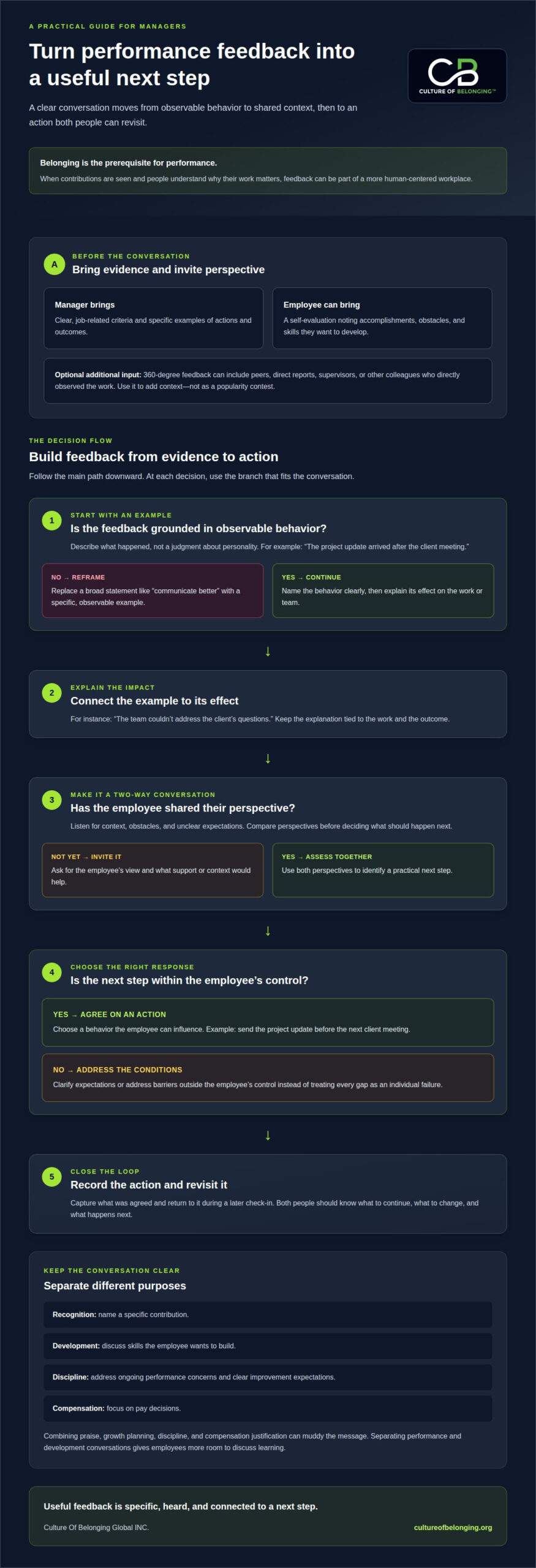
Keep different purposes from competing in one meeting. Recognition names specific contributions, such as resolving a client issue. Development explores skills an employee wants to build. Discipline addresses ongoing performance concerns and clear improvement expectations, while compensation focuses on pay decisions. Combining praise, growth planning, discipline, and compensation justification can muddy the message. Separating performance and development conversations gives employees more room to discuss learning without treating every growth opportunity as a warning.
Performance review software ranges from review forms and goal-tracking tools to broader performance management platforms. There is no single standard price: costs vary with factors such as user count, features, integrations, and contract terms. Software can organize records, but it cannot replace a manager’s specific examples or a thoughtful discussion.
Use the review to look forward, not simply score the past. After discussing results, agree on goals connected to team priorities and the employee’s role. A development plan might pair a presentation goal with opportunities to lead project updates and receive feedback. Define what progress will look like, identify resources or support, and decide when manager and employee will revisit the plan.
Make room for successes and obstacles. Ask which work felt meaningful, where expectations were unclear, and what support would help the employee perform. Then capture agreed actions and open questions. Both people should leave clear on what to continue, what to change, and what happens next. A sense of belonging can help employees see how their contributions matter, not just how they were rated.
Consistency matters, too. The Office of Inspector General, Board of Governors of the Federal Reserve System, describes a CFPB policy assigning reviewing officials responsibility for checking that performance standards were applied consistently, helping prevent or detect rating bias. Clear criteria and evidence-based discussion make it easier to explain an assessment and connect feedback to an employee’s ability to grow.
2. How Can Managers Deliver Constructive Feedback Effectively?
Constructive feedback is specific, grounded in observable behavior, and connected to a clear next action. Instead of saying, “You need to communicate better,” a manager might say, “The project update arrived after the client meeting, so the team couldn’t address their questions. Send the update beforehand next time.” This identifies the behavior, its effect, and a practical step forward.
Balance recognition with development guidance. Name a contribution the employee should continue, then discuss one behavior they could adjust. For example, recognize how an analyst clarified a complex report, then explore how earlier drafts could help colleagues offer input. Keep comments about actions and outcomes, not personality. Employees can respond more meaningfully when feedback describes something they can influence.
Make the evaluation a two-way conversation. Invite the employee to complete a self-evaluation before the meeting, noting accomplishments, obstacles, and skills they want to develop. The manager can compare perspectives, ask for context, and clarify what support would help. Shared responsibility means managers bring clear evidence and listen, while employees bring their experience and questions.
360-degree feedback adds perspectives beyond the manager’s evaluation. It may gather feedback anonymously from peers, direct reports, and supervisors; colleagues, customers, or project partners can also offer relevant observations. Use it when those people have directly observed the work being assessed. For example, a project lead’s manager can assess delivery, while collaborators describe how handoffs worked. Multi-rater input should enrich the discussion, not turn it into a popularity contest.
Organizations can reduce bias by defining job-related criteria before evaluations, grounding ratings in specific examples, and checking whether standards are applied consistently. Compare evidence against the same expectations, and review patterns across teams for unexplained differences. Multiple perspectives can add context, but they don’t replace clear criteria or manager accountability.
A practical feedback sequence is simple: share an observed example, explain its impact, invite the employee’s view, and agree on an action. Record the action and revisit it during a later check-in. If the discussion reveals unclear expectations or barriers outside the employee’s control, address those conditions instead of treating every gap as an individual failure.
Feedback works best when people can speak candidly and understand why their contributions matter. For leaders developing that foundation, Curtis Ray Hill’s perspective on workplace belonging and human-centered leadership connects everyday interactions with the conditions employees need to contribute.
3. Alignment of individual work with team and departmental goals
Individual goals matter most when employees can connect them to team priorities and organizational strategy. A customer-support employee, for example, may improve response quality while the department focuses on resolving customer issues clearly. That connection shows how daily work contributes, helps managers set relevant expectations, and gives performance conversations a shared direction.
Start goal-setting conversations with the department’s current priorities. Ask which outcomes the team needs, what the employee can influence, and where responsibilities overlap. If a department is improving reporting accuracy, an analyst’s goal might focus on producing clearer, more reliable reports. The manager should explain how that work supports the wider priority and discuss opportunities to build related skills.
Make goals specific and measurable. SMART goals are Specific, Measurable, Attainable, Realistic, and Time-bound. For example, replace “communicate more effectively” with “share project updates in the agreed format before team planning meetings.” The manager and employee can define what a complete update includes and how they’ll assess whether the expectation is being met.
Review goals against changing work, not just the original plan. A team’s priorities can shift when customer needs, project requirements, or staffing change. During a review conversation, ask: “Which goal still supports our priorities?” “What has changed?” and “What support would help you move forward?” These questions make room to adjust direction without losing sight of the intended outcome.
Clear measures should describe results employees can influence. If a team goal depends on several departments, separate the employee’s contribution from the final organization-wide result. For instance, assess whether a project coordinator documented decisions and surfaced blockers, rather than assigning responsibility for a deadline controlled by another team. This distinction makes evaluations more useful and expectations more credible.
Alignment should also make contributions visible. Employees need to understand not only what they’re expected to deliver, but why that work matters to colleagues and the organization. A manager can close the conversation by summarizing the agreed goal, its connection to team priorities, the support available, and the next point for reviewing progress. That clarity can foster engagement while keeping accountability grounded in real work.
4. Continuous reviews during an employee’s first year
A new employee shouldn’t have to wait for an annual review to learn how work is going. During the first year, managers can schedule regular check-ins to clarify priorities, notice progress, and surface obstacles early. A monthly conversation, for example, can reveal that a new analyst needs project context before deadlines become difficult to meet.
Make each check-in a two-way conversation. The manager can bring examples of recent work, while the employee describes what feels clear or challenging. Ask, “What’s helping you succeed?” and “What would make the next project easier?” Then agree on an action, such as pairing the employee with a colleague for a process walkthrough. This makes feedback shared work, not a verdict.
Prepare employees before a formal review by sharing expectations and relevant examples in advance. Invite a written self-reflection on completed work, missed goals, and support needed. A manager can compare that reflection with project outcomes, then discuss differences openly. Preparation gives both people time to bring evidence instead of relying on memory alone.
In the U.S., use consistent, job-related criteria and factual documentation, especially when reviews inform pay, promotion, discipline, or termination. Applicable requirements depend on the employment decision and jurisdiction. Record the work-related evidence behind an evaluation, and keep the review process consistent across employees in comparable roles.
Measure whether reviews are useful by tracking progress against agreed goals, skill development, and employees’ understanding of expectations. Organizations can also monitor engagement feedback and retention patterns over time. Compare these indicators with the review practices in place, and examine where employees report clearer direction or continuing barriers. These measures show trends; they don’t by themselves prove a review caused a particular outcome.
Annual-only reviews carry a timing risk: feedback may arrive long after a challenge or achievement, leaving little room to respond during the work. An employee could repeat an avoidable reporting error for months before hearing about it. Regular conversations let managers and employees adjust expectations, recognize contributions, and address support needs while events are still fresh.
If an employee disagrees with a written review, invite a response and preserve their comments with the record. A signature typically acknowledges receipt, not agreement with the evaluation. Explain that distinction during the conversation, then document any unresolved point accurately. When employees feel seen, heard, and connected to why their contributions matter, belonging can strengthen the conditions for engagement and performance.
5. Connecting performance reviews with learning management
A review should lead to a learning action, not just a recorded rating. If an employee’s project handoffs need improvement, the development plan might pair a workflow lesson with practice on the next assignment. Managers can review the work, offer feedback, and identify whether further support is needed. This connects evaluation to a real opportunity to build skills.
Prepare for the meeting with evidence that helps distinguish a skill gap from a process barrier. Gather prior review notes, project outcomes, and examples of work that met expectations. If a report contained errors, for instance, identify whether the employee needs spreadsheet training, clearer instructions, or access to source data. HR can help managers select relevant learning resources and keep development plans aligned with role expectations.
Training for managers matters, too. Practice writing feedback about observable behavior, listening without interrupting, and agreeing on a specific next step. A manager could rehearse explaining a missed deadline using project records, then invite the employee to describe the obstacles. This preparation makes a formal discussion more consistent and keeps the focus on evidence, learning, and accountability.
Learning plans should connect to goals employees value and work the organization needs. Ask what capability the employee wants to strengthen, then identify a practical way to apply it. For example, someone developing presentation skills might lead a project update and receive feedback afterward. Treat the follow-up as part of the plan, not an optional extra.
Development can also support the conditions for engagement and retention. Employees can better understand their future at work when managers discuss growth opportunities, provide relevant learning, and recognize progress. That does not guarantee someone will stay. It does make development a concrete part of the employee experience, rather than a promise mentioned only during a review.
For evaluations connected to performance pay, the U.S. Government Publishing Office describes training that includes identifying and correcting implicit or unintentional bias against protected classes. HR can reinforce that work by helping managers apply clear criteria and examine the evidence behind ratings. Consistent standards protect the integrity of performance decisions and learning recommendations.
To strengthen the human-centered leadership behind these conversations, invite Curtis Ray Hill to speak about workplace belonging and the conditions that help people contribute and grow.
Culture Of Belonging Global
Culture Of Belonging Global INC. helps organizations examine how workplace belonging shapes the conditions for performance, including how employees experience feedback and daily interactions. Turn to this work when reviews feel disconnected from workplace culture, managers need a shared approach, or stated values don’t match employees’ lived experience. The focus is on connecting performance conversations with an environment where people understand that their contributions matter.
Curtis Ray Hill, founder of Culture of Belonging Global®, is a leading authority and keynote speaker on Workplace Belonging. His work centers on a practical leadership question: do employees feel seen, understood, and connected to why their contributions matter? That perspective can help leaders look beyond review forms and examine how everyday interactions shape employees’ experience of recognition, trust, and opportunity.
For organizations seeking a shared starting point, Keynotes can introduce workplace belonging as a leadership and performance concern. Workshops give teams space to examine how review conversations happen in practice, including whether employees can raise obstacles and understand the impact of their work. These formats help leaders consider the difference between the culture they describe and the culture employees actually experience.
Professional Development can support managers as they build skills for recognition, feedback, and human-centered conversations. Consulting offers strategic guidance for organizations examining workplace culture and performance practices together. The right format depends on the need: a leadership team may want to establish a common understanding, while an organization revisiting its review approach may need guidance on how daily experiences align with stated expectations.
Culture Of Belonging Global INC.’s work is relevant when review-process changes need to address more than forms or ratings. Leaders can examine whether employees receive useful feedback, whether goals make contributions visible, and whether managers create space for honest discussion. The Carpet vs. Concrete metaphor offers a way to frame that reflection: carpet represents stated culture, while concrete represents the culture people experience through daily actions.
For HR leaders, executives, and learning teams, the next step is to identify which part of the employee experience needs attention and what kind of support fits. Review documents alone can’t shape workplace culture; the interactions around them matter, too. Contact Culture Of Belonging Global INC. to discuss how Workplace Belonging can inform your performance review process.
Make Every Review a Signal of Belonging
The next step is to treat each review as part of how leadership is experienced, not as an isolated HR procedure. Employees notice whether managers follow through, make expectations clear, and take concerns seriously. Those everyday signals shape whether people feel able to contribute openly. Belonging is the prerequisite for performance, and review conversations are one place leaders can put that principle into practice.
Improving the performance review process is about more than refining forms or schedules. It asks leaders to build habits that make feedback credible, development meaningful, and accountability human. Start by choosing a practice managers can apply consistently, then learn from how employees experience it. A deliberate next step can help turn an annual event into a more connected leadership practice.
Curtis Ray Hill brings a Workplace Belonging perspective to leaders working through these questions. Explore how Curtis Ray Hill can support your organization’s next conversation about belonging and performance. Progress begins when people are seen, heard, and able to understand why their work matters.
Frequently Asked Questions
What is a performance review?
A performance review is a structured conversation and record about an employee’s work, contributions, and growth. It can clarify what success looks like in a role and identify where expectations or support need attention. For example, a manager might discuss how an employee handled a changing project scope, then agree on what decision-making authority will apply to similar assignments.
How Can Employers Set Clear Performance Expectations?
Employers can clarify expectations by connecting role responsibilities to observable work outcomes. A customer-service role, for instance, might specify how employees document a customer issue and communicate its status, rather than relying on a vague instruction to “provide excellent service.” Managers should explain priorities, decision authority, and how competing tasks are handled, then invite employees to identify conflicting expectations before evaluation begins.
How Can Managers Deliver Constructive Feedback Effectively?
Managers deliver useful feedback by describing a specific action, its effect, and a reasonable next step. For example: “The handoff omitted the latest schedule, so the next team used an outdated plan. Include the current schedule in the shared file.” Invite the employee to explain relevant context, then agree on how the change will be applied. This keeps feedback focused on work, not personality.
Why Is Employee Participation Important During Reviews?
Employee participation helps managers understand context that work records alone may miss. An employee might explain that a missed milestone followed a late change in project scope, or identify a task they handled well but that went unnoticed. Asking employees to name their priorities, constraints, and growth interests makes the discussion more complete and helps both sides agree on practical next steps.
What are the best practices for improving the performance review process?
Strong review practices include using role-related criteria, discussing evidence, inviting employee input, and recording agreed next steps. Make the process easier to understand by explaining how reviews work and what happens after the conversation. Managers can also examine whether employees have access to the tools and opportunities required for their goals. These habits make reviews more useful without reducing performance to a single rating.
How often should employee performance reviews be conducted?
Use formal reviews to create a considered record, then maintain communication between review cycles. The right rhythm depends on the work, how quickly priorities change, and how much guidance employees need. For example, a new employee learning a complex role may benefit from more frequent manager conversations than an experienced employee working on stable responsibilities. Set a cadence people can maintain and use it consistently.
How can managers set clear, measurable performance review goals?
Define a goal by naming the outcome, the evidence that will show progress, and the employee’s control over the result. Instead of “improve project coordination,” a manager might agree that the employee will maintain a current task log and flag dependencies during planning. Clarify what a useful log contains and who relies on it. This makes progress easier to discuss without measuring activity alone.
What performance review methods and rating systems are most effective?
No single method fits every role. A written manager evaluation may suit work with clear individual deliverables, while self-reflection or multi-rater input can add perspective when collaboration is central. Choose a rating scale only if its criteria are understandable and tied to job expectations. For example, define what “meets expectations” means using role-specific evidence, then leave room to explain context beyond the score.

Article by
Curtis Ray Hill
Curtis Ray Hill, MAT, M.Ed., is a workplace belonging keynote speaker, culture strategist, author, and founder of Culture of Belonging Global®. For more than two decades, his work has centered on one core belief: belonging is the prerequisite for performance.
Curtis has worked with leaders and organizations including Pfizer, State Farm, BP, Southwest Airlines, Hallmark, and Avis Budget Group, bringing a practical, human-centered approach to workplace belonging, employee engagement, employee experience, psychological safety, and organizational culture. His background spans education, leadership, and process improvement, and he holds a Black Belt in Lean Six Sigma.
He is the author of Creating a Culture of Belonging: From Feeling Like to Knowing You Belong, a book focused on moving belonging beyond intention and creating environments where people know they belong.
Curtis is also the creator of The Belonging Effect™, his proprietary framework built around four human experiences: Noticed → Named → Known → Needed. His work equips leaders to translate belonging into everyday leadership behaviors and workplace experiences that create stronger conditions for engagement and performance.
Through his keynotes, consulting, writing, and thought leadership, Curtis is advancing workplace belonging as a business and leadership priority—not simply a culture initiative. His work connects belonging to human-centered leadership, psychological safety, employee experience, retention, engagement, and performance. His goal is to move organizations beyond talking about belonging to creating workplaces where people experience it every day—and where belonging becomes the foundation for how people connect, contribute, and perform.
Disclaimer
The content published on this website by Curtis Ray Hill and Culture of Belonging Global® is provided for general informational and educational purposes only. It is intended to share perspectives, frameworks, strategies, research, and ideas related to workplace belonging, organizational culture, leadership, employee experience, engagement, retention, psychological safety, and related topics.
No Professional Advice. Nothing on this website constitutes or should be relied upon as legal, financial, accounting, employment, human resources, medical, psychological, compliance, or other professional advice. The information provided is not a substitute for advice from qualified professionals familiar with your organization, circumstances, jurisdiction, employees, policies, and applicable laws or regulations.
No Guarantee of Results. Curtis Ray Hill and Culture of Belonging Global® make no representation, warranty, promise, or guarantee that any framework, strategy, recommendation, keynote, training, consulting engagement, or other information discussed on this website will produce any particular result. Organizational outcomes vary based on numerous factors, including leadership, implementation, organizational culture, industry, workforce, resources, timing, and circumstances.
Research, Statistics, and Results. Statistics, research findings, survey data, industry findings, quotations, and third-party information referenced in an article should be considered within the context, methodology, limitations, and publication date of the original source. Any specific client result or organizational outcome referenced is illustrative of that particular experience and should not be interpreted as typical, expected, or guaranteed for another organization.
Independent Decision-Making. Readers and organizations are responsible for evaluating the suitability of any ideas, strategies, frameworks, or recommendations for their own circumstances. Before implementing decisions that may affect employees, employment practices, workplace policies, compliance obligations, finances, or business operations, consult the appropriate qualified legal, HR, financial, compliance, or other professional advisers.
Third-Party References. References to companies, organizations, publications, research institutions, products, services, or other third parties are provided for informational or contextual purposes. Unless expressly stated, such references do not imply endorsement, sponsorship, partnership, validation, or approval by or of Curtis Ray Hill or Culture of Belonging Global®.
Intellectual Property. Culture of Belonging®, The Belonging Effect™, The Invisible Floor Plan™, and other identified proprietary concepts, frameworks, names, and materials associated with Curtis Ray Hill and Culture of Belonging Global® are protected intellectual property where applicable. Nothing published on this website grants permission to reproduce, distribute, modify, teach, sell, license, or commercially exploit proprietary materials without authorization.
Limitation of Responsibility. To the fullest extent permitted by applicable law, Curtis Ray Hill and Culture of Belonging Global® disclaim responsibility for losses, damages, liabilities, or consequences arising from reliance upon or application of information contained on this website. Use of this content and any decisions based upon it are undertaken at the reader's or organization's own discretion and risk.
Information may be updated, revised, or become outdated over time. Readers should verify information that is material to an organizational, employment, legal, financial, or compliance decision and consult qualified professionals when appropriate.


