Creativity helps teams see new possibilities, solve problems, and improve how work gets done. To foster creativity in your team, give people room to explore ideas, make it safe to learn from mistakes, and lead with support rather than control. The goal isn’t freedom without direction. It’s space to contribute within a clear, shared purpose.
Most leaders know fresh thinking can’t be ordered into existence. Yet tight control, fear of failure, and overlooked contributions can leave people holding back. Belonging supports performance: when people feel their perspectives matter, they have stronger conditions for speaking up, engaging, and doing their best work.
This article explains how creativity strengthens workplace problem-solving and teamwork, then offers practical ways to support it through autonomy, learning, and leadership. You’ll find ways to make room for ideas, respond constructively when an experiment misses the mark, and connect each person’s contribution to meaningful work.
Key Takeaways
- Make room to recognize progress and treat mistakes as opportunities to learn, so people feel safer offering fresh ideas.
- Give employees meaningful choice in how they approach work while keeping goals and responsibilities clear.
- Bring perspectives across roles and departments together to uncover ideas a single team might miss.
- Use creative problem-solving to strengthen collaboration, explore alternatives, and make challenges easier to discuss.
- Remove barriers, listen actively, and recognize contributions to reinforce belonging and support performance.
1. Celebrating progress and learning from mistakes
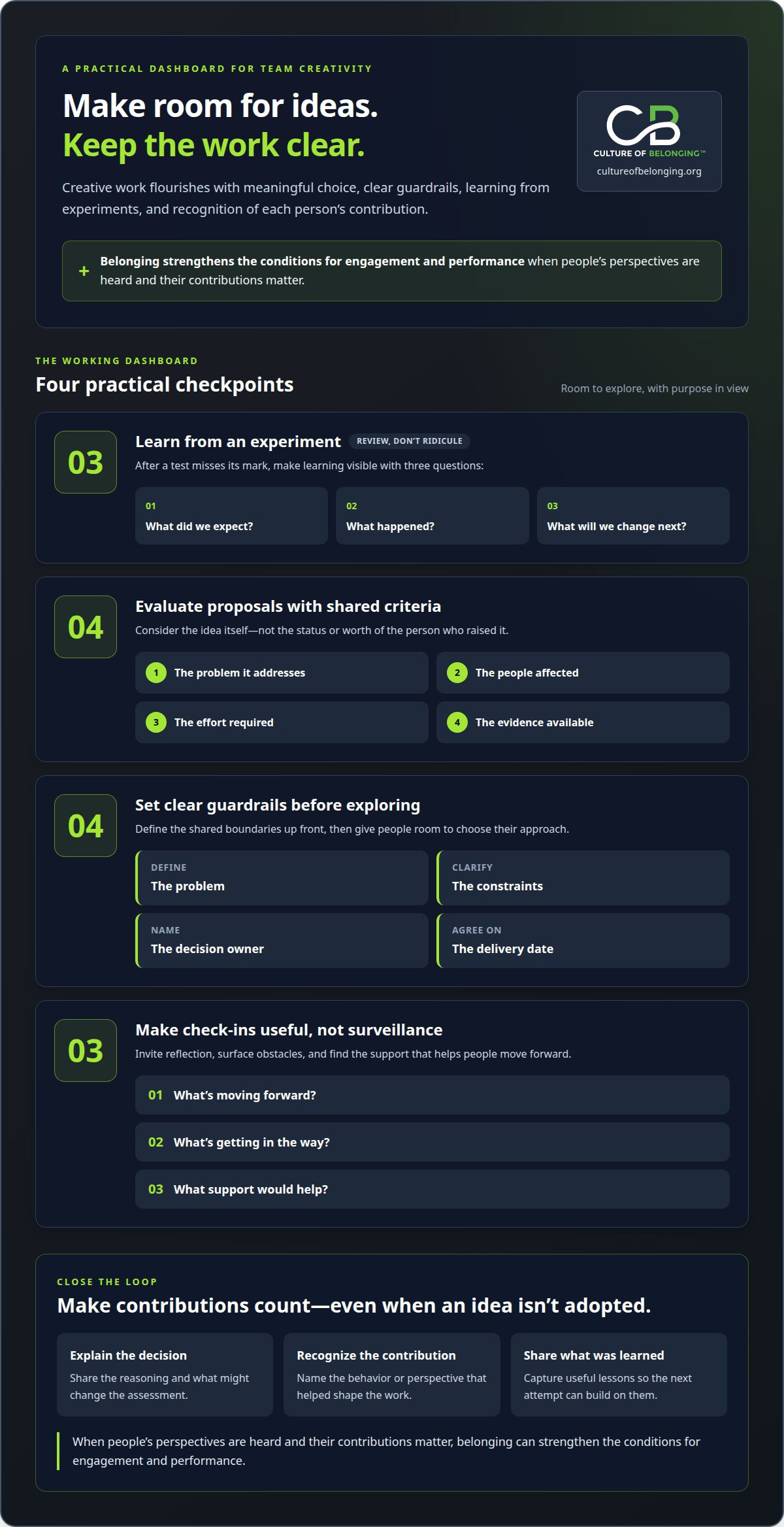
Creative work needs room for imperfect first attempts. If employees expect blame after a missed target, they may keep unconventional ideas to themselves. After an experiment, a manager can ask: What did we expect? What happened? What will we change next? For example, if a new customer onboarding email gets few responses, review its audience, timing, and message before judging the person who proposed it. This turns a setback into useful learning and makes psychological safety visible in everyday actions.
A growth mindset treats ability as something people develop through effort, feedback, and learning. Leaders can reinforce it by recognizing the process behind a contribution, not just the outcome. Instead of saying, “You’re a natural,” name the behavior: “Your customer interviews changed the problem we’re solving.” That recognition shows the team which actions matter. It also points to a practical way to improve: test an idea, gather feedback, and revise it. Mistakes still have consequences when they cause harm, but thoughtful experiments deserve review, not ridicule.
Healthy competition can energize teams when they take on a shared challenge rather than competing over colleagues’ worth or status. For example, two project groups could propose different ways to reduce confusion in a customer handoff, then compare each approach against agreed criteria such as clarity, feasibility, and customer needs. Leaders should share what both groups learned, including from unsuccessful attempts, rather than rewarding only the “winner.” This keeps competition constructive and makes useful ideas available to the whole organization. Teasing, public shaming, and withholding information undermine the culture this practice is meant to build.
Make progress visible before the final result arrives. A team can share accomplishments monthly or quarterly, naming the contributions behind each milestone and what they made possible. A project lead might recognize the employee who raised a customer concern early, even if the final solution is still in development. Specific recognition connects effort to purpose and helps people understand why their work matters. Celebrate completions in ways that suit the team, then capture the lesson before moving on. A short review can record what to repeat, change, or stop.
Continuous learning gives teams more tools for their next attempt. Schedule a knowledge-sharing session where an employee demonstrates a skill, explains a project lesson, or walks through a failed test. Pair that practice with professional development, such as relevant training or time to explore a new method. Keep useful lessons accessible on a shared internal platform, including examples of effective approaches and mistakes. Then invite colleagues to apply one insight to their current work. This cycle makes learning part of the organization’s routine, not something reserved for when a project goes wrong.
2. Employee autonomy and flexibility
Autonomy gives employees room to choose their approach while staying accountable for shared goals. A product team, for example, might agree on a launch date and customer requirements, then let each specialist decide how to test messaging. Flexibility can also mean adjusting work hours or location when the task allows. The aim isn’t to remove processes, but to distinguish useful guardrails from controls that prevent people from thinking.
Teams can make time and space for creative work by protecting focus periods and setting aside time for independent ideation. Employees might sketch proposals before a group meeting, then share them for discussion. This gives quieter perspectives a chance to emerge before the fastest voices shape the room. Managers can also invite ideas through an open-door conversation or private feedback channel, then explain how they will review submissions.
Freedom works best alongside clear outcomes. Managers can balance creative exploration with deadlines by defining the problem, constraints, decision owner, and delivery date upfront. For instance, a service team could explore several ways to simplify a handoff while keeping required steps intact. A brief check-in can surface obstacles and help adjust the approach without dictating every task.
Regular check-ins should prompt reflection, not feel like surveillance. A manager might ask: What’s moving forward? What’s getting in the way? What support would help? Employees can use the conversation to share progress, raise concerns, and connect their work to team priorities. When people’s perspectives are heard and their contributions matter, belonging can strengthen the conditions for engagement and performance.
Ideas need a path from suggestion to action. Teams should evaluate proposals based on the problem they address, the people affected, the effort required, and the evidence available. To test a promising idea, define a small trial, decide what feedback to gather, and set a review point. For example, a support team could pilot a revised response template for one type of customer request, then compare the questions and friction it reveals with the current process.
Close the loop with employees, even when an idea isn’t adopted. Explain the decision and the reasoning, identify what might change the assessment, and credit the person who raised the idea. If a proposal moves forward, invite its contributors to help shape the test. Visible follow-through encourages future contributions and makes creative effort part of normal work, rather than an extra task that disappears under deadlines.
Managers who want to connect autonomy with belonging can explore human-centered leadership approaches that make employees’ voices and contributions part of how teams work.
3. Why is Creativity Important in the Workplace?
Creativity helps organizations develop products, services, and processes that respond to real needs. It also helps people examine problems from different angles. For example, a customer service employee may notice a recurring complaint that a planning team hasn’t seen. An inclusive workplace makes room for that perspective, regardless of job title or seniority. Belonging supports performance: people need to know their contributions matter before they can fully share them.
Cross-department collaboration brings those perspectives to the wider workforce. Bring together employees who understand different parts of a customer journey, such as sales, delivery, and support. Ask each person where customers get stuck, then map how one team’s decisions affect another’s work. Complementary skills help a group examine the whole problem instead of optimizing one department’s process in isolation.
Collaborative brainstorming works best when participants understand the question and can contribute without immediate judgment. A facilitator can share the challenge in advance, allow time for independent thinking, and invite everyone to add an idea before the group discusses them. For example, ask, “How might we make this handoff clearer for customers?” Then group related suggestions and identify assumptions to test. This structure makes room for varied thinking and keeps the discussion focused on a shared problem.
Good collaboration needs practical tools. A shared document can hold the problem statement, customer evidence, and decisions; a virtual whiteboard such as Miro can help teams group ideas. A project tool such as Asana can make owners and next steps visible. Choose tools that fit the task, give participants access, and capture decisions in one place. Without that structure, valuable contributions can disappear between meetings or stay known only to one team.
A Northwestern University analysis examined 19.9 million scientific papers and 2.2 million patents across a 50-year period. It found that team-produced research was cited more than twice as often as research produced by individuals. That finding concerns scientific research and patents, not every workplace project. Still, it offers a concrete reason to examine how teams combine expertise rather than treating collaboration as a meeting alone.
Organizations can assess team creativity by tracking ideas proposed, cross-team participation, experiments completed, and ideas put into practice. Pair these activity measures with outcomes relevant to each project, such as fewer customer handoff problems. Review the measures together: a high idea count alone doesn’t show whether the ideas address a meaningful need.
To make collaboration part of the workplace culture and operating strategy, leaders can make contribution visible, invite different perspectives, and clarify how decisions get made. Those repeated practices help employees see how their knowledge connects to the organization’s goals.
4. Creativity’s effects on teamwork, problem-solving, and morale
Creative problem-solving helps teams move beyond the first answer and uncover overlooked opportunities. Imagine a project repeatedly missing customer needs. Instead of assigning blame, the team can map the customer’s experience, identify points of friction, and invite employees closest to the work to explain what they see. Bringing those perspectives together gives everyone a shared problem to solve. It also shows that expertise is distributed across roles, not held only by the person with the highest title.
Before proposing solutions, use questionstorming to agree on what the team needs to understand. For a delayed service handoff, participants might ask: Where does information get lost? Which step creates the wait? What does the customer need next? Gather questions first, then group similar ones and select those most relevant to the challenge. This process can prevent teams from rushing to fix the wrong problem.
Once the problem is clear, use open-ended prompts to broaden thinking. A facilitator might ask, “What if we removed this step?” or “How might a customer describe the problem?” Team members can then sketch options, build a simple prototype, or draw a process diagram. A visible draft gives people something specific to question and makes it easier to spot assumptions, discuss trade-offs, and revise a proposal before investing in a full rollout.
Reframing can reveal solutions hidden by familiar habits. When Apple engineers debated where to place the iPod’s on/off switch, Steve Jobs suggested eliminating the switch. The example offers a useful prompt: could the problem disappear if the team changed the design? Another method assigns a red team to challenge the usual approach and a blue team to represent established thinking. Both groups need evidence, not just opposition.
These practices can strengthen teamwork because employees build on one another’s ideas instead of competing for the only acceptable answer. They can support morale, too: a person whose question changes the team’s direction sees a meaningful contribution, even if someone else develops the final solution. Belonging is the prerequisite for performance. When different viewpoints are heard and treated with respect, psychological safety and engagement have stronger conditions to grow.
Close each problem-solving session with a clear record of the agreed problem, options considered, evidence still needed, and next decision owner. If a proposed solution carries risk, run a pre-mortem: imagine it failed and ask what caused the failure. This helps the team identify weak assumptions before taking action. It also frames challenge as shared learning, not personal criticism, putting a growth mindset into practice.
5. Leadership that removes barriers and recognizes contributions
Leaders shape whether innovation becomes part of daily work or remains a slogan. Start by identifying barriers employees encounter, such as unclear decision rights, competing priorities, slow approvals, or constant deadline pressure. For example, if a designer needs several approvals before testing a customer-facing change, clarify who owns the decision and which risks require escalation. Removing unnecessary friction gives employees room to act while keeping accountability clear.
Invite team input before decisions are final. A leader considering a new workflow could ask the employees who use it to identify likely obstacles, then adjust the plan. Active listening matters most when feedback changes a decision or receives a clear explanation. Employees can see whether their knowledge was considered, even when leadership chooses another approach. That visibility reinforces belonging, which supports performance.
Recognition should name the contribution and its value. Instead of vaguely praising someone for being innovative, a manager might say, “Your suggestion helped us identify the step confusing new customers.” This connects the person’s action to a meaningful challenge. Recognize collaborative effort as well as individual ideas, especially when one employee spots a problem and another develops a workable solution. Specific recognition makes contributions visible without turning every task into a competition.
Rewards can support innovation, but they should reflect the behaviors the organization wants to encourage. A team could celebrate an idea that improved a process, a well-designed experiment that surfaced useful evidence, or a colleague who helped another employee develop a proposal. Don’t reward only ideas that launch successfully. If only visible wins receive recognition, employees may avoid responsible experiments with uncertain results. Leaders can celebrate the learning, collaboration, and follow-through behind progress.
Build recognition into existing routines. At a project review, ask who raised an important question, removed a roadblock, or helped turn feedback into action. Record the contribution alongside the project decision, then share the lesson with relevant teams. This simple practice helps knowledge travel beyond the immediate group. It also helps leaders notice whose work is routinely overlooked and whose contributions are repeatedly relied on without acknowledgment.
Leaders can model creative behavior by testing an unconventional approach themselves. For instance, a manager might invite a team member to facilitate a review or ask the group to challenge an assumption before approving a plan. When a leader admits uncertainty, listens without defensiveness, and acts on sound input, employees see what supportive leadership looks like in practice. Explore belonging-centered leadership for creative teams to bring these conversations into organizational practice.
Culture of Belonging Global®
Culture of Belonging Global® helps leaders connect creativity with belonging, psychological safety, and human-centered leadership. Founder Curtis Ray Hill is a leading authority on Workplace Belonging and a keynote speaker who delivers interactive keynotes and leads workshops, consulting, and professional development for organizations. His perspective helps leaders examine how everyday workplace experiences shape people’s ability to contribute and engage. Turn to Culture of Belonging Global® when your team needs support building a culture where people feel recognized and able to share ideas. Through keynotes, workshops, and consulting, leaders can explore practical ways to make room for different perspectives. Book Curtis for your event or book a conversation with Curtis to discuss your organization’s needs.
Make belonging part of how work gets done
Creative capacity grows through repeated choices, not one-off campaigns. To understand how to foster creativity in your team, leaders can ask whether everyday decisions show people that their ideas matter. Belonging is the prerequisite for performance. When employees experience that principle in practice, they have stronger conditions to participate, share perspectives, and take thoughtful risks.
The next step is to turn intention into consistent leadership practice. Culture of Belonging Global® supports organizations through keynotes, workshops, professional development, and consulting focused on workplace belonging and human-centered leadership. These experiences help leaders explore how to foster creativity in your team by strengthening the environment in which people contribute.
Choose one workplace moment to examine, such as whose input shapes a decision or how managers respond to a new idea. Then decide what a more supportive response would look like and put it into practice. To explore how this work could support your organization, contact Culture of Belonging Global®. Your team’s next strong idea may begin with making room for the person ready to share it.
Frequently Asked Questions
Why is Creativity Important in the Workplace?
Creativity helps organizations adapt when customer needs, team knowledge, or operating conditions change. A billing team, for example, might rethink how it explains a confusing charge, while a product team explores a service feature. These efforts give employees ways to contribute beyond routine execution. Creativity also helps leaders see where established processes no longer serve their purpose, supporting engagement when people can see their ideas make a difference.
What leadership behaviors help foster creativity in a team?
Leaders foster creativity by staying curious, sharing decision context, and responding constructively to challenge. If an employee questions a familiar process, a manager can ask what evidence prompted the concern before defending the existing approach. Leaders can also explain why an idea was selected or deferred, so employees understand how decisions are made. These behaviors make leadership more human-centered and show that contributions matter, even when a suggestion isn’t adopted.
How can managers create psychological safety for creative collaboration?
Managers create psychological safety by making it possible to raise concerns without being mocked or dismissed. In a project review, invite employees to name risks before discussing solutions, and thank them for specific observations. Follow through by addressing issues fairly and explaining decisions. Avoid jokes at someone’s expense, especially after a failed experiment. Belonging supports performance, and respectful responses help people feel able to participate honestly.
What team brainstorming techniques generate more original ideas?
Try brainwriting: ask participants to write ideas independently before sharing them, so early comments don’t dominate the session. Then combine related suggestions and invite the group to build on them. Another technique is assumption reversal. List beliefs such as “customers need a live meeting,” then ask what a useful experience might look like without one. Keep the challenge specific, and capture unusual proposals before evaluating their feasibility.
How can diverse teams improve creativity and innovation?
Teams with varied professional, educational, and personal experiences can interpret a challenge in different ways. To make those perspectives useful, give members a shared problem and time to explain what they notice from their roles. For example, a frontline employee may identify a customer obstacle that a planning team hasn’t encountered directly. Inclusive facilitation helps bring those observations into the discussion instead of leaving them unspoken.
What tools help teams share and develop ideas remotely?
Remote teams can use Slack to gather contributions in asynchronous discussions, Mural to arrange ideas in a shared visual workspace, and Trello to track proposals through review. Agree on one place for the current problem statement and decisions, so employees don’t have to search across channels. Choose tools that fit the team’s workflow, and make the next step and its owner visible to everyone involved.
What are common barriers to team creativity and how can they be overcome?
Common barriers include unclear decision authority, excessive approval steps, constant urgency, and fear of being penalized for raising a concern. Leaders can identify these obstacles by asking employees where ideas stall, then choosing one process to simplify. For instance, clarify who can approve a low-risk test and what information they need. Addressing actual friction, rather than asking people to “be more creative,” gives ideas a clearer path forward.

Article by
Curtis Ray Hill
Curtis Ray Hill, MAT, M.Ed., is a workplace belonging keynote speaker, culture strategist, author, and founder of Culture of Belonging Global®. For more than two decades, his work has centered on one core belief: belonging is the prerequisite for performance.
Curtis has worked with leaders and organizations including Pfizer, State Farm, BP, Southwest Airlines, Hallmark, and Avis Budget Group, bringing a practical, human-centered approach to workplace belonging, employee engagement, employee experience, psychological safety, and organizational culture. His background spans education, leadership, and process improvement, and he holds a Black Belt in Lean Six Sigma.
He is the author of Creating a Culture of Belonging: From Feeling Like to Knowing You Belong, a book focused on moving belonging beyond intention and creating environments where people know they belong.
Curtis is also the creator of The Belonging Effect™, his proprietary framework built around four human experiences: Noticed → Named → Known → Needed. His work equips leaders to translate belonging into everyday leadership behaviors and workplace experiences that create stronger conditions for engagement and performance.
Through his keynotes, consulting, writing, and thought leadership, Curtis is advancing workplace belonging as a business and leadership priority—not simply a culture initiative. His work connects belonging to human-centered leadership, psychological safety, employee experience, retention, engagement, and performance. His goal is to move organizations beyond talking about belonging to creating workplaces where people experience it every day—and where belonging becomes the foundation for how people connect, contribute, and perform.
Disclaimer
The content published on this website by Curtis Ray Hill and Culture of Belonging Global® is provided for general informational and educational purposes only. It is intended to share perspectives, frameworks, strategies, research, and ideas related to workplace belonging, organizational culture, leadership, employee experience, engagement, retention, psychological safety, and related topics.
No Professional Advice. Nothing on this website constitutes or should be relied upon as legal, financial, accounting, employment, human resources, medical, psychological, compliance, or other professional advice. The information provided is not a substitute for advice from qualified professionals familiar with your organization, circumstances, jurisdiction, employees, policies, and applicable laws or regulations.
No Guarantee of Results. Curtis Ray Hill and Culture of Belonging Global® make no representation, warranty, promise, or guarantee that any framework, strategy, recommendation, keynote, training, consulting engagement, or other information discussed on this website will produce any particular result. Organizational outcomes vary based on numerous factors, including leadership, implementation, organizational culture, industry, workforce, resources, timing, and circumstances.
Research, Statistics, and Results. Statistics, research findings, survey data, industry findings, quotations, and third-party information referenced in an article should be considered within the context, methodology, limitations, and publication date of the original source. Any specific client result or organizational outcome referenced is illustrative of that particular experience and should not be interpreted as typical, expected, or guaranteed for another organization.
Independent Decision-Making. Readers and organizations are responsible for evaluating the suitability of any ideas, strategies, frameworks, or recommendations for their own circumstances. Before implementing decisions that may affect employees, employment practices, workplace policies, compliance obligations, finances, or business operations, consult the appropriate qualified legal, HR, financial, compliance, or other professional advisers.
Third-Party References. References to companies, organizations, publications, research institutions, products, services, or other third parties are provided for informational or contextual purposes. Unless expressly stated, such references do not imply endorsement, sponsorship, partnership, validation, or approval by or of Curtis Ray Hill or Culture of Belonging Global®.
Intellectual Property. Culture of Belonging®, The Belonging Effect™, The Invisible Floor Plan™, and other identified proprietary concepts, frameworks, names, and materials associated with Curtis Ray Hill and Culture of Belonging Global® are protected intellectual property where applicable. Nothing published on this website grants permission to reproduce, distribute, modify, teach, sell, license, or commercially exploit proprietary materials without authorization.
Limitation of Responsibility. To the fullest extent permitted by applicable law, Curtis Ray Hill and Culture of Belonging Global® disclaim responsibility for losses, damages, liabilities, or consequences arising from reliance upon or application of information contained on this website. Use of this content and any decisions based upon it are undertaken at the reader's or organization's own discretion and risk.
Information may be updated, revised, or become outdated over time. Readers should verify information that is material to an organizational, employment, legal, financial, or compliance decision and consult qualified professionals when appropriate.